

Q3 2026 US EV sales were the best in a year. Kelley Blue Book estimates that 266,630 battery EVs were sold in the third quarter, the highest total since the record third quarter of 2025, when buyers rushed to beat the end of the $7,500 federal tax credit. That comparison is why the headline number is still down 38.6% from a year ago. The more useful story is who is selling EVs now that the credit is gone, and the answer has changed a lot in twelve months.
Tesla took 54% of the market. Rivian moved into second place among brands. Toyota and Lexus together sold almost five times as many EVs as they did a year earlier. And a long list of brands that leaned on the credit saw their EV sales fall by half or more.
The big picture
What we’re seeing now is a market finding its footing again.
Stephanie Valdez Streaty, director of Industry Insights at Cox Automotive
Cox Automotive, which publishes the Kelley Blue Book estimates, says battery EVs made up a bigger share of new-vehicle sales in Q3 than the 5.8% they managed in the second quarter, and that nearly a quarter of all new vehicles sold in the US were electrified once hybrids and plug-ins are counted. Valdez Streaty said the improvement through 2026 “suggests the reset phase is largely behind us,” and pointed to gas prices “well above $4 a gallon” as a tailwind.
Through the first nine months of the year, Kelley Blue Book counts 729,869 EVs sold in the US, down 29.9% from the same stretch of 2025. Every figure in this story is a Kelley Blue Book estimate rather than an automaker-reported number, so individual brands may report slightly different totals.
Q3 2026 US EV sales by brand
| Rank | Brand | Q3 2026 | Q3 2025 | Change | Q3 share |
|---|---|---|---|---|---|
| 1 | Tesla | 144,094 | 179,525 | -19.7% | 54.0% |
| 2 | Rivian | 19,239 | 13,201 | +45.7% | 7.2% |
| 3 | Toyota | 12,904 | 3,015 | +328.0% | 4.8% |
| 4 | Cadillac | 12,358 | 18,383 | -32.8% | 4.6% |
| 5 | Hyundai | 12,185 | 28,780 | -57.7% | 4.6% |
| 6 | Chevrolet | 10,031 | 39,498 | -74.6% | 3.8% |
| 7 | Kia | 9,575 | 14,794 | -35.3% | 3.6% |
| 8 | Lexus | 8,464 | 1,561 | +442.2% | 3.2% |
| 9 | Ford | 6,047 | 30,612 | -80.2% | 2.3% |
| 10 | BMW | 4,945 | 10,294 | -52.0% | 1.9% |
| 11 | Honda | 4,882 | 20,236 | -75.9% | 1.8% |
| 12 | Subaru | 4,566 | 3,471 | +31.5% | 1.7% |
Source: Kelley Blue Book estimates, Cox Automotive Q3 2026 EV Sales Report (as of Oct 12, 2026).
Only six brands in Kelley Blue Book’s table sold more EVs than a year earlier: Rivian, Toyota, Lexus, Subaru, Mercedes and Ram, whose only EV is the ProMaster van. Everyone else went backward.
Tesla: down 20%, but a bigger slice than ever
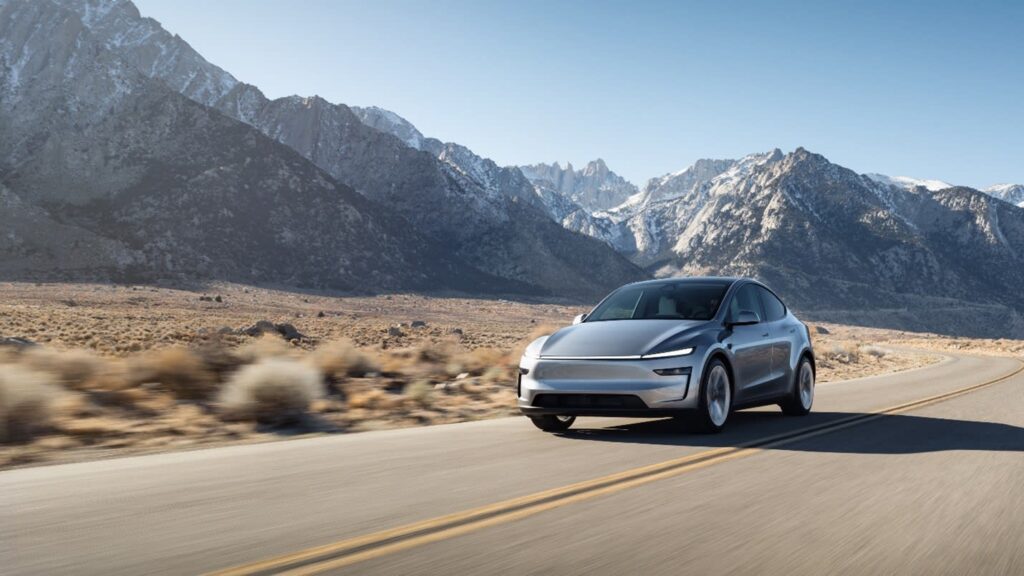
Tesla sold an estimated 144,094 EVs in the quarter, down 19.7% from a year earlier. That sounds rough until you look at everyone else. Excluding Tesla, US EV sales fell from about 254,800 to about 122,500, a drop of roughly 52%. Tesla’s share grew from about 41% in Q3 2025 to 54% this quarter, and it sits at 52.9% for the year so far.
Two cars still do almost all of that work. The Model Y sold an estimated 99,037 units, about 69% of Tesla’s US total and about 37% of every EV sold in the country. The Model 3 added 40,346, about 28%. The Cybertruck came in at 4,323, while the Model S and Model X sold fewer than 400 between them.
Rivian: second place, and the vans are the surprise
Rivian’s estimated 19,239 sales were up 45.7% from a year ago, enough to make it the second-best-selling EV brand in the US for the quarter. Cox called it one of the strongest performances in the industry.
The R2 shows up in Kelley Blue Book’s numbers for the first time this quarter, with an estimated 3,456 sales, after deliveries began on June 9 with the R2 Performance with Launch Package. The R1S added 5,582 and the R1T 1,732. But the biggest single line for Rivian was its commercial van. The EDV 500 and 700 sold an estimated 8,469 units, up 220.9%, which is about 44% of Rivian’s quarter. That made the van the fourth-best-selling EV model in the country, behind only the Model Y, the Model 3 and the Hyundai Ioniq 5.
That mix matters for where Rivian goes next. The vans give it a steady base, and the R2 is only getting started. As the R2 lineup widens beyond the Launch Package, and features like Point to Point hands-free driving roll out, the consumer side has a lot of room to grow from here.
Toyota and Lexus: from afterthought to podium
A year ago, Toyota sold an estimated 3,015 EVs in the US in the third quarter, and Lexus 1,561. This quarter they sold 12,904 and 8,464, for a combined 21,368. Toyota’s growth came from a full lineup rather than one car: the bZ led with 7,391, the C-HR added 3,467 and the new bZ Woodland 2,046. On the Lexus side, the new electric ES contributed 6,064, with the RZ up 53.7% to 2,400.
Subaru rose 31.5% on the strength of the new Trailseeker (3,174) and Uncharted (894).
The big drops
The brands that fell hardest are mostly the ones whose EV sales were strongest during last year’s rush to beat the credit deadline.
Chevrolet fell 74.6% to 10,031. The Equinox EV, a top seller a year ago, dropped 92.4% to 1,905, and the returning Bolt was Chevy’s best-selling EV in the quarter at 3,866. Among General Motors brands, Cadillac held up best with the Optiq, Lyriq, Vistiq and Escalade IQ.
Ford dropped 80.2% to 6,047, with the Mustang Mach-E carrying almost all of it at 5,574. The F-150 Lightning sold an estimated 289, down 97.1%, which helps explain why Ford’s next truck, the Fathom, is being built on a new EV-only platform.
Hyundai fell 57.7% to 12,185, though the Ioniq 5 was still the third-best-selling EV in the country at 10,382. Kia did better, down 35.3%, with the EV9 at 5,394 and the new EV3 with 514 sales in its first quarter. Volkswagen (down 90.5%), Audi (down 94.3%) and Honda (down 75.9%) all posted steep declines.
What it means
Twelve months after the federal credit ended, the US EV market is smaller but clearer. Tesla’s two mainstream models still set the pace. The brands that are growing are the ones with new, purpose-built products arriving now: Rivian’s R2 and vans, Toyota’s and Lexus’s widened lineups, Subaru’s new SUVs, and Lucid’s Gravity, which more than tripled to 2,202. Brands still leaning on older models, or on a single EV, mostly saw sales collapse once the credit disappeared.
The fourth quarter will be the first apples-to-apples comparison, since Q4 2025 was the first quarter without the credit. If the third quarter’s momentum holds, the year-over-year numbers should finally turn positive for more brands. To compare the range and efficiency of the models in this story, the Electron Motion EV Database covers more than 3,000 electric cars.