
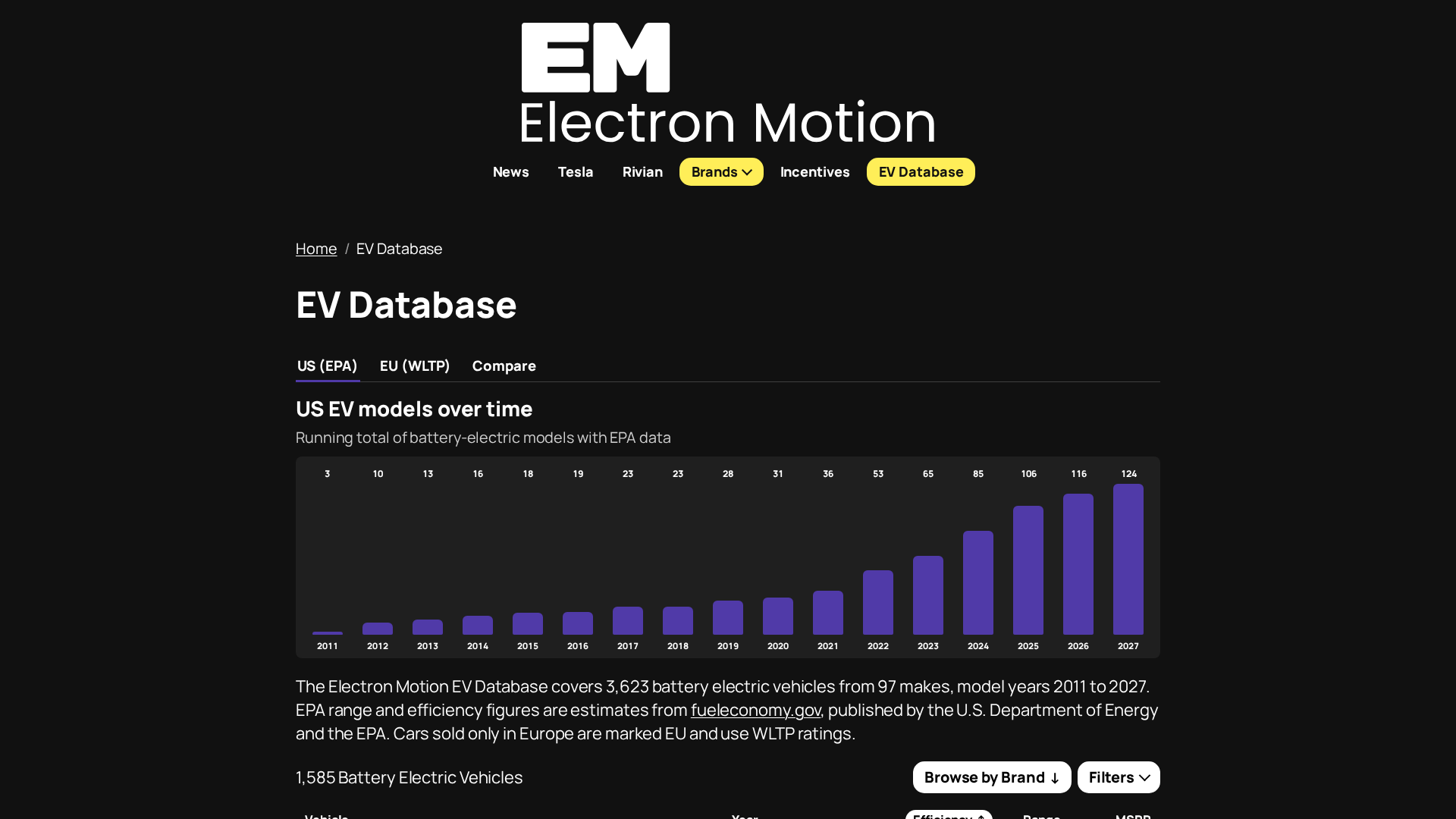
The new Electron Motion EV database is live, and it puts range and efficiency for 3,223 battery electric vehicles from 93 makes in one place. It covers model years 2011 through 2027, from the earliest modern EVs to cars that are only now reaching showrooms, and it’s free to use right now at electronmotion.com/ev-database.
We built it because the numbers behind EV shopping are scattered. US range figures sit in one government dataset and European figures in another. Now you can look them up, line them up and filter them in seconds.
Where the data comes from
Every number has a public, official source. US range and efficiency figures are EPA estimates from fueleconomy.gov, published by the US Department of Energy and the EPA. European figures come from the European Environment Agency’s data on newly registered cars, which gives WLTP range and consumption for 2,038 vehicles. Cars sold only in Europe are marked EU so you always know which test cycle you’re looking at.
That matters, because EPA and WLTP ratings aren’t interchangeable. WLTP numbers usually come out higher for the same car, and the database keeps them clearly separated instead of mixing them.
Three ways to look at the market
The database opens on three tabs. US (EPA) lists the cars with EPA ratings, EU (WLTP) lists the European figures, and Compare puts both side by side, with EPA and WLTP efficiency and range in their own columns.
Each tab starts with a chart of how many battery electric models have arrived over time. The US view climbs from 3 models in 2011 to 124 by model year 2027. The European view starts later in the data, in 2020, and reaches 303 models by 2026. It’s a quick, striking picture of how fast the electric lineup has grown.
Filters that answer real questions
Below the chart is the full list, with a filter panel that does most of the work. You can search by model name, pick a make, set a model year range, choose FWD, RWD, AWD or 4WD, set a minimum range in miles, set an efficiency window in Wh/mi, and limit the list to current models only. The list can be sorted by name, efficiency or range.
A few things you can try right away:
- Set a minimum range of 300 miles and tick “Current models only.” Today that returns 259 vehicles, sorted with the most efficient first.
- Pick a make and a single model year to see every trim that brand offers, from the base version up.
- Choose AWD with a 250-mile minimum if you need all-weather traction without giving up road trips.
- Set a low maximum Wh/mi to find the cars that go furthest on each kilowatt-hour, which is what keeps charging costs down.
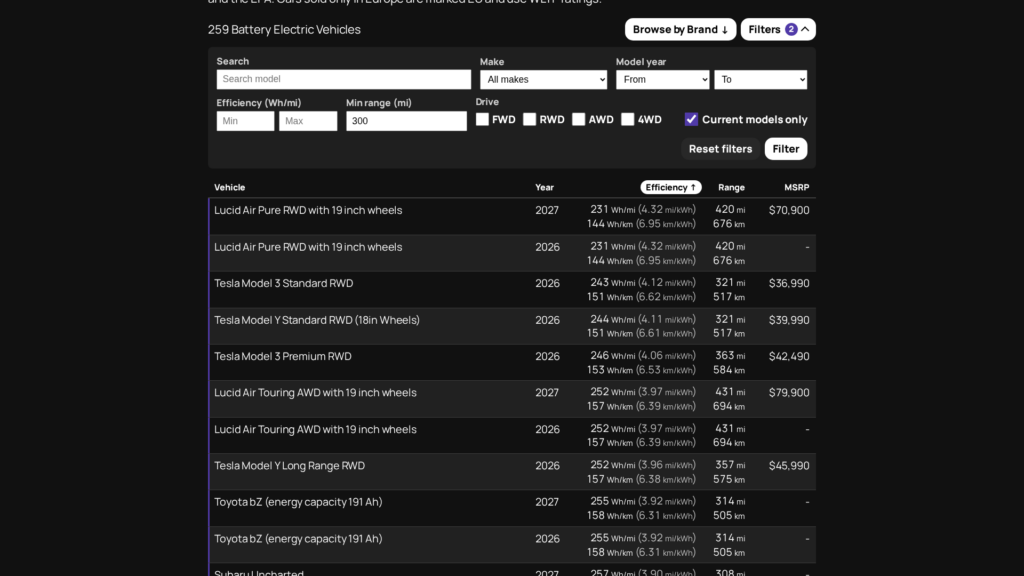
Efficiency appears four ways (Wh/mi, mi/kWh, Wh/km and km/kWh), and range appears in both miles and kilometers, so the numbers make sense wherever you drive.
If you shop outside the US, the range and efficiency figures still travel well, and the EU tab covers the cars sold in Europe.
Brand and model pages
Every make has its own page, and every model gets a page that sums it up. The Hyundai Ioniq 6 page, for example, shows the best range across all its years (361 miles), the most efficient version (the 2023 Long Range RWD on 18-inch wheels at 236 Wh/mi), and all 16 trims listed with range, efficiency and powertrain details. It’s the fastest way to see how a model has changed from year to year, or which wheel size is costing you range.
The database also pairs nicely with our news coverage. When we wrote about the BMW iX4’s price and range or every trim of the 2027 Kia EV3, those are exactly the numbers you can now compare against the rest of the market. And as new cars like the Volkswagen ID. Tiguan get official ratings, they’ll land in the database too.
Kept up to date
The EV database is built on the official EPA and European datasets, and we’ll keep adding new ratings as they’re published. Model year 2027 cars are already appearing.
Start exploring
Whether you’re narrowing down your first EV, checking what your current car is really rated for, or just curious how many electric models are out there, the answers are a few clicks away. Open the Electron Motion EV database, set a filter or two, and see what fits. We’d love to hear what you look up first.