
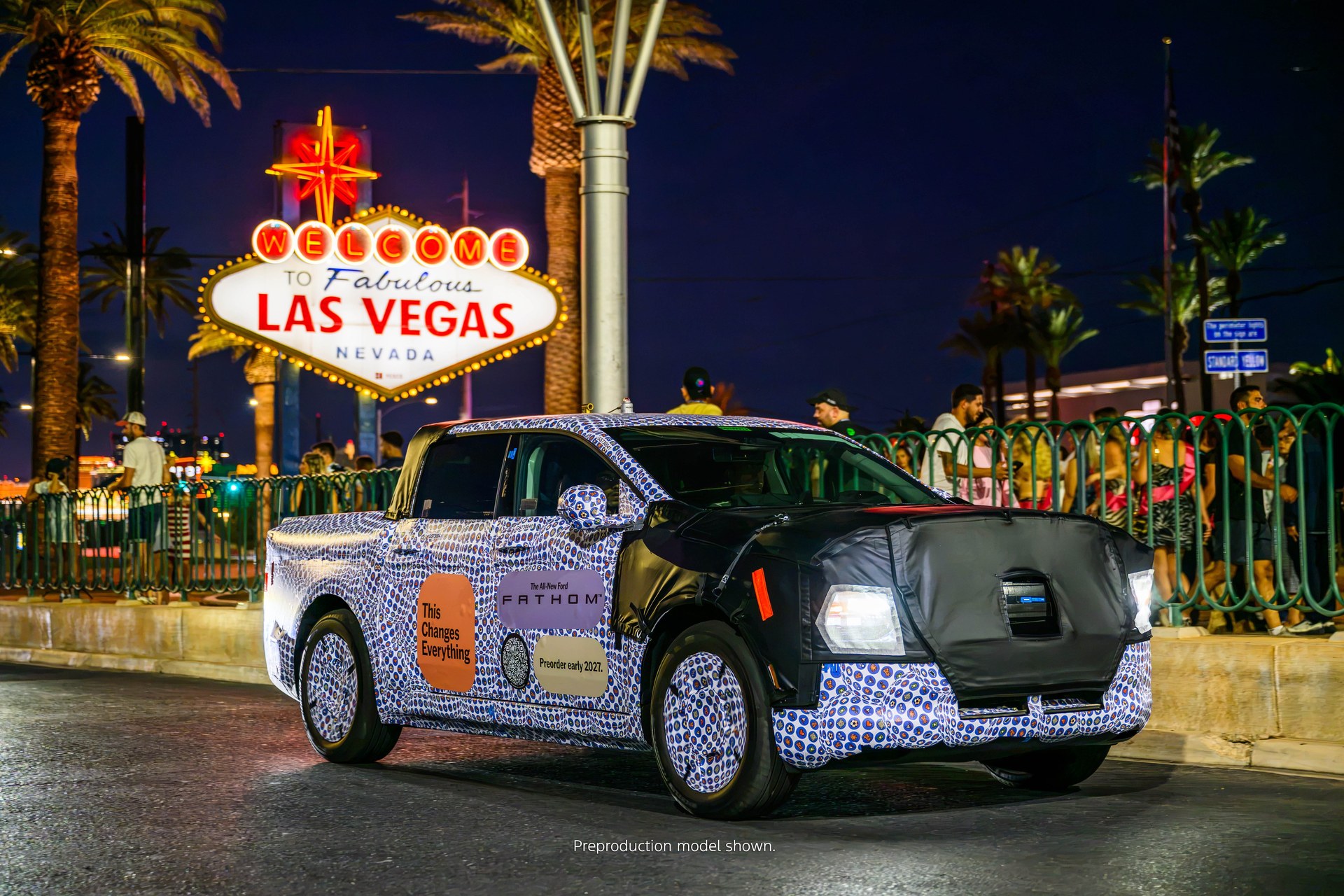
The Ford Fathom is Ford’s first pickup designed from the start as an electric vehicle, and that matters more than its price. Ford named the midsize truck in August and set a starting MSRP of $28,350 with the standard-range battery, or $29,945 with the $1,595 destination charge. Preorders open in early 2027, and customer trucks follow later that year from Ford’s Louisville Assembly Plant in Kentucky.
What Ford has confirmed
The Fathom is the first vehicle on Ford’s Universal EV Platform, which Ford says was built from a clean sheet. It seats five, has a frunk and a bed, and Ford projects more passenger volume than a Toyota RAV4 in a footprint about the size of a Maverick. Every truck gets a large touchscreen with Apple Maps, Apple CarPlay and Android Auto, a digital key, and the hardware for BlueCruise hands-free highway driving. It has bidirectional power for home backup and charges through a built-in NACS port.
The battery uses lithium iron phosphate (LFP) cells made at Ford’s BlueOval Battery Park in Michigan, on a 400-volt system. Ford’s target is 0 to 60 mph as quick as a Mustang EcoBoost. It hasn’t published EPA range, battery size, or charging speed yet. Ford has said it aims for the roughly 300 miles some buyers expect, reached through efficiency rather than a bigger pack.
Built as an EV, not adapted into one
The F-150 Lightning was a real electric truck, but Ford built it to be an F-150. It kept the gas truck’s body-on-frame layout, SuperCrew cab, and aluminum body. Ford gave it a stronger steel frame and the F-150’s first independent rear suspension, with semi-trailing arms and coil springs. That hardware had to fit around frame rails and a bed laid out for a truck with an engine and a driveshaft, with a large battery added underneath. Look at a Lightning from behind and you can see the rear suspension and drive hardware sitting below the bed. Ford lists 8.5 inches of ground clearance.
Rivian started the other way. The R1T rides on Rivian’s own skateboard, with the battery as a flat slab between the axles, and Rivian quotes up to 14.9 inches of ground clearance depending on air suspension setting and wheels. It’s a much pricier truck, but it shows what designing around the battery first allows: a clean, flat underside.
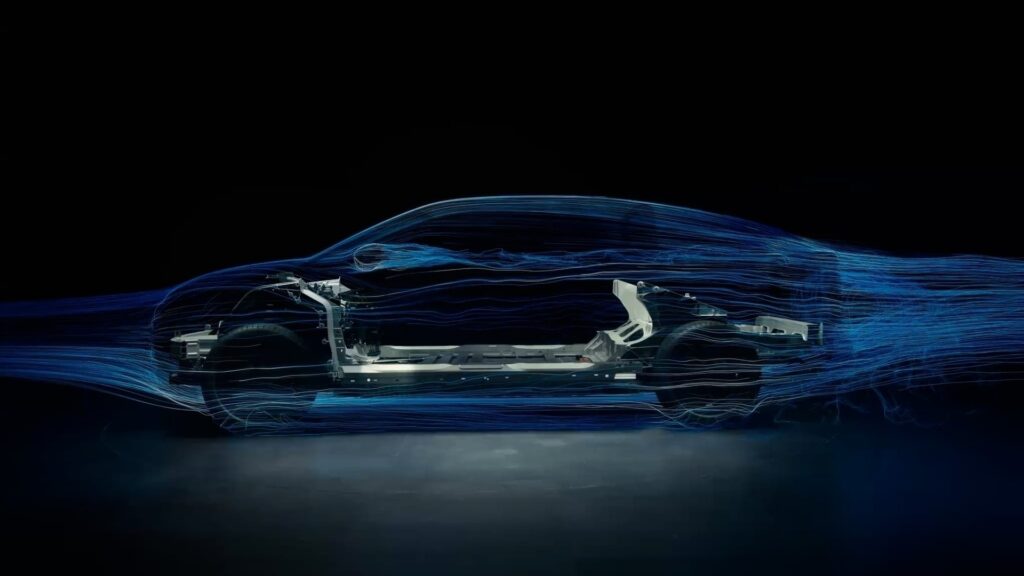
The Fathom follows that approach. Ford’s aero team wrote that it “couldn’t simply use an existing truck’s body” because “the physics wouldn’t work.” The battery pack is structural and forms the floor, and single aluminum castings at the front and rear replace dozens of stamped and welded parts. Ford says it treated the underbody “like a racing floor,” with bolts set flush in small pockets, the rear drive units placed low, and the motor case shaped for airflow. Ford hasn’t published the Fathom’s suspension design or ground clearance, so those numbers will have to wait for the reveal.
Why it matters more than people think
Ford says the battery accounts for about 40% of an EV’s cost, so every bit of drag and weight it removes means a smaller pack for the same range. Ford estimates the Fathom’s aerodynamics are more than 15% better than any pickup on sale, worth nearly 50 miles of range compared with the same battery in the most aerodynamic midsize gas truck. A flat structural floor also explains how a Maverick-sized truck can have more passenger room than a RAV4.
Fewer parts help too. Ford says the platform uses 20% fewer parts than a typical vehicle, and the wiring harness is 4,000 feet shorter and 22 pounds lighter than in one of its first-generation EVs.
It also fills a hole. Ford ended production of the current Lightning in December 2025, and the next one will be an extended-range EV with a gas generator. That leaves the Fathom as Ford’s only fully electric pickup, at a far lower price, and Ford’s EV sales need it. Ford sold 6,047 EVs in the third quarter, most of them Mach-Es.
Louisville and the timeline
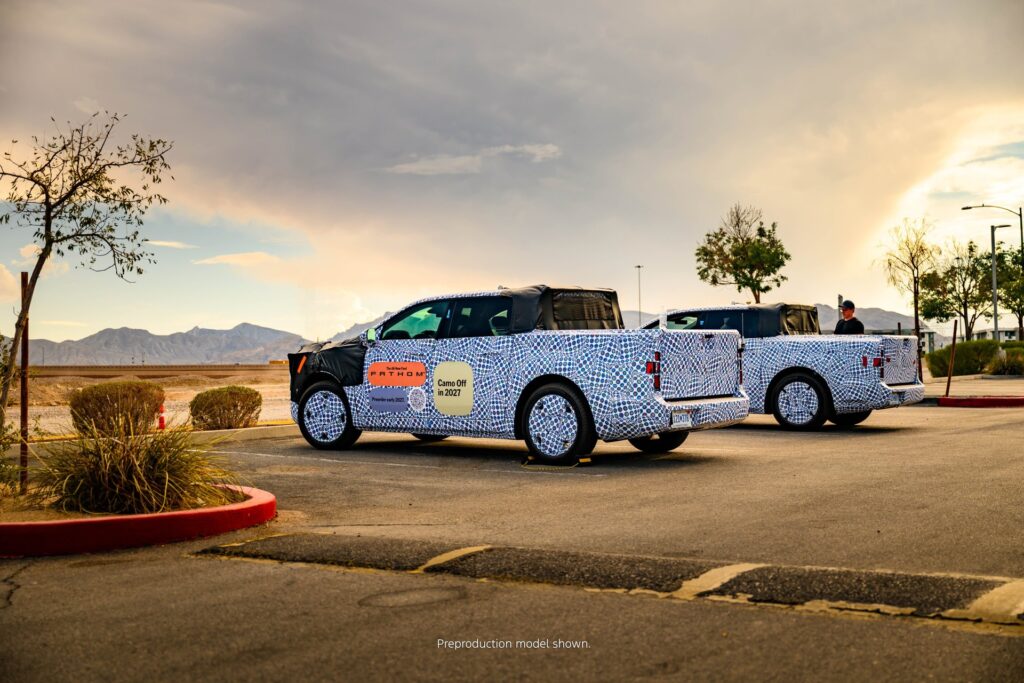
Ford gutted the Louisville plant for a $2 billion retool around its new “assembly tree.” The front section, rear section, and battery are built on separate lines, with the seats and interior installed on top of the battery, and then joined. Ford says assembly nets out 15% faster than the plant’s old products. Prototype builds with production-qualified parts start in the first quarter of 2027.

We first looked at the platform in February, when we asked whether UEV is Ford’s first ground-up EV platform. The Fathom is that platform’s first product. The price gets the headlines, but the clean-sheet design is what makes that price possible.
FAQ
How much does the Ford Fathom cost?
It starts at $28,350 MSRP with the standard-range battery, or $29,945 with destination. Preorders open in early 2027.
What is the Ford Fathom’s range?
Ford hasn’t released an EPA estimate yet. It has said it is aiming for the roughly 300 miles some buyers expect.
Is the Fathom fully electric?
Yes. It’s the first vehicle on Ford’s Universal EV Platform, which Ford built from a clean sheet for electric vehicles.
Does the Fathom use the F-150 Lightning’s platform?
No. The Lightning was based on the F-150’s body-on-frame layout. The Fathom uses a structural battery floor and large front and rear castings, and Ford hasn’t shared its suspension details yet.