
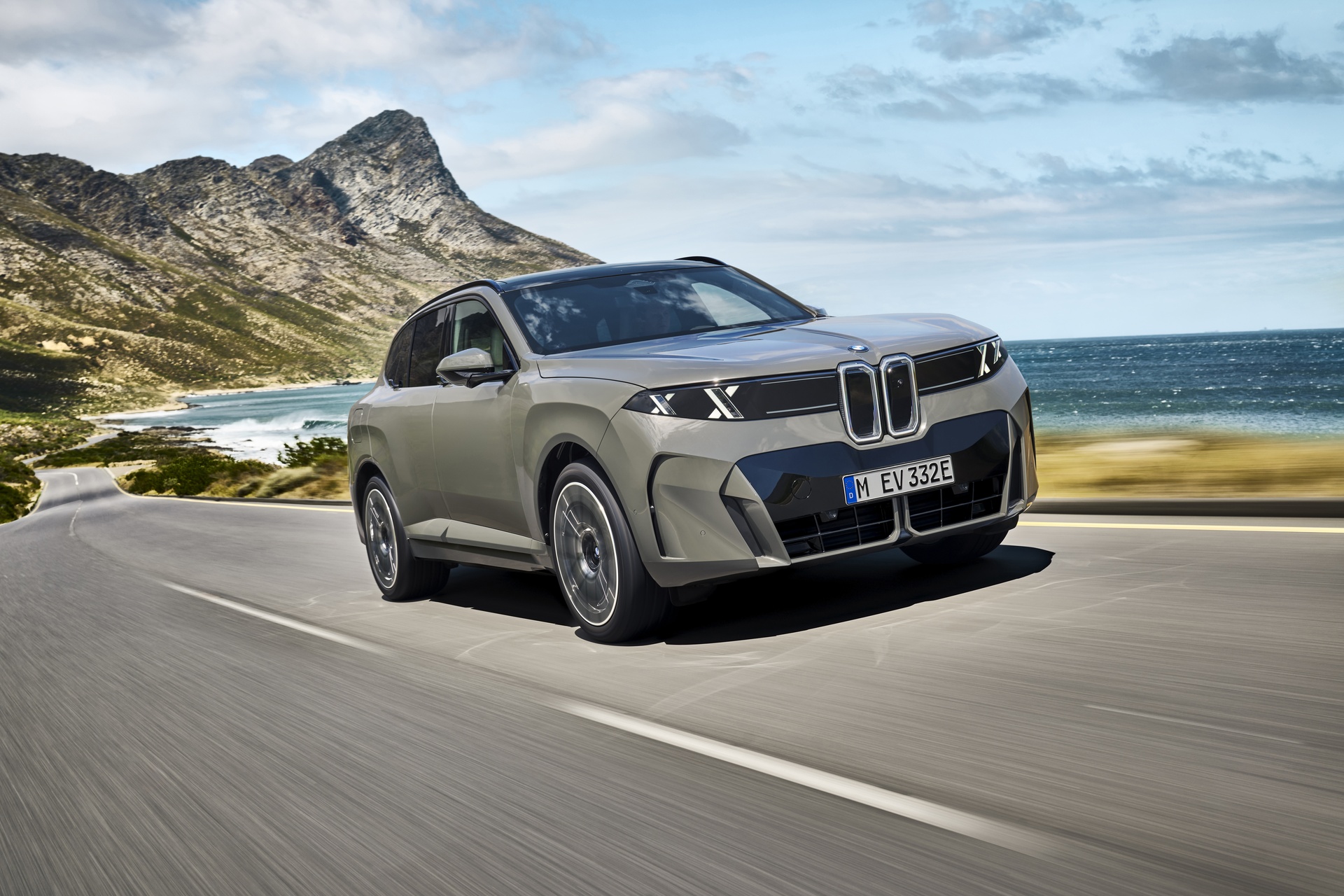
The EPA now lists BMW iX5 range at up to 456 miles, and the first independent test shows what the 144 kWh battery buys. In Out of Spec Testing’s 70 mph highway run, an iX5 60 xDrive covered 410.8 miles, farther than a Lucid Gravity Grand Touring, a Rivian R1S and a Porsche Cayenne Turbo Electric driven on the same day.
The timing lines up with a factory milestone. On November 13, BMW opened its Woodruff, South Carolina battery plant, which now builds the iX5’s packs 15 miles from the Spartanburg factory that assembles the SUV. The iX5 is BMW’s first electric vehicle built in the United States, and BMW says it goes on sale in the first quarter of 2027 at $79,800 before a $1,450 destination charge.
456 mi
EPA rating, 21-inch wheels
410.8 mi
70 mph test on 22-inch tires (426 mi EPA)
$194
MSRP per highway mile
The EPA Rates BMW iX5 Range Above BMW’s Own Estimate
When BMW revealed the new X5 family in June, it quoted a preliminary 435-mile estimate for the iX5. The official EPA ratings, now listed on fueleconomy.gov, come in higher on the base wheels:
- 456 miles on 21-inch summer tires (89 MPGe combined)
- 426 miles on 22-inch summer tires
- 418 miles on 22-inch all-season tires
That 38-mile spread from wheels and tires alone is a useful reminder when you configure one. The bigger wheels cost range, and the all-season option costs a little more.
How the 70 mph range test played out
Out of Spec Testing charged all four SUVs to 100% and drove them at a steady 70 mph until each could no longer hold that speed. InsideEVs and Motorbox reported the results, including the energy each one used.
| SUV | Price before destination | 70 mph range | Highway efficiency |
|---|---|---|---|
| 2027 BMW iX5 60 xDrive | $79,800 | 410.8 mi | 2.80 mi/kWh |
| Lucid Gravity Grand Touring | $98,900 (2027) | 367.7 mi | 3.00 mi/kWh |
| Rivian R1S Dual Max (about 30,000 miles) | Older model | 349 mi | 2.59 mi/kWh |
| Porsche Cayenne Turbo Electric | $163,000 | 309 mi | 2.90 mi/kWh |
Motorbox, reporting the same test, says the iX5 was a 60 xDrive M Sport on 22-inch summer tires, the 426-mile EPA configuration, not the 456-mile 21-inch setup. That puts its 70 mph result at about 96 percent of its EPA rating. Efficiency figures are converted from the kWh per 100 km numbers Motorbox reported for this test. Prices come from BMW, Lucid and Porsche.
The iX5 won on range without being the most efficient SUV in the group. The Gravity went 3.00 miles on each kilowatt-hour, the best result here, and even the 1,139-horsepower Cayenne beat the BMW on efficiency. BMW simply brought more energy. Its pack has 144 kWh of usable capacity according to BMW, against about 123 kWh in the Gravity and 108 kWh in the Cayenne, per InsideEVs.
There is one quirk in the BMW’s result. According to InsideEVs, the iX5 stopped at about 400 miles after using almost exactly its rated 144 kWh, having shown 0% for roughly 10 miles. Restarting the SUV released about 4 kWh more, enough to keep going to 410.8 miles. Out of Spec’s host suggested the car may hold back a small reserve that a restart unlocks, but BMW has not explained it. Either way, an owner should treat the first shutdown, not the final number, as the real end of the road.
The Rivian result comes with its own asterisk. The test car had nearly 30,000 miles on it, and the testers got about 136 kWh out of the pack, compared with about 145 kWh in an earlier test. Battery wear explains part of its gap.
The Cayenne beat its EPA rating at highway speed
The most surprising result belongs to the Porsche. The EPA rates the Cayenne Turbo Electric at 298 miles, or 303 miles on 21-inch all-season tires. At a steady 70 mph it went about 309 miles, beating its own rating. Most EVs fall well short of their EPA number at that speed, because the EPA cycle mixes in efficient city driving. The Turbo Electric also uses active aerodynamics, with rear aeroblades that Porsche says extend above 34 mph. Its charging is quick too: Porsche quotes 10% to 80% in 16 minutes on a fast enough charger.
The Cayenne’s limit is battery size. It finished about 102 miles behind the iX5, which on a long highway day can mean an extra charging stop.
What a highway mile costs
We ran the same math as our EV SUV cost per mile of range guide, but with tested highway miles instead of EPA range. Divide each base price by its 70 mph result:
- BMW iX5 60 xDrive: $194 per highway mile
- Lucid Gravity Grand Touring: $269 per highway mile
- Porsche Cayenne Turbo Electric: $527 per highway mile
The Rivian is left out because the test car is an older, high-mileage model and Rivian’s 2027 trims and prices have changed since it was built.
The iX5’s lead here is large. It starts $19,100 below the Gravity Grand Touring and went 43 miles farther. The Gravity counters with better efficiency, which means lower charging costs per mile, and it offers three rows. The Porsche is a performance SUV first, and its price reflects 1,139 horsepower rather than range.
How the iX5 charges
Range
- 144 kWh usable battery with BMW’s Gen6 cylindrical cells
- Up to 456 miles EPA on 21-inch summer tires
- 570 hp from two motors, 0 to 60 mph in an estimated 4.4 seconds
Charging
- Up to 460 kW DC, according to BMW
- 10% to 80% in 22 minutes, or an estimated 170 miles in 10 minutes
- 15.4 kW AC at home, a standard NACS port, and bidirectional charging for home backup power
A big battery takes longer to fill, which is why BMW’s 10-to-80% time is longer than Porsche’s. In miles added per minute, though, BMW’s estimate of 170 miles in 10 minutes is strong for a large SUV. For road trips, the bigger risk is cold weather, which cuts range on every EV. Our guide to winter range and preconditioning covers how to get some of it back.
Woodruff builds the packs 15 miles from the factory
BMW’s Woodruff announcement says the plant assembles finished Gen6 packs from cells bought from outside suppliers, then trucks them 15 miles to Spartanburg. It does not make cells itself. Each pack uses a cell-to-pack design with no modules, and BMW says more than 300 employees and about 250 robots work at the site.
Woodruff is the fourth Gen6 battery site to start series production, after Debrecen in Hungary and Irlbach-Strasskirchen in Germany, which supplies the BMW i3 sedan, and Shenyang in China. BMW says Spartanburg will build at least six electric models by 2030, and the iX5 is the first.
The same Gen6 hardware is already proving itself in the smaller BMW iX3 and in the i3 sedan’s record road trip. The iX5 puts it in BMW’s best-known SUV.
FAQ
What is the BMW iX5’s EPA range?
The EPA rates the 2027 iX5 60 xDrive at up to 456 miles on 21-inch summer tires, 426 miles on 22-inch summer tires and 418 miles on 22-inch all-season tires.
How far did the iX5 go at 70 mph?
In Out of Spec Testing’s highway test, the iX5 covered 410.8 miles at a steady 70 mph. It first stopped near 400 miles and needed a restart to finish.
When can you buy a BMW iX5, and what does it cost?
BMW says the iX5 60 xDrive arrives in the first quarter of 2027 at $79,800 plus a $1,450 destination charge. It is built at BMW’s Spartanburg, South Carolina plant with battery packs from nearby Woodruff.