
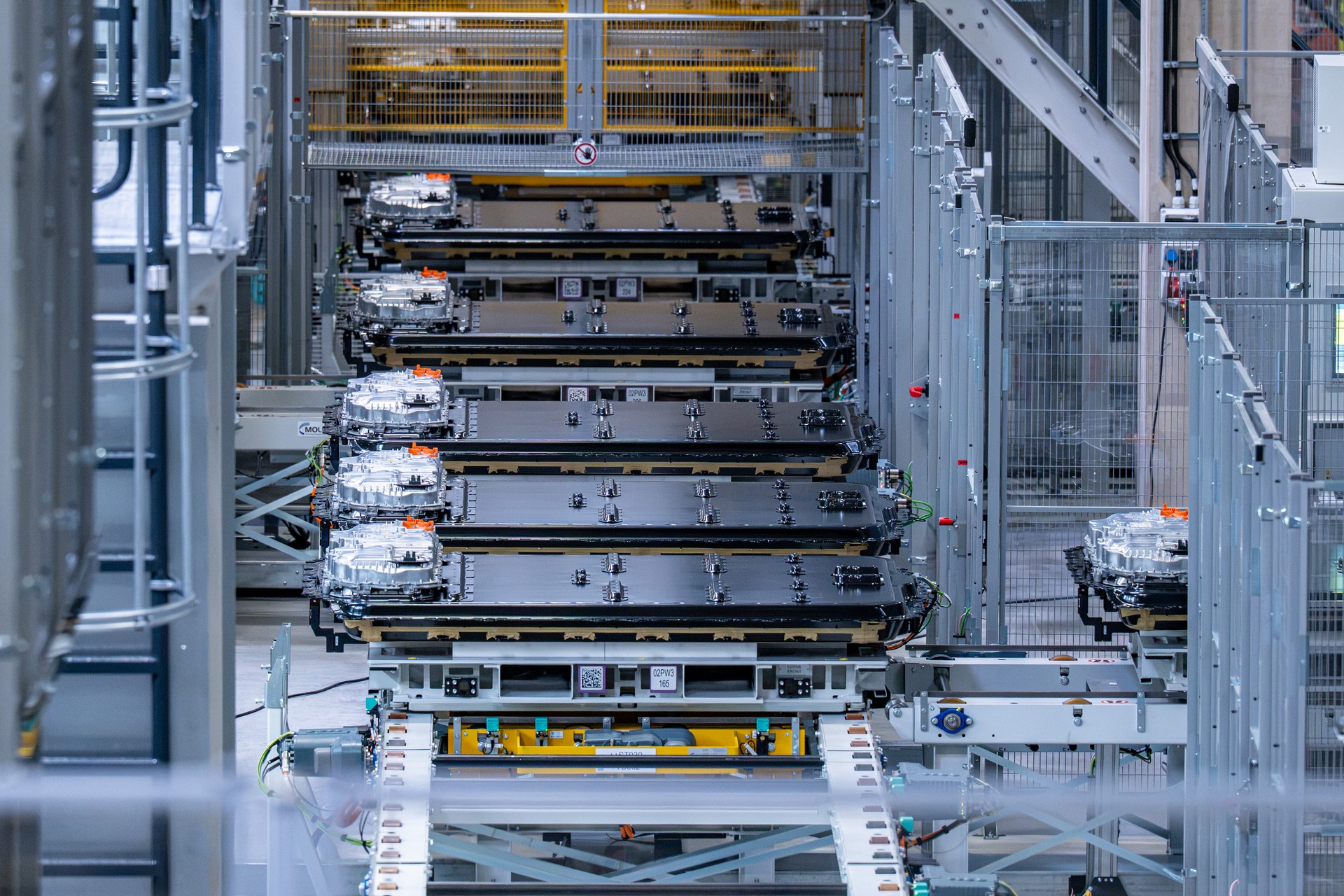
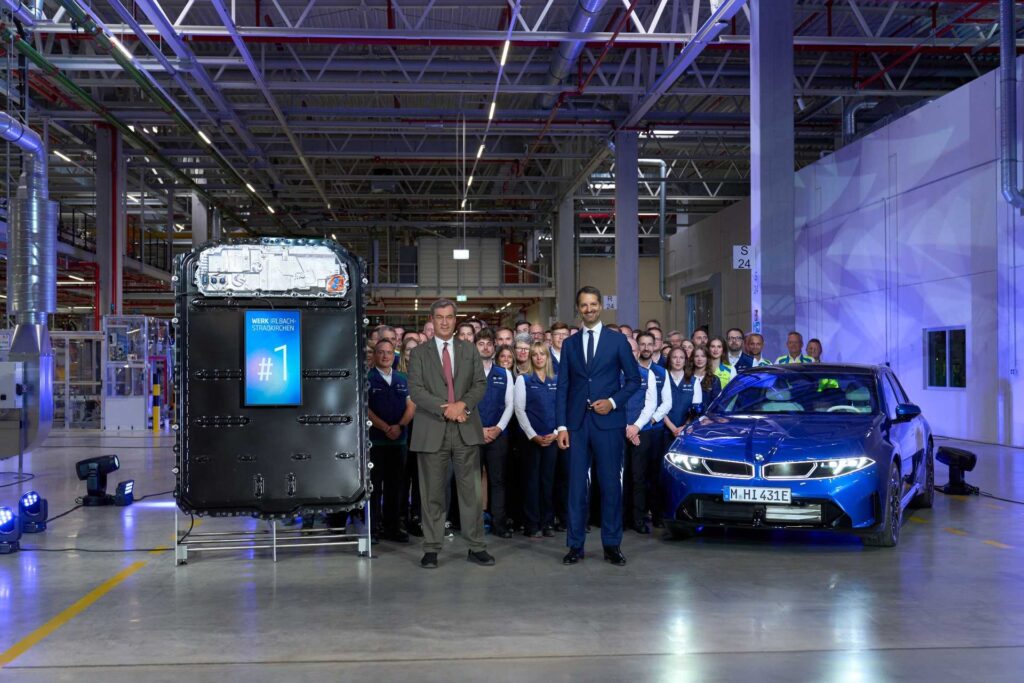
BMW Group opened Plant Irlbach-Straßkirchen in Bavaria on October 1, 2026, and the line is already in series production. The first batteries leaving the site are sixth-generation high-voltage packs for the new BMW i3. They go to BMW Group Plant Munich to be installed in the car.
The driver-facing numbers are in the same opening release. BMW says the i3 high-voltage battery has a capacity of 108.7 kWh. The pack is not a box sitting in a hole in the floor. Under what BMW calls pack-to-open-body, the housing is part of the vehicle structure. Round cells go into that pack directly, cell-to-pack, rather than through a separate module stage.
For the First Edition of the BMW i3 50 xDrive, BMW states a range of up to 906 kilometres on the WLTP cycle. The car uses 800-volt charging. BMW says a DC rate of up to 400 kW can add up to 423 kilometres of range in 10 minutes, measured according to ISO 12906 on the WLTP cycle, when the car is plugged into a DC fast charger. The release also says the new i3 can charge in both directions.
That is a European test-cycle claim, printed for the German market alongside BMW’s usual CO2 note. It is the figure BMW is willing to attach to the first packs from this plant.
Why the ramp started on two shifts
BMW says it spent around one billion euros on the site. Raymond Wittmann, the BMW AG board member responsible for production, described the plant as the central platform that will supply German vehicle plants with sixth-generation high-voltage batteries. “In this way, our high-tech plant in Irlbach-Straßkirchen is making a vital contribution to the ramp-up of the Neue Klasse,” he said.
BMW says demand for Neue Klasse models moved the schedule up. Series production started immediately on two shifts, faster than the company had originally planned. Construction on the 60-hectare site began in April 2024. The first pre-series battery was produced in March 2026, which BMW says was less than two years after the start of construction.
The local vote came earlier. In September 2023 the municipality of Straßkirchen held a referendum on the plant. BMW says more than 75 percent of residents approved it, with turnout around 77 percent. Wittmann called that kind of alignment the reason a project like this can still move in Germany. “Plant Irlbach-Straßkirchen shows what is possible in Germany when everyone involved works towards the same goal,” he said.
Once the plant is fully operational, BMW expects about 1,600 employees there, building several hundred high-voltage batteries a day on two lines. The company describes 500 robots working across a 50,000-square-metre production area, with in-house AI tools watching the line. It says it filed patent applications for more than 500 innovations while developing this generation of eDrive, and that each battery is logged at more than 3,500 data points in real time. Every pack gets a full end-of-line inspection.
Where the cells come from, and where the other plants are
BMW does not build the cells in Straßkirchen. The release says the cells come from leading cell manufacturers, and that incoming cells get extra checks, including voltage. A portion of the cobalt, lithium, and nickel in the Gen6 cells assembled here for the i3 is secondary material, BMW says. Renewable energy is used for the anode and cathode materials and for cell manufacturing. Against the Gen5 cell in the previous model, BMW says CO2e emissions per watt-hour are about 33 percent lower.
The assembly hall itself is meant to run without fossil fuels in regular operation. A photovoltaic system on site covers part of the electricity, and BMW says the rest is renewable. The company also says assembling the high-voltage batteries requires no water.
Irlbach-Straßkirchen is one of five Gen6 battery assembly sites BMW is placing next to vehicle plants under a local-for-local plan. The release names the others as Debrecen in Hungary, Shenyang in China, Woodruff in the United States, and San Luis Potosi in Mexico. About 16 kilometres from Straßkirchen, in Salching, a cell-recycling center started up in December 2025. Encory GmbH builds and runs that center. BMW says it owns the intellectual property for the direct-recycling method, which mechanically takes apart production scrap and whole cells instead of using chemical or thermal processing.
A pack built into the body is also a service part once cars are in customers’ hands. For the early Rivian R2 battery recall, and what Rivian told those owners, see our R2 battery recall.