
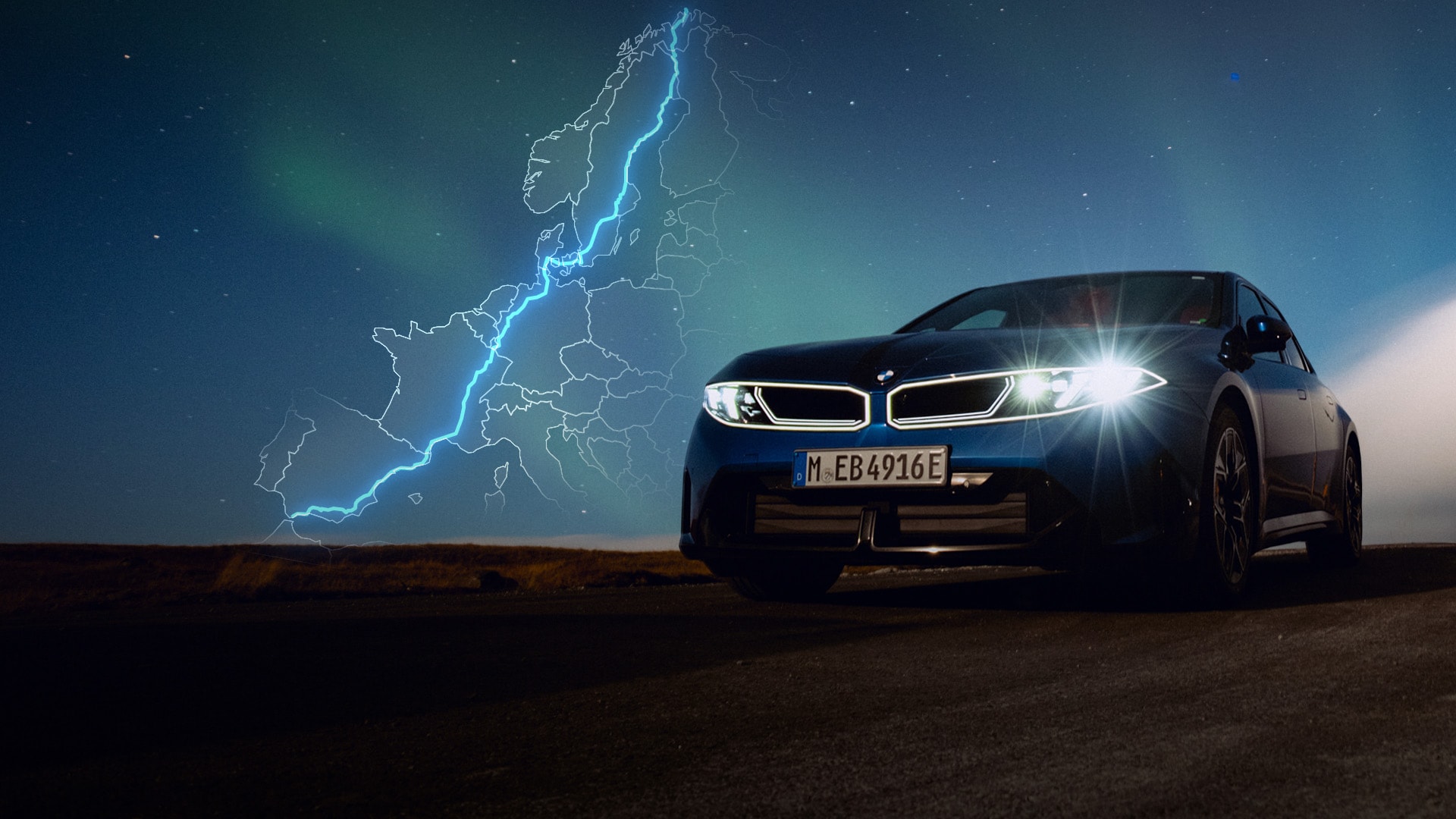
BMW’s new electric 3 Series just drove from the top of Norway to the bottom of Spain and spent about as long plugged in as a long movie runs. The BMW i3 record is 3,658 miles (5,886.7 km) on the Paneuropeana route from the North Cape to Tarifa, set by the i3 50 xDrive with 2 hours, 45 minutes and 54 seconds of total DC fast charging, at an average of 275 kW, according to BMW Group’s announcement. BMW says that beats the previous record, set in 2017, by more than seven hours.
That number is the headline, but the useful part for anyone thinking about an i3 in the US is how the car got there. The record comes from two things working together: a car that sips energy and a charging curve that stays high. Both carry over to American roads, with some caveats.
The 275 kW average is the number that matters
Peak charging speed gets the attention on spec sheets. The i3 is rated at up to 400 kW. Peak speed only lasts for a few minutes in most cars, though, and the average across a whole session is what decides how long you stand at the charger.
Across this trip, the i3 averaged 275 kW over every stop. Multiply that by the 2.765 hours spent charging and the car took on roughly 760 kWh of energy over the whole route, by our math. That lines up with BMW’s consumption figure: at 12.5 kWh per 100 km, the 5,886.7 km route works out to about 736 kWh used. The gap between the two is what you’d expect from charging losses plus the charge left in the battery at the finish.
For comparison, BMW’s own US spec for a 10 to 80% charge is 21 minutes. The usable battery is 108.7 kWh, so 10 to 80% adds about 76 kWh, which is an average of roughly 217 kW over that session. The trip average was higher than that. The likely explanation is strategy: on a record run, the driver arrives at each charger nearly empty and leaves well before the battery is full, staying in the part of the charging curve where the car pulls the most power. Anyone can do the same thing on a road trip. Stopping more often for shorter sessions is usually faster than charging to 90% every time.
If you want a refresher on why 800-volt cars like this one hold higher charging speeds for longer, our 800-volt charging explainer walks through it.
Efficiency did as much work as charging speed
The other half of the record is how little energy the i3 used. BMW reports an average of 12.5 kWh per 100 km over the trip. That converts to about 20 kWh per 100 miles, or close to 5 miles per kWh. It’s also below the car’s official WLTP combined figure of 13.4 to 18 kWh per 100 km, which is unusual. Most cars use more than their official rating in real driving, not less.
Better efficiency means each kilowatt-hour you pay for and wait for carries you farther. On this route, the i3 covered roughly 22 miles for every minute it spent charging. At the trip’s consumption, the 108.7 kWh battery would stretch to around 540 miles from full to empty, as InsideEVs calculated in its coverage of the run. That’s well beyond BMW’s US estimate of 446 to 468 miles.
BMW credits a few specific pieces of hardware:
- A drag coefficient of 0.21, which BMW says makes the i3 its most aerodynamic car to date
- Tires with rolling resistance 14% better than the threshold for the EU’s best “A” efficiency label
- 19-inch M Aerodynamic Polygon 1061 M wheels on the record car
- Sixth-generation (Gen6) electric motors that BMW says lose 40% less energy than the previous generation
- Regenerative braking that handles more than 95% of all braking, according to BMW
The wheel and tire choice matters. Unlike the iX3, whose EPA range varies from 383 to 434 miles depending on the tire, BMW has not published a wheel-by-wheel US table for the i3. If you order larger wheels or performance tires, plan around BMW’s 446 to 468-mile estimate, not this record.
One driver, public chargers and a 49.5 mph average
BMW says the car was standard production spec in both hardware and software, was driven by a single engineer the whole way, and charged only at public stations on each country’s networks. Charging locations weren’t set in advance. The driver had to plan stops around checkpoints, weather and traffic.
The route went through eight countries on highways, country roads and towns. Driving time was 3 days, 2 hours and 41 minutes, at an average speed of 79.7 km/h, or about 49.5 mph. Charging took up only about 3.6% of the combined driving and charging time, by our math.
That average speed is the main reason not to expect the same efficiency on a US interstate trip. Aerodynamic drag rises quickly with speed, and a car that averages under 50 mph through mixed roads will use noticeably less energy than one cruising at 70 to 75 mph for hours. Cold weather adds to that. If you’re planning a winter trip, our guide to preconditioning and winter range covers what to expect. Support vehicles also followed the record car, which a normal driver won’t have.
None of that makes the result less meaningful. It shows what the car and its charging system can do when conditions and planning line up, and it gives a ceiling to measure real owner reports against.
What the BMW i3 record means for US road trips
The US version is rated at the same 400 kW peak, and coverage of the US car has treated the 108.7 kWh usable pack as the same hardware. BMW’s US numbers, which we covered in our i3 price and reservation post, are:
| Spec | 2027 BMW i3 50 xDrive (US) |
|---|---|
| Base price | $61,500 plus $1,350 destination |
| Estimated range | 446 to 468 miles (BMW estimate using EPA procedures, not yet an EPA rating) |
| DC fast charging | Up to 400 kW; 10 to 80% in 21 minutes (BMW) |
| Charge port | NACS, with a CCS adapter included |
| Home AC charging | Up to 15.4 kW |
The NACS port matters most for US road trips. It lets the i3 plug straight into Tesla Superchargers, the densest fast-charging network in the country. One caveat: not every US station can deliver anywhere near 400 kW. Many Superchargers and other DC chargers top out well below that, so the charging speed you see will often be limited by the station rather than the car. The i3’s high average comes from holding strong power through the middle of the battery, and that still helps on a 250 kW station.
It’s also worth comparing the i3 with its SUV sibling. The iX3 50 xDrive shares the battery and the Gen6 hardware and carries an EPA rating of up to 434 miles. The sedan’s lower, slipperier body is where its extra range comes from, and this record shows that advantage holds up outside a test lab.
The record matters most on long US trips
If you drive long distances regularly and want a luxury sedan, this run makes the strongest case yet for the i3. A car that BMW USA says can add 165 to 180 miles in 10 minutes changes how road trips feel, and BMW has now shown it on public chargers instead of a closed course.
If most of your driving is commuting and home charging, the record matters less. Efficiency still saves money on every mile, but charging speed only pays off when you’re away from home.
Until the EPA publishes official numbers and owners start reporting US highway results, the safest plan is to treat BMW’s 446 to 468 miles as the realistic ceiling and the trip’s 5 miles per kWh as a best case at moderate speeds.
FAQ
How long did the BMW i3 charge during its 3,658-mile record?
The i3 50 xDrive spent 2 hours, 45 minutes and 54 seconds at DC fast chargers over the 3,658-mile (5,886.7 km) route from Norway’s North Cape to Tarifa, Spain, according to BMW. Its average charging power was 275 kW.
Was the record BMW i3 a modified car?
BMW says the car was identical in hardware and software to the production i3 50 xDrive available to customers. It ran 19-inch M Aerodynamic Polygon 1061 M wheels and low rolling resistance tires, and it charged only at public stations.
Can the US BMW i3 use Tesla Superchargers?
Yes. The US i3 has a NACS charge port, so it can plug directly into Tesla Superchargers, and BMW includes a CCS adapter for other networks.