
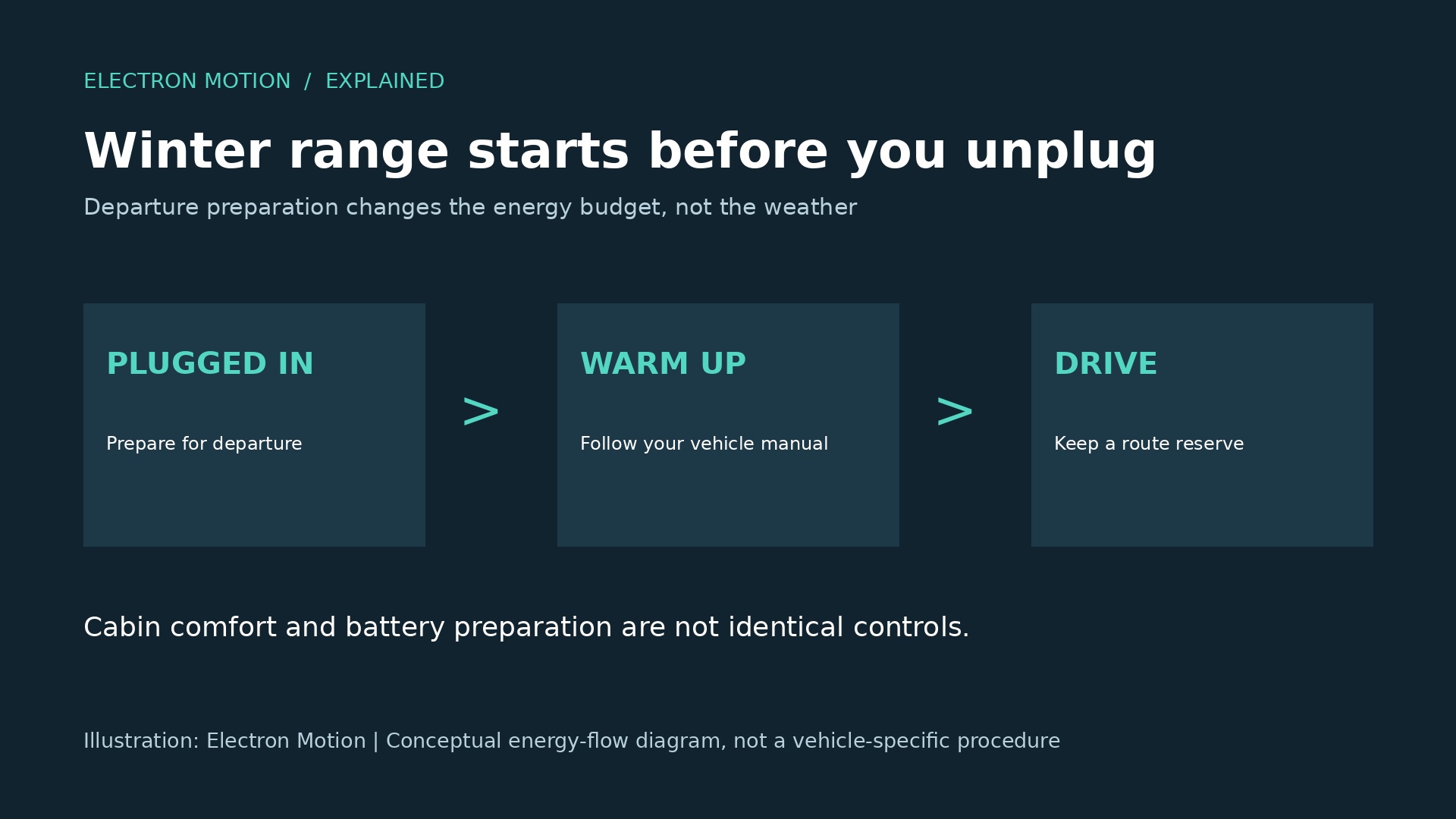
Warming an EV before a winter trip is not just about getting into a comfortable seat. When the vehicle is plugged in, preconditioning can draw energy from the electrical supply rather than spending as much of the battery’s stored energy before the drive begins. The timing matters: warm it for departure, not simply whenever you remember to open the app.
The US Department of Energy recommends preconditioning while charging. That does not make winter energy use disappear. It changes when the vehicle gets some of that energy and leaves more of its stored charge available for the road.
A warm interior is not proof of a ready battery
Cabin heating makes people comfortable. Battery temperature management helps the pack operate within the conditions the vehicle needs. They are related jobs, but the controls and behavior differ by model. Do not assume that tapping a cabin-temperature button activates every battery-preparation function your car offers.
Check the owner’s manual for departure scheduling and preparation for DC fast charging. If the vehicle uses its built-in navigation to prepare the battery for a charger, follow that process rather than assuming a route displayed on your phone does the same job. Leave time for the vehicle to prepare; a heater cannot instantly undo a night of cold soaking.
For departure, set the schedule around when you actually leave and keep the car connected where practical. Check the charge level before unplugging. A connection is not a guarantee that the supply can cover every simultaneous heating and charging demand.
What the research says, and what it does not
A DOE technical review of cold-weather EV performance presents Argonne test data showing a 9-to-20-percent reduction in energy consumption from preconditioning during a 7.5-mile regulatory city-driving cycle at 20 degrees Fahrenheit.
Those conditions belong with the number. It is not a promise of 20 percent more highway range, nor a result for every current EV. Short journeys are especially sensitive to the energy spent bringing a cold cabin up to temperature. A long highway drive has a different balance of heating time, speed and distance.
A heat pump can help reduce heating energy use, but it does not erase cold weather. The DOE review notes that heat pumps become less effective in extreme cold and that some vehicles combine them with resistance heating. Keep the cabin warm enough for comfort and clear visibility. Range is not a reason to drive with a fogged windshield.
Plan the leg you need, not the full-battery headline
Consider a hypothetical EV with 72 kWh of usable battery energy. Leaving at 70 percent and aiming to arrive at 20 percent gives it a 36-kWh travel budget. At 3 miles per kWh, that budget corresponds to 108 miles. At 2.4 miles per kWh, it corresponds to about 86 miles.
Those are illustrative numbers, not a prediction of a particular car’s winter penalty. They show why the same charge percentages can produce a different useful distance when consumption changes. Terrain, weather and detours can consume more of the buffer. Use the vehicle’s updated route estimate and actual trip consumption, and choose an earlier charging stop when the margin shrinks.
Our electricity-cost-per-mile guide explains the consumption side of that calculation. A public charger’s advertised peak power does not tell you the energy needed to reach it.
Check Cold Tire Pressure and a Backup Charger
Cold air also lowers tire pressure. NHTSA recommends checking cold tires, meaning they have not been driven on for at least three hours, against the pressure on the vehicle’s label or in its manual. The maximum number on the tire sidewall is not the vehicle’s recommended setting. Do not overinflate to chase range.
Before a longer trip, look at weather and road conditions, identify an alternate charging stop and leave room for delays. If the roads are unsafe, postponing a nonessential trip is more useful than optimizing the battery percentage.
Preconditioning is a good habit because it tackles an avoidable energy expense before the drive. It works best alongside a realistic route and a reserve, not in place of them.