
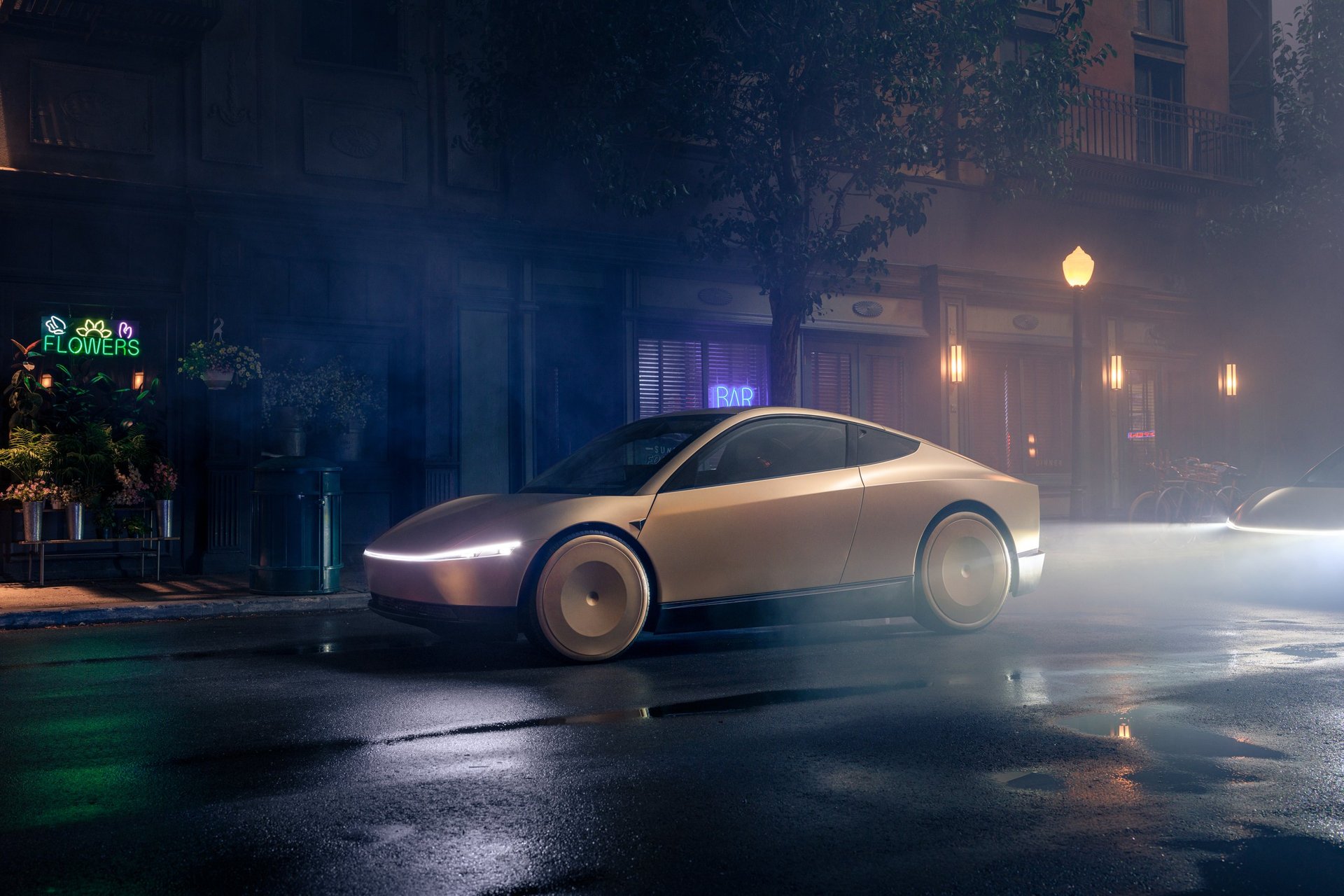
Federal regulators want cyan lights for self-driving cars. On October 23, the National Highway Traffic Safety Administration proposed letting vehicles run steady cyan marker lamps whenever an automated driving system is in control and no one inside is expected to watch the road. The same proposal rewrites a handful of lighting rules that only make sense if a person is holding a steering wheel.
That matters most for cars built without one, and Tesla’s Cybercab is the best-known example on US roads. The proposal also lands while NHTSA is still auditing how Tesla certified the Cybercab in the first place.
What NHTSA proposed
The proposal amends FMVSS 108, the federal standard that covers every lamp, reflector and signal on a car. It’s signed by NHTSA Administrator Jonathan Morrison and is set to be published in the Federal Register on October 26 under docket NHTSA-2026-1519.
NHTSA’s press release says the lamps are meant “to clearly and consistently signal to law enforcement and other road users when an automated driving system is operating the vehicle.” Morrison said the changes “address unnecessary regulatory burdens for vehicles built without traditional manual controls while establishing clear performance standards for automated vehicle marker lamps.”
In practice, the proposal would:
- Allow optional cyan “ADS marker lamps.” Automakers could fit them, but nobody would have to.
- Drop steering wheel rules for turn signals on vehicles with no manual driving controls.
- Limit the turn signal and high beam dashboard telltales to vehicles that have manual controls.
- Remove the rule that the low beam must sit on top when headlamps are stacked vertically. Mounting height limits stay the same.
- Test integral beam headlamps at the voltage marked on the lamp instead of a fixed 12.8 volts. Replaceable bulb and sealed beam headlamps keep the 12.8 volt test.
This is separate from the broader lighting overhaul, including headlamp glare, that NHTSA announced earlier this month. That one is going through a negotiated rulemaking under docket NHTSA-2026-1981, with comments and committee nominations due November 9.
What the cyan lamps would look like
NHTSA defines an ADS marker lamp as “a lamp that is used to indicate when a vehicle is operating without the expectation that an occupant is monitoring the roadway.” The lamps are tied to who’s responsible for watching the road, not to whether a driver aid happens to be switched on.
| Item | NHTSA’s proposal | Why it matters |
|---|---|---|
| Required? | No, optional (“if equipped”) | NHTSA says it lacks the information to show a safety need for a mandate |
| Color | Cyan, the blue-green defined by SAE J578 | Different from police blue and from amber, red and white |
| How many | 4 to 8: one or two each on the front, each side and the rear | Visible from every direction |
| Placement | A single front or rear lamp on the centerline; a pair at the same height, symmetric about the centerline | Looks consistent from car to car |
| Height | At least 15 inches off the ground, inside or outside the vehicle | Can sit behind the windshield or rear glass |
| Behavior | Steady burning, no flashing | Avoids looking like an emergency vehicle |
| When on | Only when no occupant is expected to monitor the road; must switch off automatically when that changes | All lamps switch on and off together |
| Combining | Can’t be optically combined with any other lamp | Keeps the color pure |
| Near turn signals | A lamp closer than 100 mm to a turn signal must switch off while the signal or hazards flash | Your turn signal still wins |
Brightness limits depend on whether the headlamps are on, not on the time of day. The lamps get dimmer when the headlamps are lit, so they don’t drown out brake lights and turn signals.
| Position | Minimum, headlamps off | Maximum, headlamps off | Minimum, headlamps on | Maximum, headlamps on |
|---|---|---|---|---|
| Front | 20 cd | 125 cd | 4 cd | 125 cd |
| Rear | 10 cd | 90 cd | 2 cd | 18 cd |
| Side | 3 cd | 90 cd | 0.6 cd | 18 cd |
For scale, the front maximum is the same ceiling NHTSA sets for parking lamps. These are marker lights, not beacons.
A car without an automated driving system couldn’t use them. And a lamp mounted inside a car that still has manual controls would need a way to keep its glow from reflecting into the driver’s view.
Why cyan
Amber, red and white already mean something on a car, so NHTSA says reusing one of them “would not have clear meaning.” Cyan matches SAE J3134, the industry standard for these lamps, first issued in 2019 and revised in December 2025.
On the police-light question, NHTSA says cyan was picked partly because it’s distinct from police blue, and the lamps are far dimmer than emergency lights and never flash. It doesn’t expect a conflict with state laws that reserve blue for police.
This isn’t only an American idea. Regulators in Europe, through the UN’s vehicle lighting working party, and in China are weighing rear and side marker lamps too. A survey led by Japan’s National Traffic Safety and Environment Laboratory asked more than 4,400 drivers in the UK, Japan, the US and Germany, and upwards of 80% of US and UK respondents said self-driving vehicles should carry a marker lamp. Mercedes-Benz ran a two-year road test of cyan lamps in California from 2023 to 2025 with five vehicles, though The Verge reports that Mercedes has since dropped the turquoise lights it planned for Drive Pilot.
California already allows J3134 lamps. NHTSA’s tentative view is that the federal rule would override state rules only where they differ from it or block a compliant lamp.
What it means for people on the road
If automakers adopt the lamps, a steady cyan glow would tell you a computer is driving and nobody inside is expected to step in. For a pedestrian at a crosswalk or a cyclist at a four-way stop, that’s useful, because eye contact with whoever is sitting up front won’t tell you much.
For police, it answers the first question at a traffic stop or crash scene. The American Association of Motor Vehicle Administrators backs rear and side lamps for exactly that reason, so an officer walking up from behind knows what they’re dealing with.
The lamps won’t signal what the car is about to do. NHTSA asked whether flashing could show intended movement, but says it knows of no research supporting that, so the proposal keeps them steady.
The rule follows responsibility, not hardware. A Tesla on FSD (Supervised) wouldn’t qualify, because the driver is still expected to watch the road. An unsupervised system could, which makes Tesla’s goal of unsupervised FSD in owner cars the case to watch. Tesla hasn’t said whether it would fit cyan lamps to any car.
What changes for cars with no steering wheel
Today, a turn signal must cancel itself when the steering wheel turns back and must have a manual cancel control. A car with no wheel can’t do either. The proposal drops both requirements for vehicles without manual driving controls. Those vehicles would still need a way to run the turn signals and switch the high beams, just not one built for a hand or foot.
NHTSA’s reasoning: “unlike a human driver, the system cannot forget that the turn signals are active.” The hazard light definition would say “operator” instead of “driver,” and the turn signal and high beam telltales would apply only where a person is expected to use them. Riders wouldn’t be left guessing, though. The hazard telltale stays, and a car without turn signal telltales would need a lamp failure warning in view of every seat.
NHTSA notes that vehicles with no manual controls “currently are not available for consumer purchase,” though they’re already deployed in some cities. Tesla says it plans to change that, and we covered whether you’ll be able to buy one separately.
The Cybercab audit connection
On September 3, NHTSA opened an audit query, AQ26002, into how Tesla certified an estimated 1,000 Cybercabs to federal safety standards, and announced it the next day. One question is whether Tesla treated some standards as not applying to the car.
NHTSA’s special order to Tesla, dated September 10, has 21 requests. Request 13 asks whether the Cybercab’s turn signal cancels itself by steering wheel rotation and has a manual cancel control, and if not, how the car complies with FMVSS 108 S9.1.1. Those are the same two requirements this proposal would lift for vehicles like the Cybercab.
That overlap is our reading of the two documents. NHTSA hasn’t connected them, a proposal doesn’t change the standard that applies today, and the agency hasn’t found any violation. Tesla’s response was due September 30 and was reportedly extended to October 30. The service has kept running through its first month and beyond.
How to comment
Anyone can comment. Comments are due 30 days after the October 26 publication, which would be November 25, 2026. Check the date printed in the Federal Register notice before you rely on it.
- Go to regulations.gov on or after October 26.
- Search for docket NHTSA-2026-1519 and open the proposed rule.
- Click Comment, then type your comment or attach a file.
- Submit and save the tracking number.
Every comment is posted publicly, including any personal details you include. You can also fax comments to (202) 493-2251 or mail them to Docket Management, U.S. Department of Transportation, 1200 New Jersey Avenue SE, West Building, Suite W58-213, Washington, DC 20590.
Specific comments carry the most weight. NHTSA is asking whether the lamps should ever flash, whether they could be combined with other lamps, and whether the brightness and color rules are right. If you ride a bike past robotaxis every day, that experience counts.
What happens next
Once comments close, NHTSA can issue a final rule. It proposes that the rule take effect immediately, with no lead time, because it adds options rather than burdens. The agency hasn’t put a dollar figure on costs or benefits.
Even then, cyan lights won’t show up overnight. They’d be optional, and each company would decide whether to fit them. Until a final rule lands, the current standard, steering wheel assumptions and all, still applies to every car on the road, Cybercab included.