
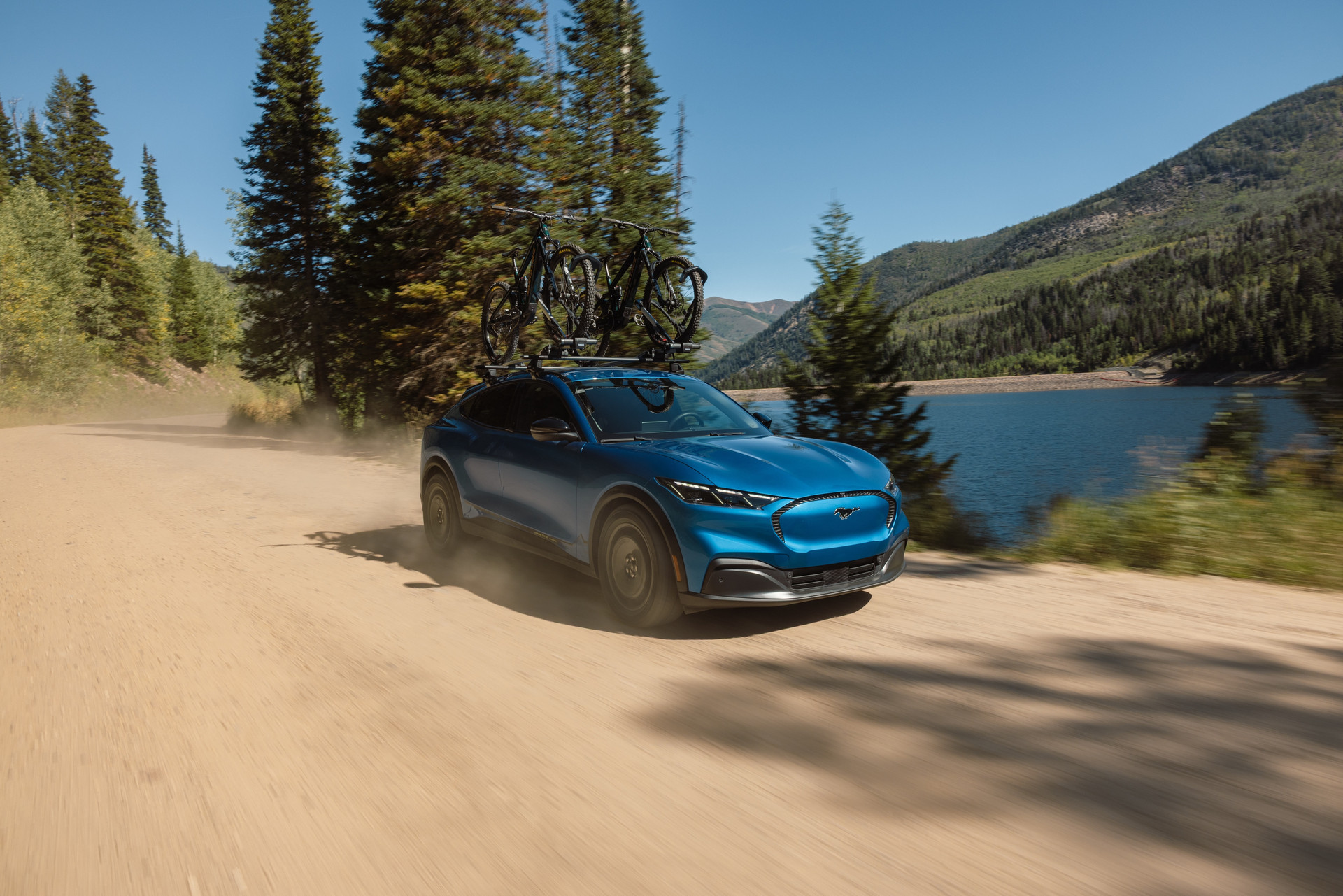
Ford opened orders for the 2027 Mustang Mach-E on October 22, and the lineup has changed more than the styling suggests. The smaller battery is gone, so every car now gets the extended-range pack. A new Trail package offers a cheaper way into the Rally’s gravel hardware, and at least one option has to be chosen on the order because Ford won’t let you add it later. The prices, the trims and the order-time choices all shifted, and they are worth going through before you sign anything.
The big change: the bigger battery is standard
For 2027, Ford says the extended-range battery is standard on every Mach-E for the first time. Select and Premium get 88 kWh of usable capacity. GT and Rally get 91 kWh.
On the 2026 car, the base Select and Premium came with a 73 kWh standard pack, and the bigger battery was an extra. Dropping the small pack is the main reason the entry price moved.
The 2027 car also gets a new secondary drive unit, the front motor on all-wheel-drive models, which Ford says delivers the same performance at a lower cost. It hasn’t published new horsepower or 0-60 figures for 2027, so treat the 2026 numbers as a guide until it does.
What it costs
Ford’s release gives two prices. The Select RWD starts at $39,995 before destination and delivery, a figure that also excludes fees and Ford’s A, Z and X Plan pricing, and the Trail is a $2,295 package on the Select eAWD.
Ford hasn’t posted per-trim prices yet, and its Build & Price tool won’t cover the 2027 car until early next year. Electrek, Car and Driver and Motor1 all report the same trim prices and the same $2,045 destination fee, so those figures are in the table below, with and without destination.
| Trim | Drive | Battery (usable) | MSRP before destination | With $2,045 destination | 2026 EPA range, same layout (context) |
|---|---|---|---|---|---|
| Select | RWD | 88 kWh | $39,995 (Ford) | $42,040 | 320 mi (2026 RWD Extended) |
| Select | eAWD | 88 kWh | $42,995 | $45,040 | 300 mi (2026 AWD Extended) |
| Select eAWD with Trail package | eAWD | 88 kWh | $45,290 ($2,295 package, Ford) | $47,335 | Not yet rated |
| Premium | RWD | 88 kWh | $42,995 | $45,040 | 320 mi (2026 RWD Extended) |
| Premium | eAWD | 88 kWh | $45,995 | $48,040 | 300 mi (2026 AWD Extended) |
| GT | eAWD | 91 kWh | $50,995 | $53,040 | 280 mi (2026 GT) |
| Rally | eAWD | 91 kWh | $55,290 | $57,335 | 255 mi (2026 Rally) |
Prices other than those marked Ford are as reported by Electrek, Car and Driver and Motor1. Range figures are 2026 EPA ratings from fueleconomy.gov. Ford says 2027 EPA ranges will be announced closer to availability.
Is it cheaper than 2026?
Not at the bottom. The 2026 Select RWD started at $37,795 before destination, according to the EPA’s fueleconomy.gov listing, so the cheapest Mach-E is now $2,200 more. What changed is that the extra money now buys the battery that used to cost extra.
Higher up, the picture flips. Car and Driver reports the GT falls from $55,440 to $53,040 with destination and the Rally from $59,735 to $57,335. Electrek reports the 2026 car with the extended-range battery started at $45,345. If you were going to buy the bigger battery anyway, you pay less for it on the 2027 car than on a comparable 2026 car. If you only wanted the cheapest Mach-E, you pay more.
A leftover 2026 is also worth pricing before you order. Ford extended its Power Promise offer through the fourth quarter for 2026 Mach-E buyers, with a choice of a free home charger with standard installation or $1,500 in bonus cash. We covered it alongside the Mach-E’s Q3 sales. Sales fell 72.4% in the quarter to 5,574, so dealers may have 2026 stock to move.
What the Trail adds
The Trail is a factory-built package, not a limited run and not a dealer add-on. It requires the Select eAWD and costs $2,295. Ford gives it its own passive struts and springs, which raise the car 10 mm at the front and 15 mm at the rear compared with Select and Premium. The steering rack comes from the Rally, as do the 19-inch High Gloss Dark Carbonized Gray wheels and the Michelin CrossClimate 2 all-weather tires. A Carbon Black lower front fascia and a Trail logo on the center armrest set it apart visually.
The package also makes Pro Power Onboard standard, with 400 watts from outlets in the cargo area and at the rear of the center console. That is easy to overlook, but Ford lists Pro Power Onboard as available on the Premium and GT, including the Rally. On a Select, the Trail is how you get it.
Nick Rallis, Ford’s lead Mustang Mach-E vehicle integration engineer, says the Trail is built for loose gravel, sand and two-track dirt, and that the tires give “a significant traction benefit in winter conditions.”
Ford also offers an Interior Protection Package for the Trail, with all-weather floor mats and a cargo protector, plus a Thule Clamp On Cross Bar Kit through Ford accessories. Trail buyers get 100,000 Ford Rewards points on top of the 22,000 every Mach-E buyer gets.
Ford expects Trail cars to reach customers in the first quarter of 2027.
Trail or Rally?
On the reported prices, the gap is $10,000: $47,335 for a Trail against $57,335 for a Rally, both with destination.
The Rally is the performance car. It shares the GT’s 91 kWh battery and powertrain; on the 2026 car that meant 480 horsepower and 0-60 mph in 3.4 seconds, per Ford. It has its own suspension and comes with BlueCruise as standard. The trade-off shows in efficiency: the 2026 Rally was rated at 255 miles, the lowest of any Mach-E.
The Trail is a Select with the Rally’s wheels, tires and steering rack and its own lift. You give up the GT-level power and the bigger battery. In return you save $10,000 and keep the Select’s efficient setup. Ford hasn’t rated the Trail’s range, and all-weather tires and a lift tend to cost some range, so don’t assume it will match the 2026 Select eAWD’s 300 miles.
How the two compare on ride height depends on which outlet you read. Motor1 reports the Rally sits 10 mm higher at the front and 20 mm higher at the rear than the standard car, which would put it slightly above the Trail at the rear. Car and Driver says the opposite, that the Trail sits higher at the rear, and Ford’s Trail release doesn’t give a direct comparison.
Pick the Trail if you want a car that handles gravel roads, snow and campsite access without paying for speed. Pick the Rally if you want the quickest Mach-E with the rugged look and can live with less range.
Decide these at order time
BlueCruise hardware
BlueCruise is the choice that can’t be fixed later. BlueCruise 1.5, Ford’s hands-free highway driving system, is optional on the Select with the Tech Pack Lite and on the Premium with the Premium Tech Pack. It is standard on the GT and Rally. Cars with it include one year plus 90 days of service.
Ford is explicit about the Trail: because it is built on the Select, the BlueCruise hardware has to be selected when you order and cannot be added afterward. Ford does offer a one-time BlueCruise purchase, but only on cars that already have the hardware. If there is any chance you will want hands-free driving, put the tech pack on the order.
Drive and package
The Trail needs eAWD, so a Select RWD order rules it out, and with it the only route to Pro Power Onboard on a Select. If you want the outlets on a Premium or GT, check that they are on the build sheet.
Color
Desert Sand and Shadow Black are the no-cost colors. Adriatic Blue Metallic, Eruption Green Metallic, Glacier Gray Metallic, Race Red, Star White Metallic Tri-coat and Velocity Blue Metallic cost extra.
Connected services
Ford’s Connectivity and Security packages are standard, each with one year included. Plan on a subscription after that if you want to keep them.
How to order
For now, orders go through Ford dealers. The online Build & Price tool for the 2027 car opens early next year. Because Ford has confirmed only two prices so far, ask the dealer for a written build sheet that shows the MSRP, the $2,045 destination fee and every package line before you put down a deposit.
These details are for the US lineup. Ford of Europe handles its own Mach-E updates, and Ford hasn’t said whether the Trail will be sold outside the US.
If a $40,000 crossover is more than you want to spend, Ford’s next EVs are coming from a lower-cost platform. Our pieces on the UEV platform and the Ford Fathom cover what is coming. For how the Mach-E stacks up against the rest of the market, see our Q3 EV sales roundup.