
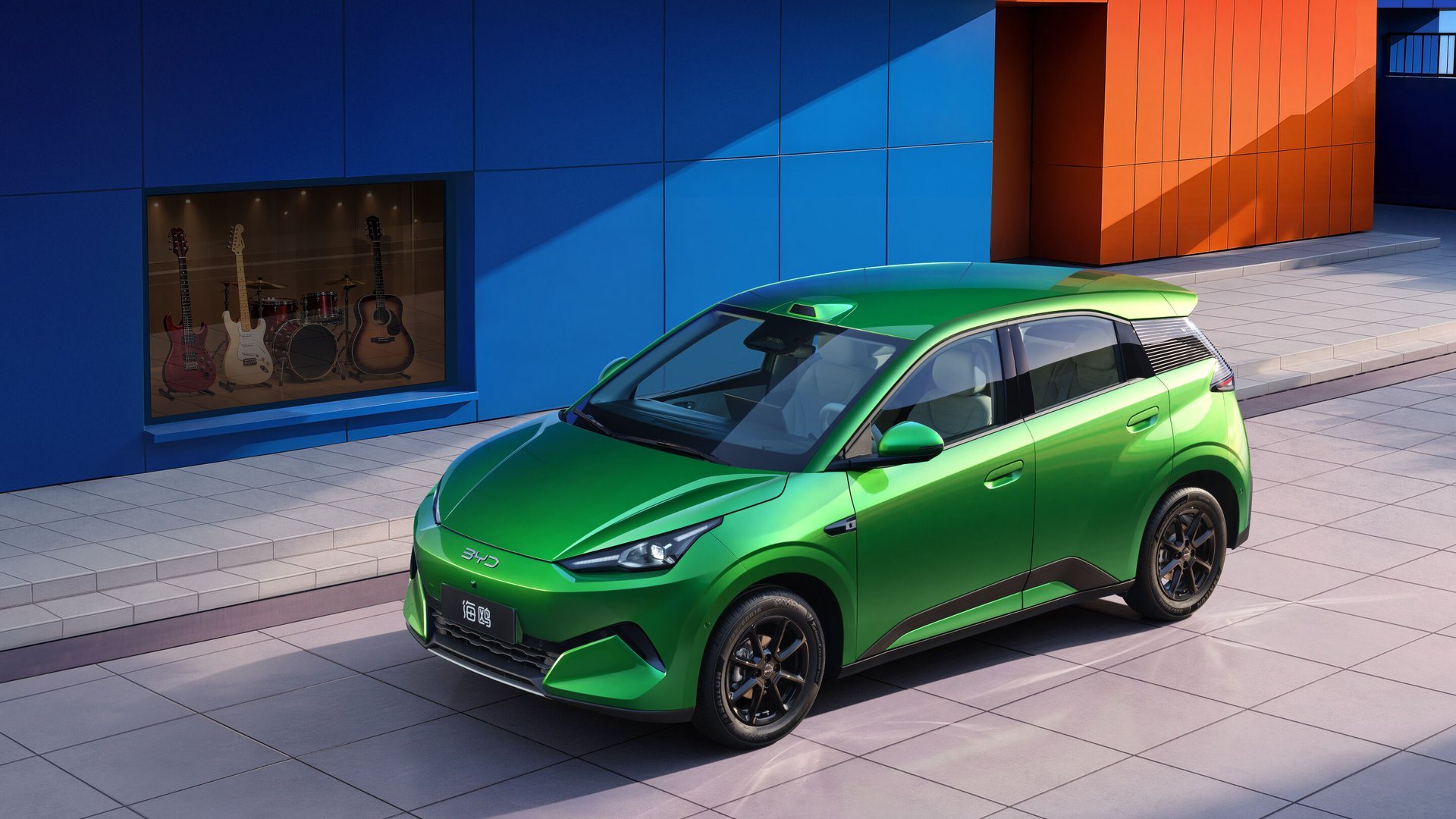
The second-generation BYD Seagull went on sale in China on Tuesday, Oct 20, starting at 65,900 yuan. At the day’s official exchange rate that is about $9,800, £7,400 or €8,800, and a limited-time BYD trade-in subsidy takes another 3,000 yuan off, to 62,900 yuan (about $9,400). Electrek broke down the launch pricing, and every price and spec below is checked against BYD’s own Seagull parameter sheet.
The price is only half the story. For under $10,000, BYD now sells a five-seat, rear-drive hatchback, and a little more money buys one that takes Flash Charging, the 5-minute charging tech BYD showed off in March. The top trim adds a roof-mounted LiDAR.
What changed from the first Seagull
The new car is 4,205 mm long, 1,810 mm wide and 1,570 mm tall on a 2,650 mm wheelbase. CnEVPost reports that it is 425 mm longer than the outgoing car, which is how a four-seater became a five-seater. The motor moves to the back and drives the rear wheels, with 85 kW on the two 320 km trims and 95 kW on the three 420 km trims. Both outputs are well up on the 55 kW the first-generation car offered, according to CnEVPost and Electrek. The rear suspension is now multi-link, and there is a 94-litre front trunk.
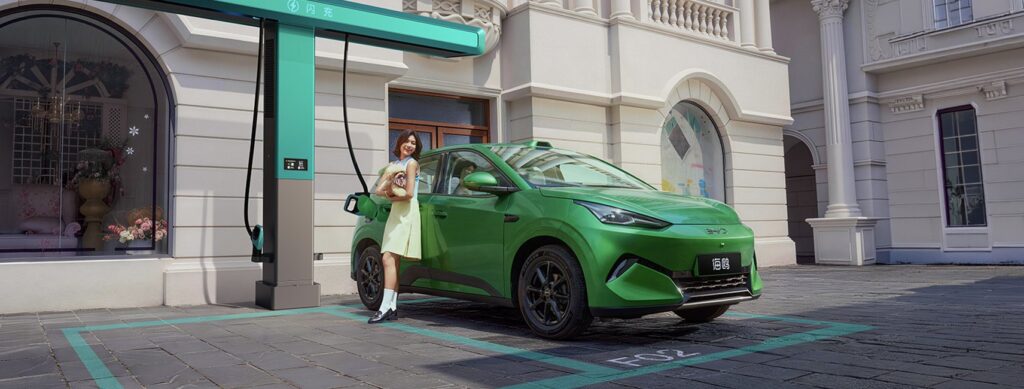
There are two Blade 2.0 LFP packs, 30.1 kWh and 39.2 kWh. Only the three bigger-battery trims support Flash Charging, and BYD’s model page rates them at 10 to 70% in 5 minutes and 10 to 97% in 9 minutes. In BYD’s March figures, charging from 20 to 97% at minus 30°C takes only about 3 minutes longer than at room temperature. Those times depend on BYD’s own Flash Charging stations, and AC charging tops out at 7 kW on every trim. At the launch BYD said it had 12,165 of those stations running in China, according to Chinese tech outlet Kuai Technology, against a goal of 20,000 by the end of the year. Private buyers of the Flash Charging trims who complete their purchase by Nov 30 get a year of free charging at them.
| Trim | Price (yuan) | Approx. USD | Battery | CLTC range | Motor | Flash Charging |
|---|---|---|---|---|---|---|
| Vitality | 65,900 | $9,800 | 30.1 kWh | 320 km | 85 kW | No |
| Freedom | 72,900 | $10,850 | 30.1 kWh | 320 km | 85 kW | No |
| Comfort | 75,900 | $11,300 | 39.2 kWh | 420 km | 95 kW | Yes |
| Flying | 82,900 | $12,350 | 39.2 kWh | 420 km | 95 kW | Yes |
| Smart | 99,900 | $14,850 | 39.2 kWh | 420 km | 95 kW | Yes, plus LiDAR |
Those ranges come from China’s CLTC test, a gentle drive cycle with plenty of idling and no sustained highway running. It lands well above Europe’s WLTP figure and further still above the EPA rating US buyers see.
What under $10,000 actually gets you
The base Vitality is a simple car. It has steel wheels, manual seats, four speakers, a 12.8-inch screen, a 360-degree camera, conventional cruise control and the smaller battery. Instead of Flash Charging, BYD offers buyers of the two smaller-battery trims a free 7 kW home charger with installation, where one can be fitted. Step up to the 72,900-yuan Freedom and you get power-adjusted, heated and ventilated front seats, a massage function for the driver, a 50 W phone charger and a power tailgate. The Comfort and Flying trims repeat that pattern with the bigger battery and Flash Charging: Comfort has the Vitality’s equipment, Flying has the Freedom’s.
The tech story sits at the very top. Only the 99,900-yuan Smart trim has God’s Eye B with LiDAR, city and highway navigation assist, automated parking and a 15.6-inch screen. The same trim is also where the active safety kit shows up. BYD’s China configuration sheet lists automatic emergency braking, forward collision warning, adaptive cruise and blind-spot monitoring for the Smart and marks them as not fitted on the four cheaper trims, with no option to add them. That matters beyond China, because new cars registered in the EU must have automatic emergency braking as standard, so any European version would need a different spec.
Compared with the cheapest new EVs in the US
Leaving aside Slate’s two-seat pickup, which starts at $24,950 on preorder, the cheapest new electric car in the US is the 2027 Chevrolet Bolt at $27,600 before destination. The Nissan LEAF S+ starts at $29,990, and the Chevrolet Equinox EV at $34,995. That makes the cheapest Bolt about 2.8 times the price of a base Seagull. You could buy the top Smart trim with LiDAR and still have roughly $12,700 left before you reached a Bolt.
It is not a like-for-like trade, though. The Bolt, which was Chevrolet’s best-selling EV in the third quarter, has a 65 kWh battery and a 262-mile EPA range, more than twice the base Seagull’s capacity, and it is built for American highway distances. The fairer reading is that China has a whole class of small, short-range city EVs with no real US equivalent, much like the kei cars Japan builds around efficiency, and BYD is now pushing fast charging and driver assistance down into the bottom of that class. US buyers will not get the choice anyway: Chinese-built EVs face a 100% US tariff, and the federal EV tax credit ended in September 2025.
What it means for the Dolphin Surf in Europe and the UK
Outside China, today’s Seagull is sold as the Dolphin Surf, and in some markets as the Dolphin Mini. BYD has not announced a successor to either, or said when or whether the second-generation car will go abroad, so any timing is a guess for now.
The current Dolphin Surf costs from £18,665 in the UK, according to Auto Express pricing, and from €23,490 in Germany on BYD’s Q4 2026 list price before its own year-end discount, as tallied by a German dealer. Converted at Tuesday’s rates, those are about $24,800 and $26,300, or roughly two and a half times the Chinese base price of the new car. Shipping, duties and European safety equipment explain much of that gap. On top of the normal 10% import duty, BYD’s China-built EVs carry a 17.0% EU countervailing duty.
The European car is also a step behind. According to BYD’s UK media site, it is 3,990 mm long, front-drive, and charges at up to 85 kW DC, which means 30 minutes for 10 to 80%. A five-seat version only arrived this autumn, shown at the Paris Motor Show, where BYD also revealed the Flash Charging Atto 8 for Europe. A second-generation Dolphin Surf would be over 20 cm longer, rear-drive and able to charge in minutes, but Flash Charging only matters in Europe once the stations exist. In March BYD said it would begin rolling them out globally at scale by the end of 2026, and it has not yet given a European station count.
That puts real pressure on small European EVs. Volkswagen’s ID. Cross 37 kWh just opened pre-sales from €27,995, and BYD is showing what the same money could look like once its newest hardware reaches the region.
What comes next
The clearest signals will be a European type approval or a renamed Dolphin Surf at a launch event, followed by firm numbers on Flash Charging stations outside China. Buyers in Europe should also look closely at the safety spec of any export version, since the Chinese sheet keeps the full driver-assistance pack for one trim. For now the new BYD Seagull is a China-only car, and a clear sign of how far the price of a usable EV has fallen in its home market.