
The Lucid Cosmos release date is still unannounced, but Lucid now says it will name the reveal date and the start-of-production date for its midsize platform in the first quarter of 2027. Production itself is still planned for the second half of 2027. That came in the company’s third-quarter update on November 9, and CEO Silvio Napoli repeated it on the call that afternoon: “Today, we are on track to start production in the second half of 2027.”
The first car on that platform is the Cosmos, a midsize crossover that Lucid, at its March Investor Day, said will start under $50,000. If you are shopping for an EV in that price band, the update gives you a calendar, a set of claimed numbers, and a fairly clear answer about whether waiting makes sense.
Where the Cosmos program stands
According to Lucid’s release, the midsize program spent the third quarter in testing and final-stage prototyping, with pilot production “entering the final phase.” On the call, Napoli said the work now includes homologation and crash testing, the steps that let a car be certified for sale.
The car will be built at Lucid’s new AMP-2 plant in Saudi Arabia. Lucid says that factory has entered the final stages of industrialization and commissioning, with an inauguration expected in early 2027. On the call, Napoli said the AMP-2 timeline is unchanged despite the conflict in the region, while noting the team keeps adding mitigations.
The timeline has already moved once. Lucid originally pointed to late 2026 for the Cosmos. In August, Napoli pushed it to the second half of 2027 and said the midsize car would launch “only when every process and quality requirement have been met.” Monday’s update holds that window and adds a promise to put real dates on it in the first quarter.
The number that matters: 4.5 miles per kWh
Lucid’s March 12 Investor Day presentation, introduced in the company’s official Investor Day story, says the midsize platform reaches up to 4.5 miles per kWh, and that the Cosmos would need 69 kWh to cover 300 miles. Multiply 69 by 4.5 and you get about 310 miles, which is consistent with that 300-mile comparison. No EPA rating exists yet for a car that is not in production. These are company targets from March, not certified figures, and they were not restated in the November 9 update. A smaller pack is how Lucid plans to sell a cheaper car without giving up distance: less battery means less cost and less weight.
The same number explains the charging claim. Lucid’s Investor Day materials say the car can add over 200 miles in 14 minutes on a DC fast charger. At 4.5 miles per kWh, 200 miles is about 44 kWh of energy. Putting 44 kWh into the pack in 14 minutes works out to an average of about 190 kW across the whole session, using 200 miles as a rounded input on Lucid’s claim. Those materials also describe an 800-volt architecture for the platform, which makes that kind of sustained rate plausible on a high-power charger.
Lucid’s Investor Day materials also describe a new Atlas drive unit with over 30% fewer parts and 37% lower bill-of-materials cost than the Zeus unit in the Gravity, and a 0 to 60 mph time of under 3.5 seconds. On Monday’s call, Napoli said the Atlas unit has “demonstrated incredibly high power densities” in testing.
What Lucid has shown so far
Lucid first presented the Cosmos and a second midsize model, the Earth, at its Investor Day in March. Both start under $50,000. Lucid described Earth as the more adventure-oriented of the two and said it would share details on a third midsize consumer model later. A robotaxi application on the same platform is also planned; Lucid has shown a two-seat Lunar concept and, on Monday’s call, a European midsize deployment goal with Bolt.
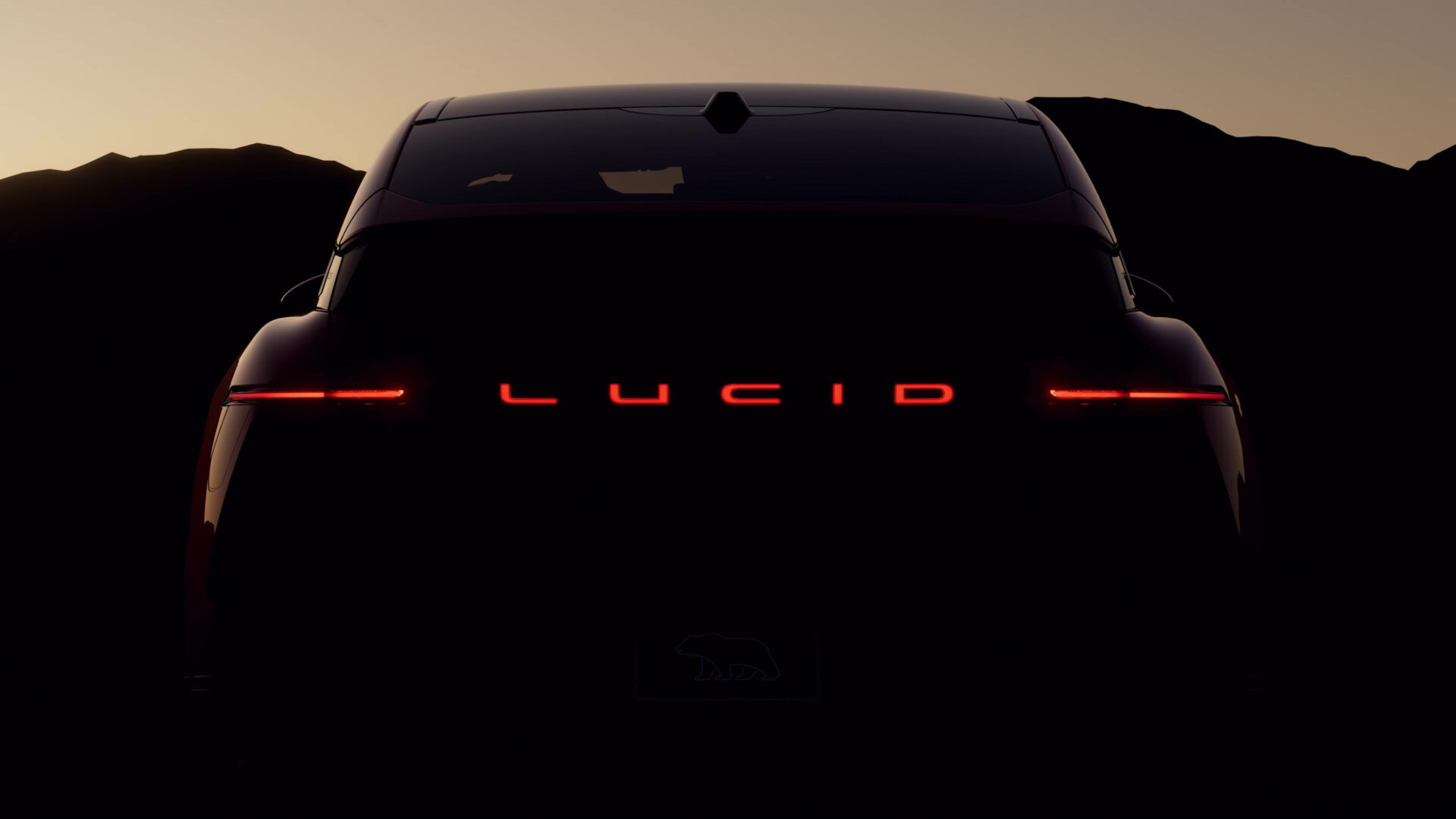
The most recent look came on November 5, when Lucid posted a short teaser, Shaping How Movement Feels. It shows red “LUCID” lettering across the tailgate, thin red light strips, and a segmented LED headlight. The caption did not name the vehicle, but it said Lucid wants to “share this feeling with even more people.”
Lucid has published Air and Gravity prices in France, but it has not published Cosmos trim prices, a battery warranty, an EPA estimate, or a reservation page.
Lucid’s other news for current and future owners
Two other points from the update matter to shoppers.
First, Lucid’s UX 3.0 software has brought the Gravity’s interface to newer Air sedans over the air. That points to one shared software base across models, which is the same approach the Cosmos is expected to use.
Second, Lucid’s robotaxi program with Uber and Nuro is moving into driverless testing. Lucid’s release says the program expanded to more than 100 vehicles on the road in August, and on the call Napoli said the commercial launch in the Bay Area is planned for the first quarter of 2027 and “will be fully driverless from day 1.” The robotaxi version of the midsize platform comes later, but the Gravity-based fleet is the first test of Lucid’s autonomy work at scale.
Should you wait for the Cosmos?
It depends on when you need a car.
If you need an EV in the next six to nine months, the Cosmos is not an option. Even the reveal date is not yet set, and the earliest production window is the second half of 2027. First deliveries usually trail the start of production, so a realistic plan is to treat late 2027 as the earliest you could own one, and possibly later depending on where you live.
If you already like the Rivian R2, it is on sale now. Our R2 trim guide compares price and range by version, and our R2 delivery tracker shows how long buyers are waiting by color.
If efficiency is what you care about most, and your current car can last into 2028, the Cosmos is worth watching. A midsize crossover that could cover about 300 miles on 69 kWh, if Lucid’s March efficiency target holds, would use less energy per mile than most of its rivals, which means lower charging costs over the life of the car. The key number will be the EPA rating once the car is certified.
Wait for three things before you change your plans: a US starting price for a specific trim, an EPA range estimate, and a delivery window. Lucid says the first of the dates arrives in the first quarter of 2027.
Lucid Cosmos FAQ
When will the Lucid Cosmos come out?
Lucid plans to start production in the second half of 2027 and says it will announce the reveal and start-of-production dates in the first quarter of 2027. Deliveries would follow production.
How much will the Lucid Cosmos cost?
Lucid said at its March Investor Day that the Cosmos will start under $50,000. It has not announced trim prices.
How far will the Lucid Cosmos go on a charge?
Lucid’s March Investor Day materials say the Cosmos would need 69 kWh to cover 300 miles, based on efficiency of up to 4.5 miles per kWh. Those figures are a company comparison case and efficiency target, not a confirmed pack size or an EPA rating.
Where will the Cosmos be built?
Lucid plans to build its midsize vehicles at its AMP-2 plant in Saudi Arabia, which it expects to inaugurate in early 2027.