
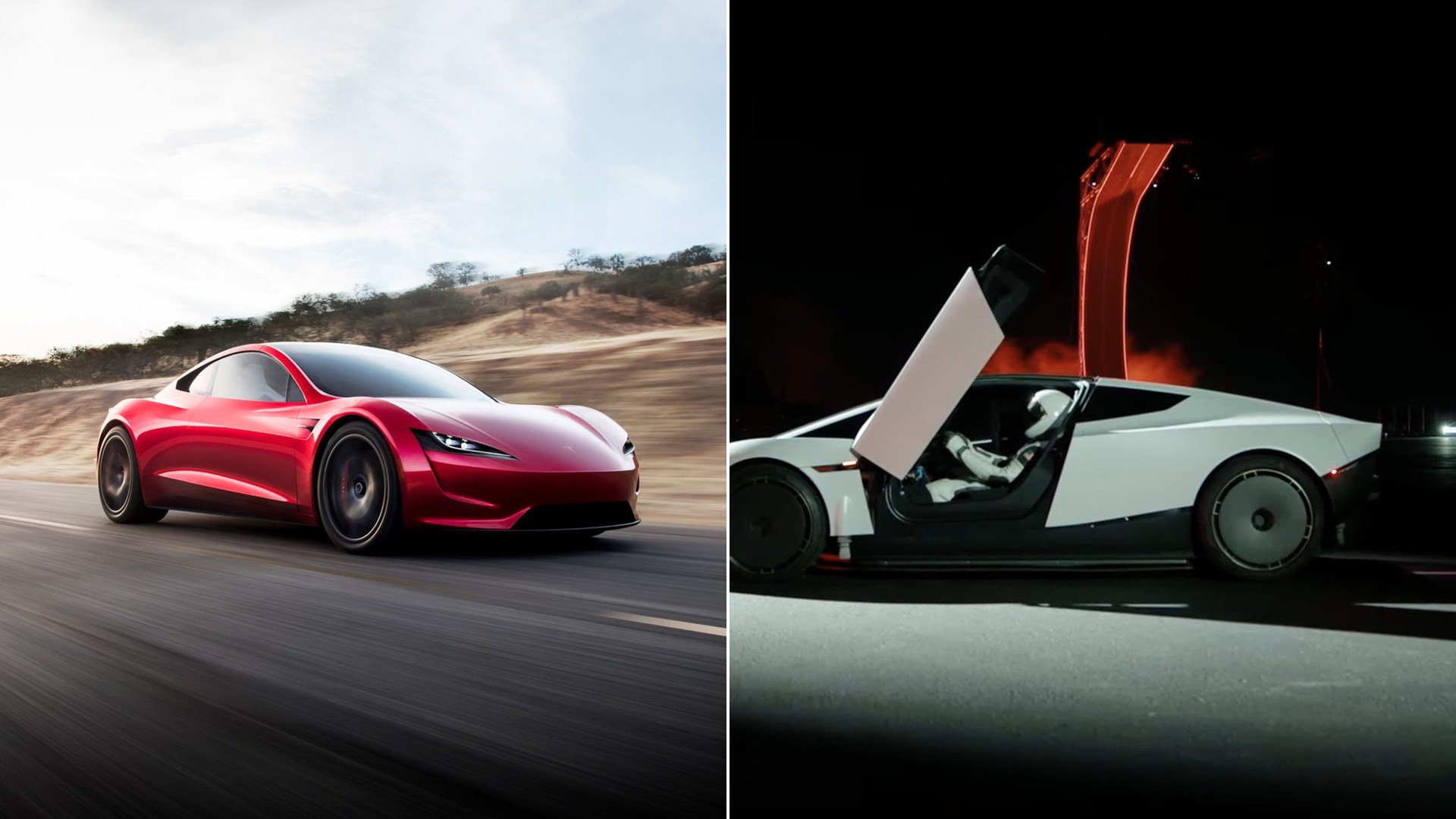
Set side by side, the Tesla Roadster 2017 vs 2026 story is a trade of range and seats for speed. When Tesla first showed the second-generation Roadster in November 2017, it promised 0 to 60 mph in 1.9 seconds, 620 miles of range, four seats and deliveries in 2020. The car Tesla revealed on October 15, 2026 kept the name and the ambition and went much further on speed. Tesla’s media specs list under 0.59 seconds to 60 mph for the top Rocket version, and the car ran 0.81 seconds live in front of the crowd. To get there, Tesla made it a lighter, rear-wheel-drive car with one or two seats, over 300 miles of range and a thruster system developed in collaboration with SpaceX. Production starts in 2028.
Here’s how the two cars compare, what you get in each new trim, and how the nine years in between played out.
2017 Roadster vs 2026 Roadster: the specs
The 2017 numbers come from Tesla’s original Roadster page. Most 2026 numbers come from the spec tables Tesla shared with media on October 14, which reporters Ryan Zohoury and Sawyer Merritt published this week. The rest come from Tesla’s current Roadster page, the reveal livestream and executives’ interviews, which our reveal coverage sources in full. The new car is still a prototype, so treat every 2026 figure as a Tesla target that can change before production.
| Spec | 2017 Roadster (promised) | 2026 Roadster (Tesla targets) |
|---|---|---|
| First shown | Nov 16, 2017, at the Tesla Semi event | Oct 15, 2026, at SpaceX McGregor, Texas |
| Versions | Base and Founders Series | Performance, Thrust and Rocket |
| 0 to 60 mph | 1.9 seconds (base) | Under 1.6 s (Performance), under 0.9 s (Thrust), under 0.59 s (Rocket) |
| Best shown so far | Prototype rides | 0.81 seconds, live at the reveal |
| Peak acceleration | Not announced | Over 1.5 g (Performance), over 5 g (Thrust, Rocket) |
| 0 to 100 mph | 4.2 seconds | Not announced |
| Quarter mile | 8.8 seconds | Not announced |
| Top speed | Over 250 mph | Over 210 mph (Performance), over 230 mph (Thrust, Rocket) |
| Range | 620 miles | Over 300 miles EPA, all trims |
| Battery | 200 kWh, per Musk | About 115 kWh, per von Holzhausen |
| Drive | Three motors, all-wheel drive | Two rear motors, rear-wheel drive |
| Power and torque | 10,000 Nm at the wheels | Over 1 MW peak power, over 1,400 Nm peak motor torque |
| Thruster force | None | Over 80 kN (Thrust, Rocket) |
| Seats | 4 (2+2) | 2 (Performance, Thrust), 1 (Rocket) |
| Roof and doors | Removable glass roof | Dihedral doors, removable roof panels |
| Fast charging | Not announced | Over 500 kW at 800 volts |
| Production | “Available in 2020” | Starts 2028 at Roadster Factory Texas |
What got better
Acceleration. The 2017 car’s 1.9 seconds was already a stunning number for a road car. Even the new Performance version, the one most buyers will reserve, targets under 1.6 seconds. Thrust targets under 0.9 and Rocket under 0.59. Tesla’s public Roadster page still commits only to under 1 second for Thrust, so the media kit is the first Tesla material to put a number on every trim. No production car on sale today matches those targets. Musk said on stage the production car will be quicker than the 0.81 second run Tesla showed live.
The SpaceX package is real. In June 2018, Musk described an optional SpaceX package with about ten small thrusters that might “even allow a Tesla to fly.” Eight years later, the Rocket version has exactly ten. Thrust carries one carbon-wrapped pressure tank feeding four rear thrusters, worth over 80 kN of push. Rocket carries two tanks and adds four downward thrusters around the edge of the car for lift and two side thrusters for turning. Musk described the stored gas as air on stage, while Moravy told reviewers the tank is filled from a nitrogen system, so the final answer isn’t settled. Our thruster explainer covers how the fans and nozzles work together.
Charging and weight. The 2017 car had no announced charging speed. The new one runs at 800 volts and targets over 500 kW on Tesla’s newest Superchargers. It’s also built light, with a target weight just under 1,700 kg (about 3,700 lb), using magnesium, titanium and carbon fiber.
What changed, and why
Fewer seats. The 2017 car was pitched as the first supercar with seating for four. The new car is what Tesla calls “a true pilot’s car,” with a fixed seat base, an adjustable pedal bay and a yoke built for steer-by-wire. Performance and Thrust seat two. Rocket seats one, because the second pressure tank takes the passenger’s place.
Rear-wheel drive instead of all-wheel drive. Three motors became two, both on the rear axle, with over a megawatt of peak power between them. Each rear wheel gets its own motor, so the car can vector torque wheel by wheel. Tesla calls the Roadster “the best of the last human-driven cars,” and a rear-drive layout fits that brief.
A smaller battery and less range. 620 miles from 200 kWh was a long-distance figure. The new car’s goal is speed and handling, so it carries about 115 kWh for over 300 miles. That’s a pack about 40 percent smaller, which helps the car hit its weight target and makes room for the tanks.
Top speed is still moving. Tesla’s kit lists over 210 mph for Performance and over 230 mph for Thrust and Rocket. Executives have given 330 mph as a target for the versions with the pressure tank, and Musk has since posted that he expects “~400 mph.” The 2017 car’s over 250 mph sits in the middle of that range.
What stayed the same
The Roadster is still Tesla’s halo car, the one meant to show what its batteries, motors and software can do when cost isn’t the first constraint. It’s still shaped by chief designer Franz von Holzhausen, who also drew the 2017 car, and it still opens to the sky. The SpaceX link runs through both: Musk’s original Roadster flew on Falcon Heavy in 2018, and the new one was revealed at SpaceX’s McGregor test site. As Tesla puts it: “We already put Roadster in a rocket. Now we put a rocket in Roadster.”
What’s in each trim
Tesla’s trim chart splits the car into three levels: Road Ready, Race Ready and Air Ready. Every trim shares the same chassis hardware, including steer-by-wire and brake-by-wire, carbon-ceramic brakes, adaptive dampers and a dual ride height setting. In track mode the suspension gets more than three times stiffer and the car drops by up to 40 mm. What you pay more for is thrust, a special cabin and, on Rocket, a space-grade paint.
| Feature | Performance | Thrust | Rocket |
|---|---|---|---|
| Readiness | Road Ready | Race Ready | Air Ready |
| Seats | 2 | 2 | 1 |
| Pressure tanks | None | 1 | 2 |
| Thrusters | None | 4 rear | 10 (4 rear, 4 lift, 2 yaw) |
| Yoke and steer-by-wire | ✓ | ✓ | ✓ |
| Dihedral doors, removable roof panels | ✓ | ✓ | ✓ |
| Rear wing | ✓ | ✓ | ✓ |
| Active aero (wings and barge boards) | ✓ | ✓ | ✓ |
| Fan and skirt suction, ground sealing | ✓ | ✓ | ✓ |
| Hidden aero (hidden headlights, flush body) | ✓ | ✓ | ✓ |
| Active Track Mode | ✓ | ✓ | ✓ |
| Carbon-ceramic brakes, brake-by-wire | ✓ | ✓ | ✓ |
| Dual ride height, adaptive dampers | ✓ | ✓ | ✓ |
| Lightweight wheels | ✓ | ✓ | ✓ |
| Gold-tinted glass | No | ✓ | ✓ |
| Supersonic interior | No | ✓ | ✓ |
| Ano White paint | No | No | ✓ |
The Supersonic interior pairs an ultrawhite cabin with gray microsuede, microsuede seat bolsters for grip, and a center touchscreen backed by two smaller forward displays. The gold-tinted glass is meant to look like copper with subtle titanium accents. Rocket’s Ano White paint is built for UV and cryogenic protection, static dissipation and corrosion resistance. Tesla also notes that every car on its Roadster product page is a Thrust or Rocket, so a Performance car may look a little plainer than the photos. Our current trim guide goes deeper on which one to reserve.
Price and deposits, then and now
Tesla hasn’t announced final prices for the new Roadster. What’s public is the deposit for each version.
| Version | 2017 | 2026 |
|---|---|---|
| Base or Performance | $200,000 price, $50,000 reservation | $50,000 deposit ($5,000 at order, $45,000 within 10 days) |
| Limited version | Founders Series, $250,000 paid in full, 1,000 cars | Thrust, $250,000 deposit ($5,000 at order, $245,000 within 10 days), limited |
| Top version | None | Rocket, invite only, one seat, not for public roads |
Those figures come from Tesla’s reservation page, which says the first $5,000 is fully refundable and that reservations are not final until payment is received. Tesla hasn’t said which countries get the Roadster first, and its Roadster page notes that Rocket is not available in all regions. For everyone priced out at $50,000 down, we’ve made the case for a driver’s car the rest of us can afford.
The timeline from promise to reveal
| Date | What happened |
|---|---|
| Nov 16, 2017 | Roadster rolls out of a Semi trailer. Musk says it will be “available in 2020.” |
| Feb 6, 2018 | Musk’s original Roadster flies on the first Falcon Heavy. |
| Jun 2018 | Musk describes a SpaceX package with about ten thrusters. |
| Jan 2021 | Musk says engineering finishes this year and production starts next year. |
| Sep 2021 | Musk cites supply chain shortages and says it should ship in 2023. |
| Feb 2024 | Musk says Tesla has “radically increased the design goals” and is targeting under 1 second to 60 mph. |
| Jun 2024 | Musk posts that the new Roadster “can fly.” |
| Nov 2025 | At Tesla’s shareholder meeting, Musk sets a demo for April 1, 2026. |
| Mar 2026 | Musk says the unveil is “probably in late April.” |
| Sep 12, 2026 | Tesla posts a “Go for launch” teaser for Oct 1. |
| Sep 28, 2026 | Tesla moves the event to Oct 15, and Musk points to high winds. |
| Oct 14, 2026 | Tesla shares per-trim specs with media ahead of the reveal. |
| Oct 15, 2026 | Tesla reveals the Roadster at SpaceX McGregor, runs 0 to 60 in 0.81 seconds live and opens reservations. |
| 2028 | Production is set to start at Roadster Factory Texas. |
Our Roadster history goes deeper on the original 2008 car and the Starman launch.
What the nine years bought
The 2017 Roadster was a set of numbers on a stage. The 2026 Roadster is a running car that did its headline trick live, and Tesla has since put a target on every trim. Tesla traded rear seats and some range for something no other road car offers: suction fans and thrusters. Hitting 60 mph in under a second takes more grip than tires can supply alone, which is why those systems matter. The first reviewers came away impressed, as our roundup of the first drives shows. Next up are final prices and the bigger prototype build Tesla plans for early next year, on the way to 2028 production.