
The Tesla Roadster thrusters and suction fans are the two systems Tesla says let its new car corner harder than its tires allow, hold itself upside down and leave the ground entirely. One is a fan system that pins the car to the road. The other is a set of cold-gas thrusters, an idea borrowed from rockets. Our Tesla Roadster reveal recap covers the full show. Below is what Tesla said about each system on stage, and the engineering that explains it.
Why a car needs more grip than its tires
Every car is limited by friction. A tire can only push sideways or forward so hard before it slides, and that limit scales with how hard the car presses down on the road. Lars Moravy told Top Gear that the best tires in the world might manage about 2 g, and most sit around 1.6 to 1.8 g. Add weight and you get more grip, but you also add more mass to accelerate, so the two cancel out.
Downforce breaks that trade. If air pushes the car into the ground without adding mass, the tires gain grip for free. That is the whole idea behind the Roadster’s fans, and it is why, according to Tesla, the car can corner at greater than 2 g.
What Tesla said about the suction fans
Tesla calls it a multi-mode fan and ground sealing system. Fans pull air out from under the car, and Elon Musk said the system “can pull up to 2 Gs,” enough to hold the Roadster upside down. Tesla says it delivers “massive downforce at zero speed.”
The details from the stage:
- The car has two aero modes, a high downforce mode and a low drag mode.
- The fan system also has two modes. At low speed it sucks the car down for traction. At high speed it opens the front and rear parts of the suction system to push even more air under the car.
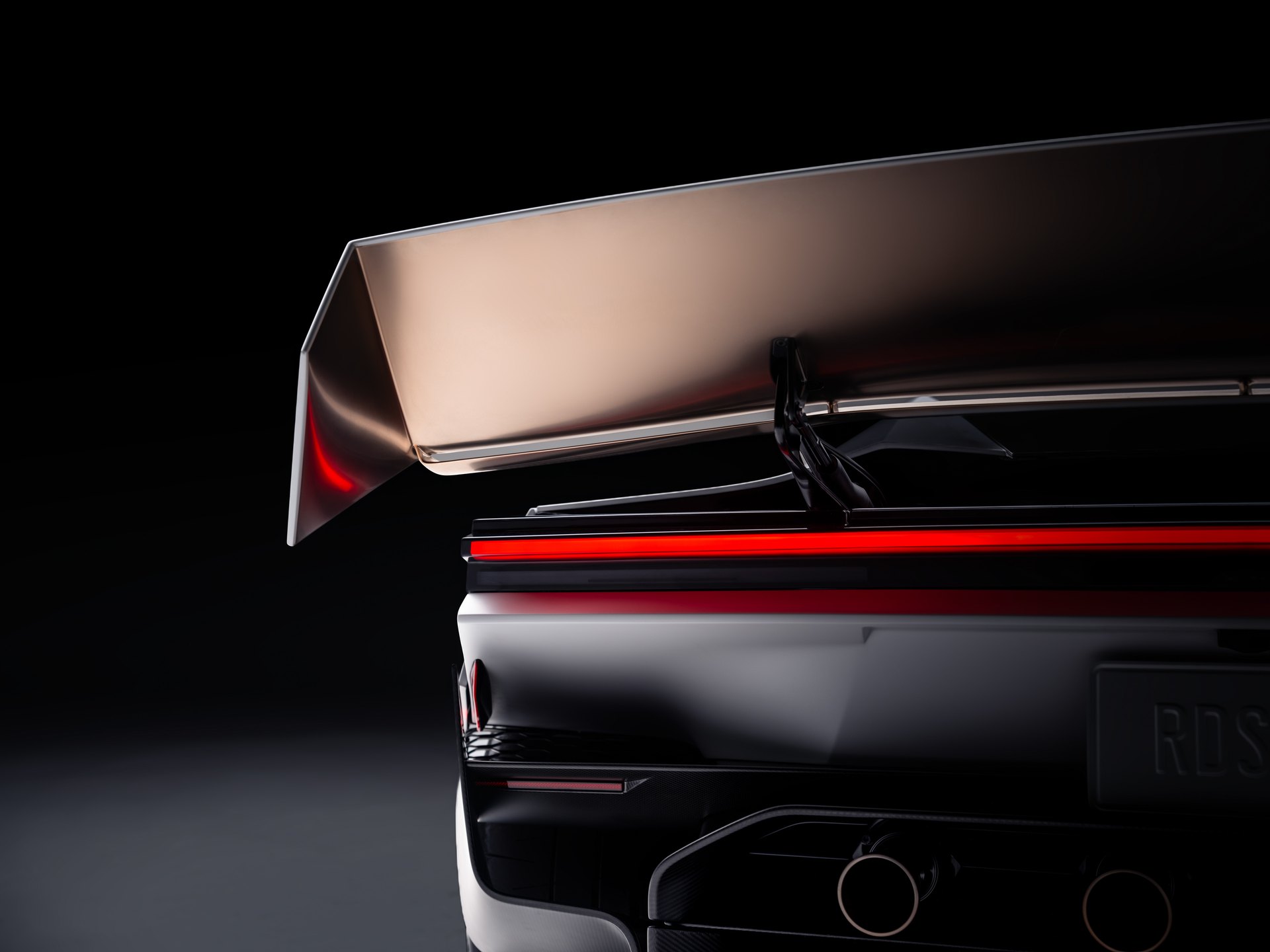
- The rear wing has variable pitch and adjusts automatically based on what the car calculates you need on track. In Track Mode, Tesla says the wing is moved by its Optimus actuator system and the aero delivers “the best passive downforce package of any road car (approaching F1 levels!).”
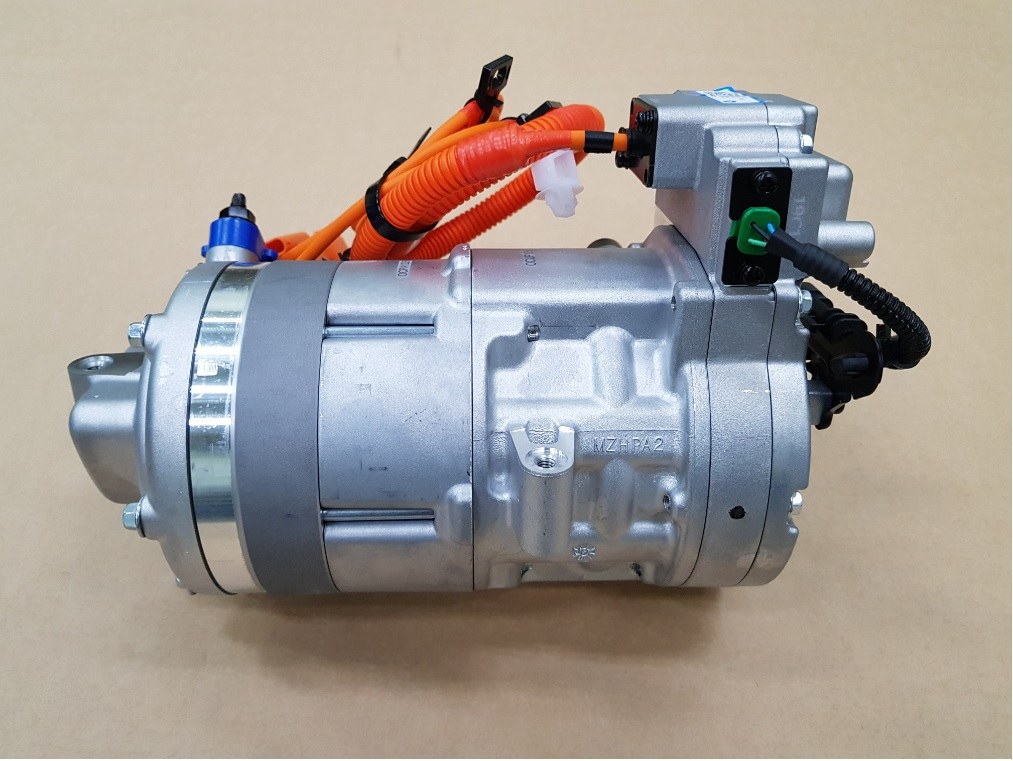
The hardware is simple to count. There are four fans at the back, each good for about 20 kW and based on the high-voltage compressor motor from Tesla’s heat pump, Moravy told Hagerty. In a Model 3, that compressor is an everyday replacement part, listed in Tesla’s parts catalog at $820. Moravy gave MotorTrend more detail: the stock compressor motor runs about 12 kW, and Tesla spins it past 15,000 rpm and has tuned the inverter to aim for 20 kW per fan, about 80 kW for all four (MotorTrend, 03:24). He put the fan downforce at over 2 g, “like 2,500 kilos or something,” and Franz von Holzhausen noted it works at 0 mph, well before the wings do anything. Four independent skirts drop down to seal the underbody, and Hagerty reports they are replaceable wear parts made of rubber with nylon bristles. In sucker mode, Moravy said, the car can hold more than 2 g in a corner between 0 and 50 mph, exactly where wings do almost nothing. Above roughly 200 mph the front and rear skirts open, and the fans pull a high-flow venturi under the car instead. The wings take over from about 50 or 60 mph, and Moravy said they make up to 2 g of downforce above 200 mph, helped by front wings behind the chin spoiler that move up to 80 degrees.
Musk was less formal. “This car could suck the chrome off a trailer hitch,” he said, and the payoff is not just party tricks. “It looks like you’re breaking physics, because the car sticks to the ground so hard.”
How a fan car works
A normal wing makes downforce by bending air, and that only works when the car is moving fast. Downforce from a wing grows with the square of speed, so at walking pace it is close to zero. A fan car takes a different route. It treats the space under the car as a sealed chamber, and fans pump air out of it. The air pressure underneath drops below the air pressure on top, and the atmosphere presses the whole car into the road.
The physics is simple and powerful. Air pressure at sea level is about 101 kilopascals, which works out to roughly 10 tonnes of force on every square meter. A car only needs to pull a small fraction of that out from underneath to create downforce greater than its own weight. Once downforce is bigger than weight, the car can drive on a ceiling, because the pressure difference is doing the holding, not gravity.
The hard part is the seal. If air rushes in around the edges, the fans just move air without lowering the pressure. That is why Tesla describes a ground sealing system and not just fans. Because the fans do not depend on speed, the grip is there in a slow hairpin just as much as on a fast sweeper.
The fan cars that came before
Racing engineers proved the idea decades ago. The Chaparral 2J ran in Can-Am in 1970 with two fans at the back, driven by a separate two-stroke engine, and sliding polycarbonate skirts to seal the underbody. The Chaparral was ruled out at the end of that season. In 1978 the Brabham BT46B won the Swedish Grand Prix with Niki Lauda driving, using an engine-driven fan that Brabham said was there for cooling. Brabham withdrew the car after that single race, and fan cars were outlawed in Formula 1 from 1979.
More recently, the electric McMurtry Spéirling brought the fan car back and set the outright Goodwood Festival of Speed hill climb record in 2022 at 39.08 seconds with Max Chilton driving. In 2025 McMurtry turned it fully upside down on a rotating platform, and it drove forward unsupported, held up by its fan system alone. Electric motors are a natural fit, because a fan can be spun up instantly and controlled precisely without a second engine. The Roadster takes that same idea into a road car Tesla plans to build.
What Tesla said about the thrusters
The Roadster’s other trick comes from rockets. Tesla describes advanced cold-gas thrusters with all-electric actuators that make micro adjustments within a fraction of a second to stabilize the car in flight. Musk said the car has attitude control thrusters and main thrusters in the rear, “so it can basically fly like a rocket.”
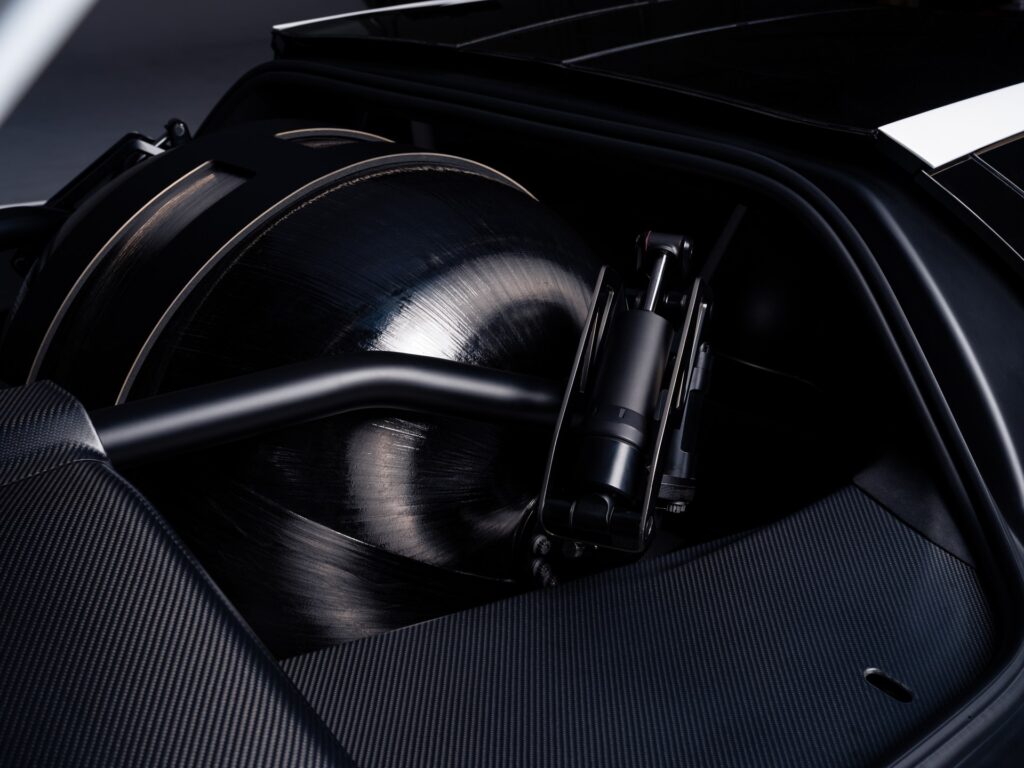
Lars Moravy gave the hardware numbers. In its fullest form the car carries two carbon overwrapped pressure vessels, or COPVs, totaling 600 liters and holding about 250 kilograms of gas, feeding 10 nozzles. In interviews with Top Gear and Hagerty, Moravy broke that down. The Thrust version has one 200 liter COPV in the trunk, rated up to 10,000 psi and feeding four rear nozzles. The Rocket adds a second 400 liter COPV where the passenger seat would be, making it a single seater, plus six more thrusters: one at each corner pointing down and two at the front for yaw.
The gas could be air or nitrogen, depending on which Tesla executive you ask. Moravy said nitrogen, which he pointed out already makes up about 80 percent of the air we breathe. At the reveal, Elon Musk said the Roadster refills its own high-pressure air tank, with no special propellant needed (livestream, 16:58). In an interview filmed before the reveal, Lars Moravy told Top Gear that the 200 liter tank is filled with nitrogen from an outside high-pressure system, taking two to six hours today with a target of under 30 minutes. Franz von Holzhausen gave MotorTrend a similar picture the day before the reveal: “We’re working on the system that allows for filling it up” (MotorTrend, 10:43). The two versions differ, and Tesla hasn’t said yet whether the production car will be self-filling, station-filled or both.
A valve at the end of the COPV is opened by an actuator borrowed from Tesla’s Optimus robot, working through a rocker, and equal-length pipes made of Inconel and titanium carry the gas to the nozzles. Tesla’s Lars Moravy told MotorTrend the two sides have to match closely, since a 10 percent difference would put the car into a spin, so the left and right valves are controlled separately and adjusted in real time (MotorTrend, 13:27). That lets the car stay dead straight or add a little yaw when it needs to turn.
During the 0 to 60 run, a Tesla presenter said the gas leaves the four rear thrusters faster than the speed of sound, creating “over 80 kilonewtons of thrust.” Moravy gave Hagerty the same figure and compared it to a single fighter jet engine. He told MotorTrend it is about the same as a single-engine F-16 before the afterburner, and that he has challenged the team to beat the afterburner next. Tesla rates the thruster system at four to five times the force the tires can. Tesla says the car ran 0 to 60 mph in 0.81 seconds on stage, and it quotes under 0.59 seconds for the Rocket configuration. Moravy told Hagerty that with the suction system, the thrusters and the more than one megawatt powertrain working together, the car can do it in 0.55 seconds, a rollout figure.
A full tank is a single shot. Moravy told Top Gear that one fill lasts about five seconds, spent over the first part of a quarter-mile run. Thrust also tapers as the tank empties. He compared it to letting go of a balloon: the push is strongest at full pressure, which is why Tesla went to 10,000 psi to get more usable thrust out of every fill.
Tesla offers the thrusters in steps. The Thrust configuration pairs the suction system with rear-mounted thrusters. Rocket adds perimeter-mounted thrusters for forward and upward acceleration and for rotating the car.
How a cold-gas thruster works
A cold-gas thruster is the simplest rocket there is. There is no fuel and no fire. Gas is stored at very high pressure, a valve opens, and the gas expands through a shaped nozzle. The nozzle turns pressure into speed, and pushing mass out the back at high speed pushes the car forward. That is Newton’s third law, and Musk referenced Newton too: with a = F/m, more force and less mass means more acceleration.
“Cold” is relative. Moravy told MotorTrend the nitrogen leaves the nozzles below freezing and quickly warms back to ambient, and the only visible plume is a whitish cloud of condensation, which is not toxic (MotorTrend, 14:01).
Spacecraft have used cold-gas thrusters for decades for small, precise movements, because they are reliable, clean and can fire in very short pulses. After stage separation, SpaceX’s Falcon 9 booster pulses nitrogen cold-gas thrusters to flip itself around and control its attitude at the edge of space, before grid fins take over steering in the thicker air. The Roadster uses the same idea with high-pressure gas, so there is nothing to burn, only a tank to refill.
COPVs are what make the stored gas practical. A thin liner wrapped in carbon fiber holds enormous pressure at a fraction of the weight of a steel tank, which matters on a car where every kilogram counts.
Why the exhaust showed Mach diamonds
The bright, repeating bands in the Roadster’s thruster plume are shock diamonds, also called Mach diamonds. They show up when gas leaves a nozzle faster than sound at a pressure different from the surrounding air. The jet overshoots, gets squeezed back by the atmosphere, overshoots again, and each cycle forms a standing shock wave you can see. Musk summed it up: “There are cars, and then there’s one car that has Mach diamonds.”
How the two systems work together
The fans and the thrusters solve different problems. The fans add grip, so the tires can put more of the motors’ power on the road and carry more speed through corners. The thrusters add force that does not depend on the tires at all, for launches, for keeping the car level in the air, and for the flights and the kickflip in Tesla’s reveal footage.
Tesla says the thrusters’ all-electric actuators can correct the car’s attitude in a fraction of a second, which is what keeps it stable in the air. The fans keep it planted once it is back on the ground.
What Tesla has not said yet
Tesla engineers have now filled in most of the gaps: a 10,000 psi tank, four 20 kW fans, a weight target just under 1,700 kg, about five seconds of thrust per fill and a refill time Tesla wants under half an hour. Franz von Holzhausen told MotorTrend the pack is 115 kWh. Top speed is still a moving target: Moravy told Top Gear today’s prototype tops out at 214 mph, and Franz told MotorTrend the base car is around 220 mph, with 330 mph targeted for versions carrying the pressure tank. Musk has since said on X he thinks the Roadster can reach a peak speed of more than Mach 0.5, or “~400 mph” as he put it, above the 330 mph target given earlier. What Tesla has not shared yet is thrust per nozzle, and we will add it as Tesla publishes it. Tesla is targeting production in 2028. For everything else from the night, read our full Roadster reveal recap and the history of the original Roadster. It is a bold bet on old racing ideas, and we are looking forward to seeing it on the road.