
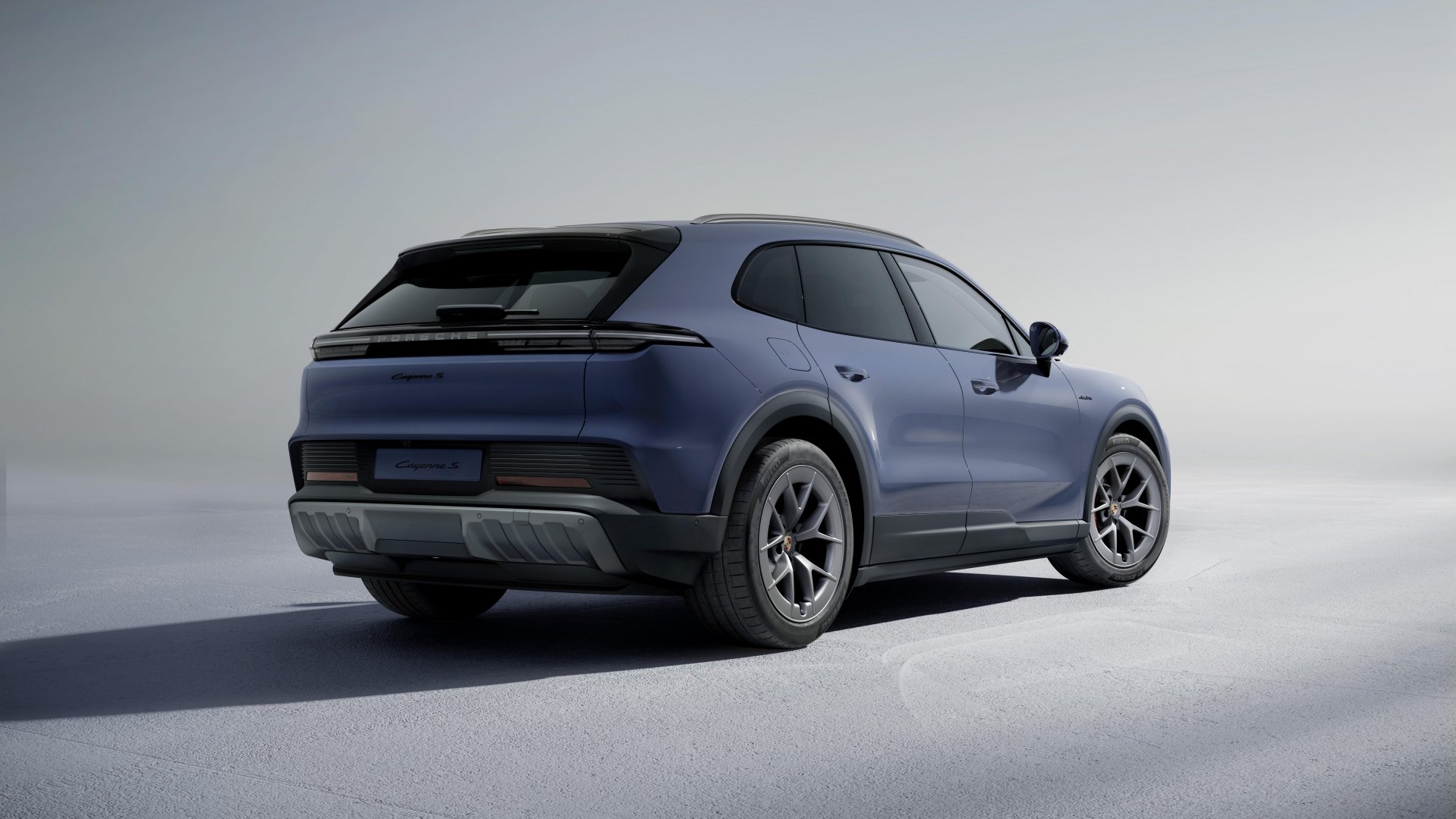
Among the three SUV trims, the longest Cayenne Electric range belongs to the cheapest one. The base Porsche Cayenne Electric starts at $109,000 and carries an EPA estimate of 317 miles, more than either the $126,300 Cayenne S Electric (299 miles) or the $163,000 Cayenne Turbo Electric (298 miles), according to Porsche USA’s range table. All three use the same 113 kWh battery and the same 800-volt charging hardware, so the extra money buys power, not distance.
Customer deliveries began this summer. Porsche says it had handed over 7,002 electric Cayennes worldwide by the end of September, according to its nine-month delivery report.
Range and price for each trim
Every Cayenne Electric has two motors and all-wheel drive. The trims differ in output, wheels and tires, and price. Prices below are Porsche’s US MSRPs before the $2,350 delivery fee. Price per mile of range is our math: MSRP divided by EPA range.
| Trim | MSRP | EPA range | Power (Launch Control) | 0-60 mph | Price per mile of range (EM math) |
|---|---|---|---|---|---|
| Cayenne Electric | $109,000 | 317 mi | 402 hp (435 hp) | 4.5 s | $344 |
| Cayenne S Electric | $126,300 | 299 mi | 536 hp (657 hp) | 3.6 s | $422 |
| Cayenne Turbo Electric | $163,000 | 298 mi | 844 hp (1,139 hp) | 2.4 s | $547 |
The base car’s 317 miles rises to 322 with Porsche’s Range Setup option. The S gains more from that option, climbing from 299 to 325 miles, which puts a Range Setup S ahead of a standard base car on paper. The Turbo gains 5 miles, to 303, on 21-inch all-season tires. The Coupe body is more slippery still: Porsche lists 326 miles for the Cayenne Coupe Electric and 339 with Range Setup.
Price per mile of range is a blunt measure, but the pattern is clear. Going from the base car to the S costs $17,300 and adds 134 hp and almost a second off the 0-60 time. Going to the Turbo costs another $36,700 for a 2.4-second 0-60 run and a 162 mph top speed. Neither step adds range. A buyer who mainly wants a quick, quiet family SUV with the most miles per charge should start with the base model.
How fast it charges in practice
Porsche says the Cayenne Electric charges from 10 to 80 percent in under 16 minutes. Porsche rates the Cayenne Electric for up to 400 kW, but the fine print in the Cayenne S Electric release shows that the 400 kW peak only happens when the charge starts between 45 and 48 percent with the battery at 104 to 107 degrees F. The more useful number is 390 kW, which Porsche lists for a normal 10 to 80 percent session on a charger that can supply more than 850 volts and 520 amps.
MotorTrend reports that about 108 kWh of the 113 kWh battery is usable. By our math, adding 70 percent of that, roughly 76 kWh, in 16 minutes averages about 284 kW across the session. On the base car, that is about 220 EPA miles in a quarter of an hour. Porsche’s separate figure of up to 200 miles in 10 minutes is based on the European WLTP cycle, which runs more generous than EPA ratings, so expect less on a US highway.
Getting near those times takes the right charger and a warm battery. Porsche’s figures assume a station that supplies more than 850 volts, and the Porsche Charging Planner preconditions the pack when you navigate to one with the car’s own navigation. Ask Porsche also warns against stalls that split power between two cars. Our 800-volt charging explainer covers why voltage matters this much.
Tesla Superchargers and the NACS port
The Cayenne Electric is the first Porsche with a NACS (J3400) port built in. It sits on the driver-side rear fender and handles DC fast charging only. A CCS adapter comes standard for other networks. Home AC charging uses a separate J1772 port on the passenger side, so a standard Level 2 wall charger plugs in without an adapter.
Superchargers are slower for this car. Most US Superchargers are older units, and MotorTrend reports the Cayenne charges at about 200 kW on them, roughly half its peak. Only newer stations get close to its full rate. Porsche said in January that its Plug & Charge service, which already works at more than 27,500 Superchargers for the Macan Electric and 2026 Taycan, would come to the Cayenne Electric when it reached the US. With it, you plug in and billing runs through your Porsche Charging Service account, with no app or card needed at the stall.
On road trips, Superchargers give the widest coverage, but the fastest stops come from 800-volt CCS stations.
Charging at home
The standard onboard charger takes 11 kW, which Porsche says fills the battery from empty in about 11 hours. That is enough to refill a typical day’s driving overnight with room to spare. A 19.2 kW onboard charger is optional. By our estimate it cuts a full charge to roughly six hours, but it needs a 100-amp circuit and a wall charger that can deliver 80 amps, which many homes cannot add without a panel upgrade. For most owners the standard 11 kW charger is enough.
Porsche also offers optional inductive charging. A pad on the garage floor charges the car at up to 11 kW, the same rate as the standard plug-in charger, and the suspension lowers the car toward the pad once it is parked. It saves plugging in, not time.
Cayenne Electric or Macan Electric
The Macan Electric costs far less and goes about as far. Porsche’s Macan Electric spec sheet lists the rear-drive Macan at $80,300, and fueleconomy.gov rates it at 309 miles.
| Model | MSRP | EPA range | Price per mile of range (EM math) | 10-80% DC | Towing |
|---|---|---|---|---|---|
| Macan Electric (RWD) | $80,300 | 309 mi | $260 | 21 min | 4,409 lb |
| Macan 4 Electric | $84,000 | 304 mi | $276 | 21 min | 5,512 lb |
| Macan 4S Electric | $89,900 | 290 mi | $310 | 21 min | 5,512 lb |
| Macan Turbo Electric | $112,700 | 293 mi | $385 | 21 min | 5,512 lb |
| Cayenne Electric | $109,000 | 317 mi | $344 | under 16 min | 7,716 lb |
| Cayenne S Electric | $126,300 | 299 mi | $422 | under 16 min | 7,716 lb |
| Cayenne Turbo Electric | $163,000 | 298 mi | $547 | under 16 min | 7,716 lb |
A Macan 4 Electric gives you all-wheel drive and nearly the same range as the base Cayenne for $25,000 less. What the Cayenne adds is room and charging speed. Its wheelbase is 5.1 inches longer than the Macan’s, which shows up in rear legroom, and Porsche lists its cargo area at 19.5 to 56.1 cubic feet plus a 3.2 cubic foot front trunk. The Macan Electric has 18 cubic feet behind the rear seats, 46.5 with them folded, and a 2.9 cubic foot front trunk (less in the Turbo). The Cayenne also tows 7,716 pounds against the Macan’s 5,512, and it saves about five minutes on every 10 to 80 percent fast charge, since the Macan peaks at 270 kW.
The Macan Turbo Electric is the hardest to justify on these numbers. At $112,700 it costs more than a base Cayenne Electric, goes 24 fewer miles, and charges slower. Unless the smaller size is the point, the base Cayenne is the better use of that money.
Battery warranty
Porsche covers the high-voltage battery for 8 years or 100,000 miles. The coverage applies if a dealer capacity test shows the pack below the expected level, and Porsche says it expects most packs to keep 70 percent of their original capacity over that period. Losses tend to be steepest in the first years and slow down after that.
Which Cayenne Electric to buy
For range, charging and value, the base Cayenne Electric is the right choice for most buyers. It goes the farthest of the three SUV trims, charges just as fast, tows the same 7,716 pounds, and still runs 0-60 in 4.5 seconds. The S makes sense if you want noticeably more power and add Range Setup to recover the lost miles. The Turbo is a performance car first, priced accordingly. If you do not need the Cayenne’s space or towing, a Macan 4 Electric covers about the same distance for $25,000 less. Porsche’s next new electric model, the 718 Boxster and Cayman, is a two-seat sports car with 2028 as its first full production year. For a family that needs space and towing, the Cayenne Electric is the electric Porsche to shop.