
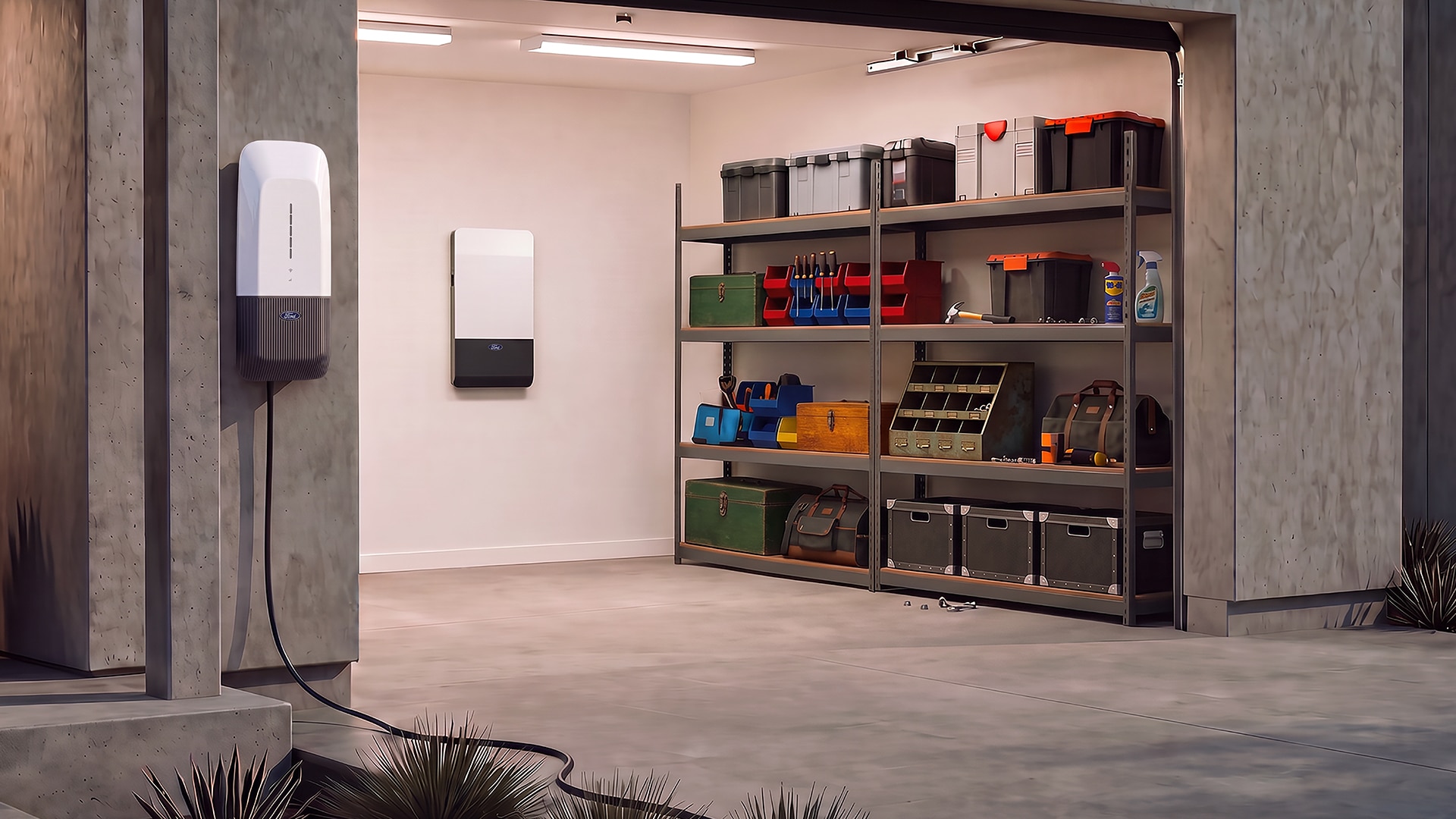
Ford said today that the Fathom, its $28,350 electric pickup due in 2027, is designed to send over a projected 10 kW of AC power to a house without a wall-mounted inverter. The inverter is built into the truck’s E-box, one of the five main modules on Ford’s Universal EV Platform. Because the expensive power conversion now rides in the truck, Ford says the home equipment will cost much less than what F-150 Lightning owners bought.
Ford has not set final prices. It has given percentage targets instead, and those are enough to see roughly what a Fathom owner will spend compared with a Lightning owner.
What the Lightning needed
A Lightning stores DC power in its battery, and a house runs on AC. The Lightning’s home backup system did the conversion on the wall. Owners needed the 80-amp Ford Charge Station Pro plus a Home Integration System installed by Sunrun, which disconnected the house from the grid during an outage and fed it from the truck. Ford’s support page lists both parts as required, and notes the Charge Station Pro is no longer for sale.
MotorTrend puts that original package at $1,310 for the Charge Station Pro and $3,895 for the Home Integration System, or $5,205 before installation.
What the Fathom changes
Ford built the Fathom’s bidirectional system with Auto Motive Power, a startup it bought in 2023. The truck converts its own battery power to household AC, so the box on the garage wall no longer has to. Ford says the system is designed to meet UL 1741 and IEEE 1547, the safety and grid connection standards utilities already use for solar and home batteries, and it uses SAE J3068 communication between the truck and the charger, per Electrek.
Fathom owners get two levels of home power, and each needs different hardware:
- Home Power Management charges the truck when power is cheap and runs the house from the battery when rates are high, with the grid still on. It needs the new Ford Home Power Station.
- Home Backup Power runs the house during an outage. It needs the Home Power Station plus the new Ford Home Backup Power Panel.
Ford’s Fathom page describes both uses and says a properly equipped home is required.
What the gear should cost
Ford expects the Home Power Station to cost about half as much as the Charge Station Pro, and the station plus the Home Backup Power Panel to cost at least 60% less than the first-generation backup hardware. Applied to the Lightning-era prices, that works out to roughly $650 for the station and about $2,100 or less for full backup. Those are our numbers from Ford’s percentages, not Ford prices.
| Setup | What it does | Home hardware | Hardware cost before install |
|---|---|---|---|
| F-150 Lightning backup | Outage backup, later grid-parallel | Charge Station Pro + Sunrun Home Integration System | $5,205 ($1,310 + $3,895) |
| Fathom Home Power Management | Shift home use to cheap off-peak power | Ford Home Power Station | About $650 (target, about half of $1,310) |
| Fathom Home Backup Power | Outage backup | Home Power Station + Home Backup Power Panel | About $2,100 or less (target, at least 60% below $5,205) |
Some early coverage used a 40%-off figure for the backup bundle, which conflicts with Ford’s target of at least 60% off, so we’re using Ford’s percentage. Axios, citing Ford, also puts the new hardware at roughly $2,100.
Ford estimates that owners using Home Power Management could save $30 to $60 a month, according to Axios. That depends on a time-of-use rate with a real gap between peak and off-peak prices. On a flat rate, the station mostly works as a charger.
What you still pay for
None of these targets include installation, and installation is where home backup gets expensive. A backup panel means an electrician, a permit in most places, heavy-gauge wiring between the panel and the station, and sometimes a service or panel upgrade, as The Verge points out. Those costs vary a lot by house and region, and they can match or beat the hardware price.
There is also the utility. The more than 3,000 utilities in the U.S. and Canada each have their own interconnection rules, most written for solar panels and home batteries rather than trucks. Dave McCreadie, Ford’s director of grid and energy services, told Canary Media that only California and Maryland have rules for AC bidirectional charging outside pilot programs.
The utility working group
Ford said it has been working since July with five utilities: American Electric Power, BC Hydro, Consumers Energy, Exelon, and Pacific Gas and Electric. The group’s goal is a lighter approval process for owners who only use the truck for outage backup, kept separate from owners who send power to the grid, along with common rules for newer bidirectional standards and for joining virtual power plant programs.
Grid export has been a hard sell so far. PG&E told Axios its vehicle-to-grid pilot has fewer than 70 enrolled customers. Backup during an outage is the easier pitch, and it’s the use Ford is trying to make cheap first.
What to plan for
If you’re on Ford’s preorder list and want backup power, budget for the Home Power Station and Home Backup Power Panel plus a licensed electrician, and call your utility early about interconnection rules. If you only want bill savings, the Home Power Station alone should be a much smaller buy, and it is only worth it on a time-of-use plan.
We covered the truck itself and the Universal EV Platform in our Fathom explainer. Today’s news is the cheaper half of the equation. Final prices for the station and panel, and real installation quotes, will decide whether Fathom home backup costs far less than the Lightning’s did.