
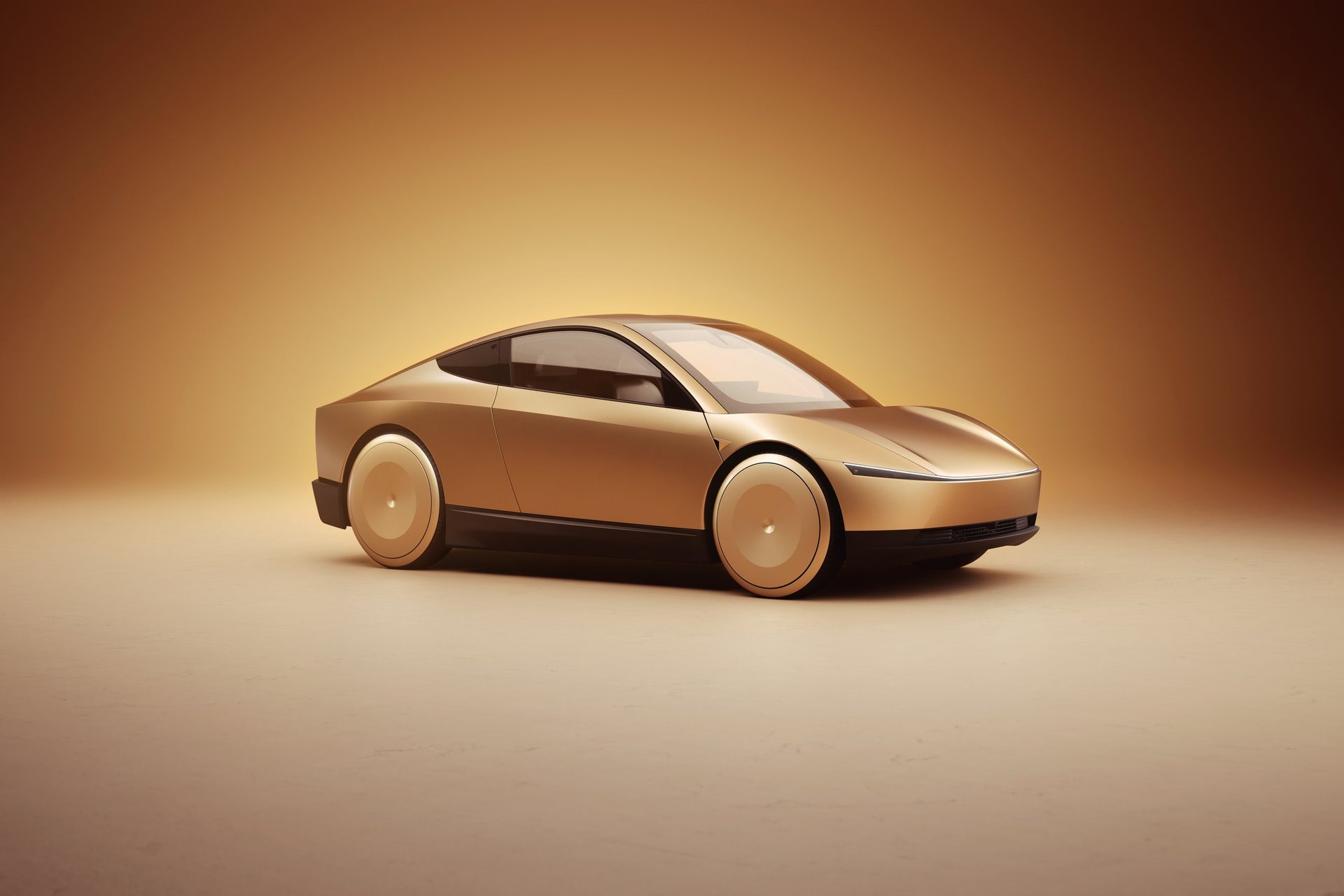
Munro Live has posted a walk through Tesla’s Cybercab factory line with Lars Moravy, Tesla’s vice president of vehicle engineering, and engineers from his team. It covers how the car is built in separate modules, the battery pack, the drive unit, the thermal system, and the plastics shop that replaces painting.
Final assembly, where the modules come together, is about 25 stations and fully automated, Tesla’s team said on the stream. Munro’s host guessed a Model Y final line is five to ten times that, and Tesla said it depends on the plant. Across the whole line, the team put automation at about 78% today.
How the unboxed build works
Tesla calls the process unboxed. The team said the idea started five or six years ago, when it kept adding automation and found that “the problem wasn’t the automation, the problem was the design.” Smaller modules let robots reach parts from several sides. On the front module line, the pitch between stations is about 2 meters. Tesla says the layout uses about 50% less floor space per car built, and that cut was a target from the start.
1. Split the car into modules
The car is split into a front, rear, two sides, a center (the battery pack with the seats on it), and a top. Each module is built and tested on its own line, then the modules are joined at the end.
2. Build the front module
The front module holds about half the car’s parts. That includes the 48-volt low-voltage battery, the drive unit, and the thermal module. It arrives at final assembly already tested with its computers connected. Splitting the car also forced a brake-by-wire system, Tesla’s first. With no hydraulic lines running between modules, the front and rear brakes are tested separately. The front suspension is a strut, with the kingpin moved ahead of the wheel center to fit under the low hood.
3. Build the sides flat
The side modules use a single-piece inner and single-piece outer boron steel door ring, sandwiched together to protect the cabin and battery in a side crash. They are built flat on a bench, which the team said helps both workers and robots. The framing line is 100% automated, including parts delivery by mobile robots.
4. Lower the body onto the drivetrain
The drive unit, suspension, and thermal system sit on a pallet, and the body is lowered onto them, the reverse of how most plants install a subframe.
5. Put the wheels on last
Wheels go on at the second-to-last station, so the first time a Cybercab sits on its own wheels is when it leaves the line. Tesla also said the line can currently build faster than the company is deploying cars, so it does not run every day.
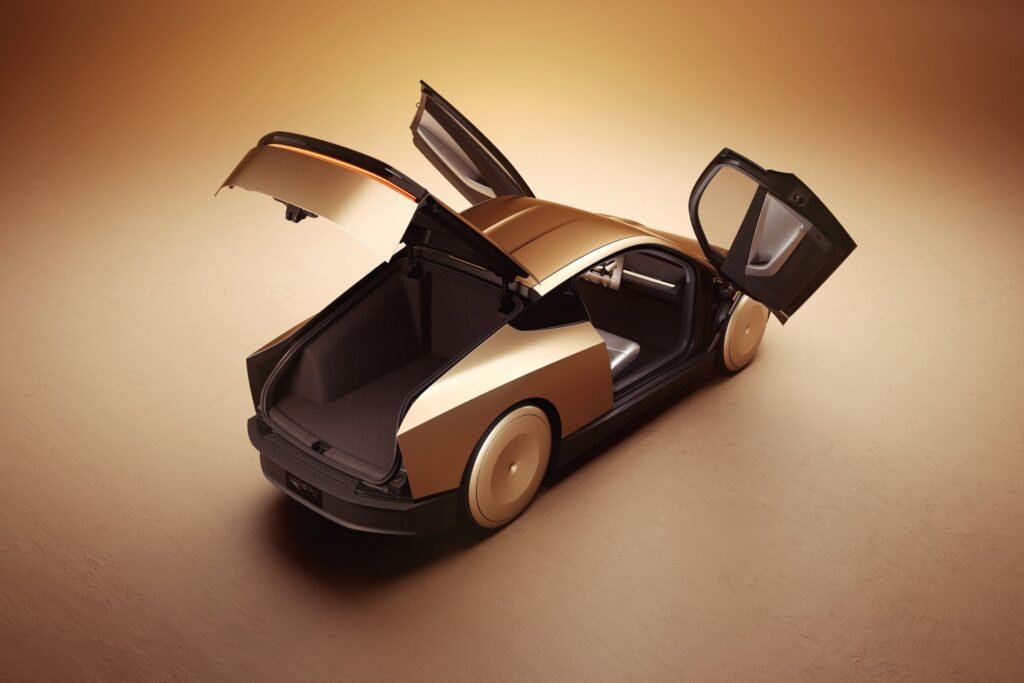
Asked why the Cybercab uses butterfly doors, which cost more to service, the team said there was no technical reason: “it’s cool.” It did list side benefits. The seat sits at the same height as a standard wheelchair, the lower part of the door swings out first to leave room for your feet, and the open door gives a little rain cover.
No paint shop
Only the side modules are e-coated. The front and rear modules are not. Tesla said its casting alloys do not lose strength from oxidation the way other aluminum does, and the team chose sheet alloys and joining methods to match.
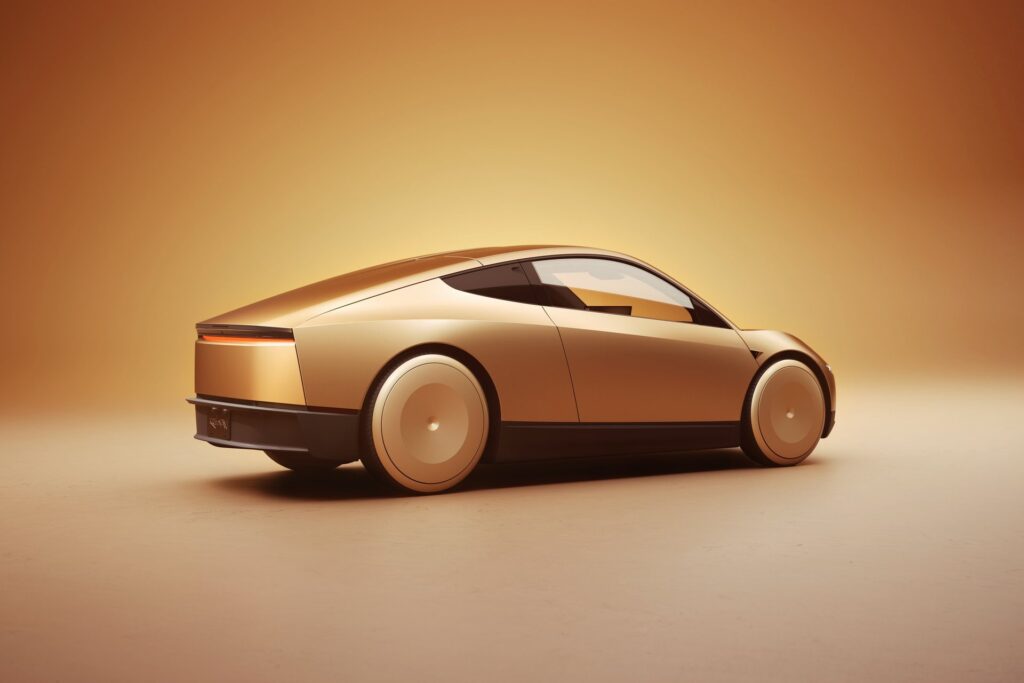
Body color comes from the plastics shop. “This is our paint shop,” Tesla’s head of plastics said. Panels are made by reaction injection molding, with color mixed in at the mix head just before injection. Robots trim the overflow that keeps sink marks and flow lines off the Class A surface. Tesla said scratches can be repaired like normal paint. It also tried in-mold lamination, now used on the Semi, and a painted film on stamped panels.
Without a paint shop, unboxed panels do not have to be reassembled into a body just to go through the ovens.
Battery pack
The pack uses 4680 cells in what Tesla’s battery team called an 88S6P layout, with room for a few more cells and space under the modules for LFP later. The pack top cover is the cabin floor, and the seat crossmembers are welded to it. The enclosure is steel, a first for the program. The team put steel at about $1.90 per kilogram, against $5 to $8 for the material it would otherwise use, and said the cost still wins after the extra mass. It added that it is “still learning” whether steel was the right call.
Tesla calls this pack semi-structural. Potting is done per module, not across the whole pack, so a failed module can be replaced instead of the pack. The battery team graded its own work: Model Y’s structural pack got a D, Cybertruck a B-minus, and Cybercab an A-minus. A structural pack can fit about 10% more cells, the team said, but it loses on service cost, because a failed module here can be swapped instead of scrapping the pack.
Other changes:
- Wireless communication between the battery management boards, deleting the internal harness
- No pyro fuse; the contactors can open under load and keep working (Tesla has filed a patent application)
- High-voltage blind-mate connectors, checked by insertion force and distance instead of a visual click
- Pack electronics service from below, because field data shows cells fail less often than the electronics
Drive unit and thermal
The Cybercab is front-wheel drive. Because it does not need a high top speed, Tesla’s drive unit team said it went to an 11:1 gear ratio, against roughly 9:1 in most of its cars. Stator cooling channels moved from the electrical steel into the cheaper die-cast aluminum housing, and the electric oil pump Tesla uses elsewhere was replaced with a mechanical one. The inverter’s circuit board works at 12 or 48 volts. The team also said an in-house lubricant change later this year cuts gear mesh losses by 7%.
Every part on the new inverter board is designed to be dual-sourced, with empty pads left for a second supplier’s part, because AI demand has made chips harder to get. The team said the same power stage will ship in other Tesla models this year, and that it could drop straight into a Model Y drive unit. By Munro’s own rough math, a Chevy Bolt motor and gear ratio in this car would cost 30 to 40 miles of range.
The inverter also powers the thermal system through a small junction box, so no separate high-voltage line runs from the pack. The thermal module, Tesla’s third-generation heat pump, moves most of its complexity to the coolant side. The compressor bolts straight to the refrigerant manifold with no refrigerant hoses. The module is built, filled, and leak-tested before it goes in the car, and the drive inverter can be serviced from above once the thermal module is lifted out. In the cold, heat from the drive unit still goes to the battery. “We’re very greedy with all heat,” the thermal team said.
Those choices feed the efficiency numbers we covered in how efficient the Cybercab is.
Charging: a plug for now, Optimus next
The Cybercab still has a charge port, and Tesla’s team said that was on purpose. Tesla already has a huge charging network, switching it to a new automated system takes time, and the cab has to use what exists today. Asked about charging, the team said, “Hopefully, Optimus will help us with that shortly.” For now, Tesla staff plug robotaxis in by hand at Superchargers, Not a Tesla App reported.
Optimus is the stopgap, not the end state. The team said Tesla is working on more automated charging as it adds sites, and that the cab is already built for it. That step would mean not needing “a human or Optimus to plug it in.” Tesla did not say “wireless” on camera, but it has an FCC waiver for a radio system that lines a Cybercab up over a wireless charging pad, and Austin city filings describe a later phase with 80 wireless chargers at a planned robotaxi hub, EVwire reported. Tesla gave no date for Optimus or for wireless.
Charging speed is also a cost lever. The battery team said the faster a cab charges, the more time it spends carrying riders and the fewer charging posts Tesla has to build.
Is wireless charging less efficient?
Usually yes, by a few points, and by more if the car parks off-center. The SAE J2954 standard for wireless EV charging only requires 85% efficiency from the grid to the battery with the coils lined up, and 80% at the edge of its allowed misalignment (about 75 mm front to back and 100 mm side to side). When Idaho National Laboratory tested eight systems built to that standard, it measured about 80% to 93%, with most runs above 89%.
Wired charging measured the same way does better. INL put a Chevy Volt on Level 2 at about 91% from the grid to the battery. ADAC’s tests this year found 5% to 7% lost on a 22 kW wallbox, and DC fast charging losses as low as 1% to 4% with a warm battery, higher when the pack has to be heated or cooled. The Cybercab reportedly has no onboard AC charger, so for this car the real comparison is wireless against a Supercharger, where wired has the clearer edge.
Tesla said in 2024 that its Cybercab wireless system is “well above 90%” efficient, and Oak Ridge National Laboratory has shown more than 95% at 270 kW on a Porsche Taycan in a lab. Neither number comes from independent testing of a working robotaxi fleet. Alignment is the swing factor, which is why Tesla’s system uses that radio positioning to park the car over the pad. For a fleet, every lost point is paid on every kWh, every day, so a gap that barely matters at home adds up fast.
Built for 500,000 miles
The team said the Cybercab is designed to run at least half a million miles, and that replacing a pack before then would hurt its cost per mile. That explains the serviceable pack, the top-access inverter, and the coolant-side thermal system. When Munro asked to buy one for a teardown, the answer was not yet. For now, see whether you can buy a Tesla Cybercab. The team also said the car was engineered to one mass target, with no group adding its own 20% safety margin, and that a part should fail between 95% and 100% of its spec.