
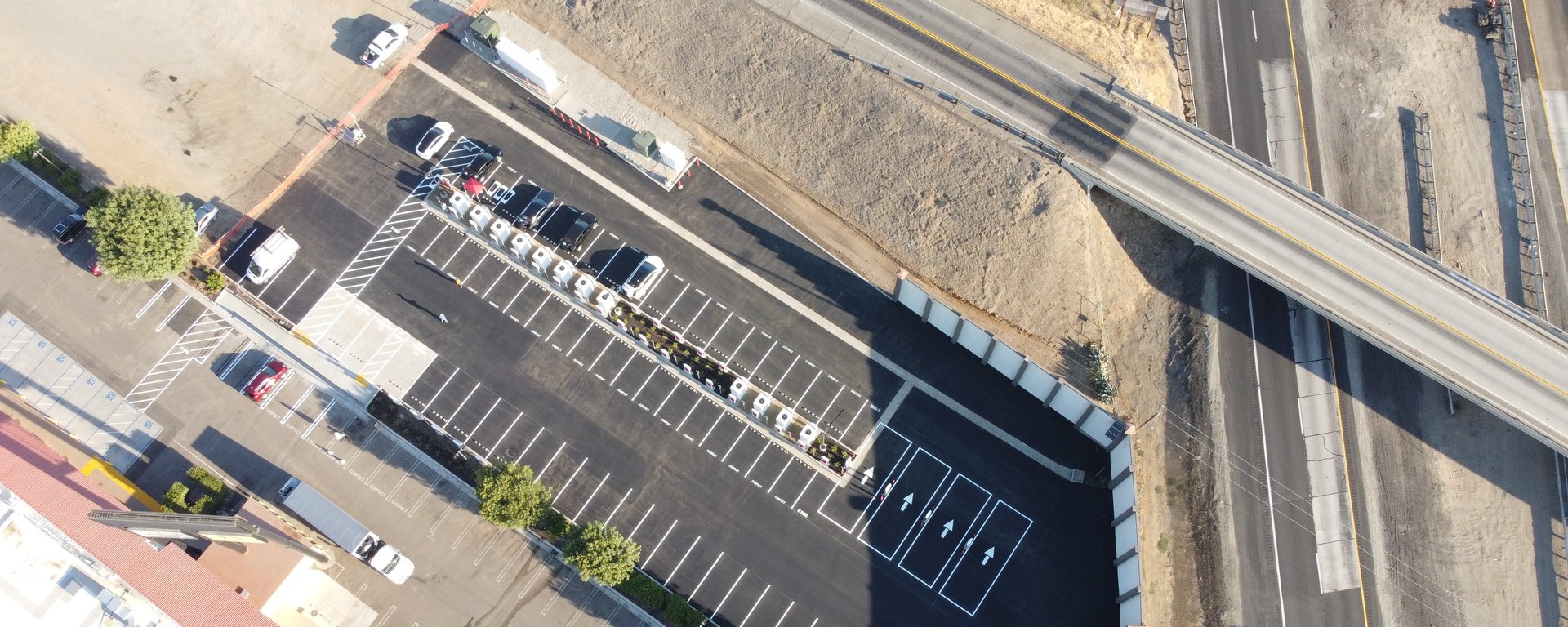
Tesla flexible grid connections are Tesla’s answer to the slowest part of building a Supercharger, which isn’t the chargers at all. In an article posted on October 12, Tesla Charging explained how it is working with Pacific Gas and Electric (PG&E) to open new sites on the grid’s spare capacity while the utility finishes its upgrades. Tesla says a typical project should be able to open more than two years sooner.
The real bottleneck is the grid, not the chargers
Tesla has gotten very fast at building Superchargers. It has iterated on the hardware, the construction and the permitting process to put more stalls in the ground in less time. But as Tesla puts it, there is one bottleneck faster construction can’t solve: grid capacity.
Anyone who has followed a fast charging project knows the pattern: the construction takes weeks, and then everything waits on the utility. A large DC fast charging site needs a big new service connection, and before a utility will commit to delivering that much power at full load, it has to study the local feeder and substation and often upgrade transformers or lines. That work sits in an interconnection queue with every other large project, and it can take years.
The problem gets worse as charging power climbs. Tesla specifically calls out megawatt-scale charging for the Semi, and says Megacharger projects in Southern California can wait more than three years in the utility queue for power. Our recent look at Tesla’s Megacharger site in Georgia shows how much power these truck sites need, and why getting them energized is a bigger job than building them.
How a flexible connection works
The key idea is simple. The grid is built for its busiest hours, so most of the time it has room to spare. A traditional interconnection asks the utility to guarantee full power at every hour of the year, including the worst summer afternoon. A flexible connection doesn’t. It lets a new Supercharger use the capacity that is already there today, with the understanding that the site will pull back when the local grid is tight.
Tesla describes it in three parts:
- Open now, upgrade later. Drivers can start charging while the utility completes its multi-year grid upgrades.
- Full power when there’s room. When the grid isn’t constrained, the site runs at full power.
- Reduced power when it’s tight. When the local grid is constrained, the site can be de-rated.
That last part sounds like a compromise, but in practice it rarely bites. Tesla notes that sites typically run well below their maximum, especially early on after a new opening, so drivers shouldn’t notice. A brand new site with modest traffic seldom needs every stall pulling full power at once, which is exactly why holding it closed for years waiting on full-power service makes so little sense.
PG&E Flex Connect and IEEE 2030.5
Tesla has been doing this through PG&E’s Flex Connect program. It says the approach has already accelerated some existing Supercharger projects, with dozens more underway. Drivers get Superchargers sooner, and the utility gets more use out of the grid it already has.
This month the setup got more automated. Tesla’s V4 Supercharger cabinets can now talk directly to PG&E’s systems using IEEE 2030.5, an open standard for communication between utilities and equipment like chargers, inverters and batteries. With that link in place, PG&E can set a site’s power limit from day-ahead forecasts instead of relying on fixed, conservative caps. Several pilot sites are scheduled to open this October, followed by a wider rollout across Northern California.
That standards piece matters more than it might seem. A flexible connection is only as good as the conversation between the site and the utility. If the utility can tell a charger tomorrow’s limit ahead of time and trust it to follow, it can safely hand out more of its spare capacity. An open standard means any utility that supports it can do the same thing.
What Tesla is asking utilities to do
Tesla closed the article with a short set of principles for utilities. First, make the path to full service clear by sharing how much capacity is available and when upgrades should be done, because Supercharger use does grow over time. Tesla calls a flexible connection a bridge, not a permanent solution. Second, start now and improve as you go. Utilities without advanced grid monitoring could begin with simple fixed seasonal limits and refine from there. Third, standardize communications. Tesla says IEEE 2030.5 should be the protocol between utility systems and on-site charging equipment, and it’s the one Tesla recommends to utilities around the world.
Why this is a good move
This is one of the more practical charging ideas we’ve seen in a while. It just treats grid capacity the way it actually behaves, which is plentiful most hours and tight a few, and lets chargers follow along. Utilities get paying load on assets they already own, and drivers get stalls years earlier in the places that have been waiting longest.
It also isn’t Tesla-only in principle. Any operator whose hardware speaks IEEE 2030.5 could use the same approach, which is good news for everyone driving an EV, whatever the badge. If more utilities follow PG&E’s lead, the wait for new fast charging could shrink from years to months.
For range, charging and specs on every Tesla model, check out the Tesla page in the Electron Motion EV Database.