
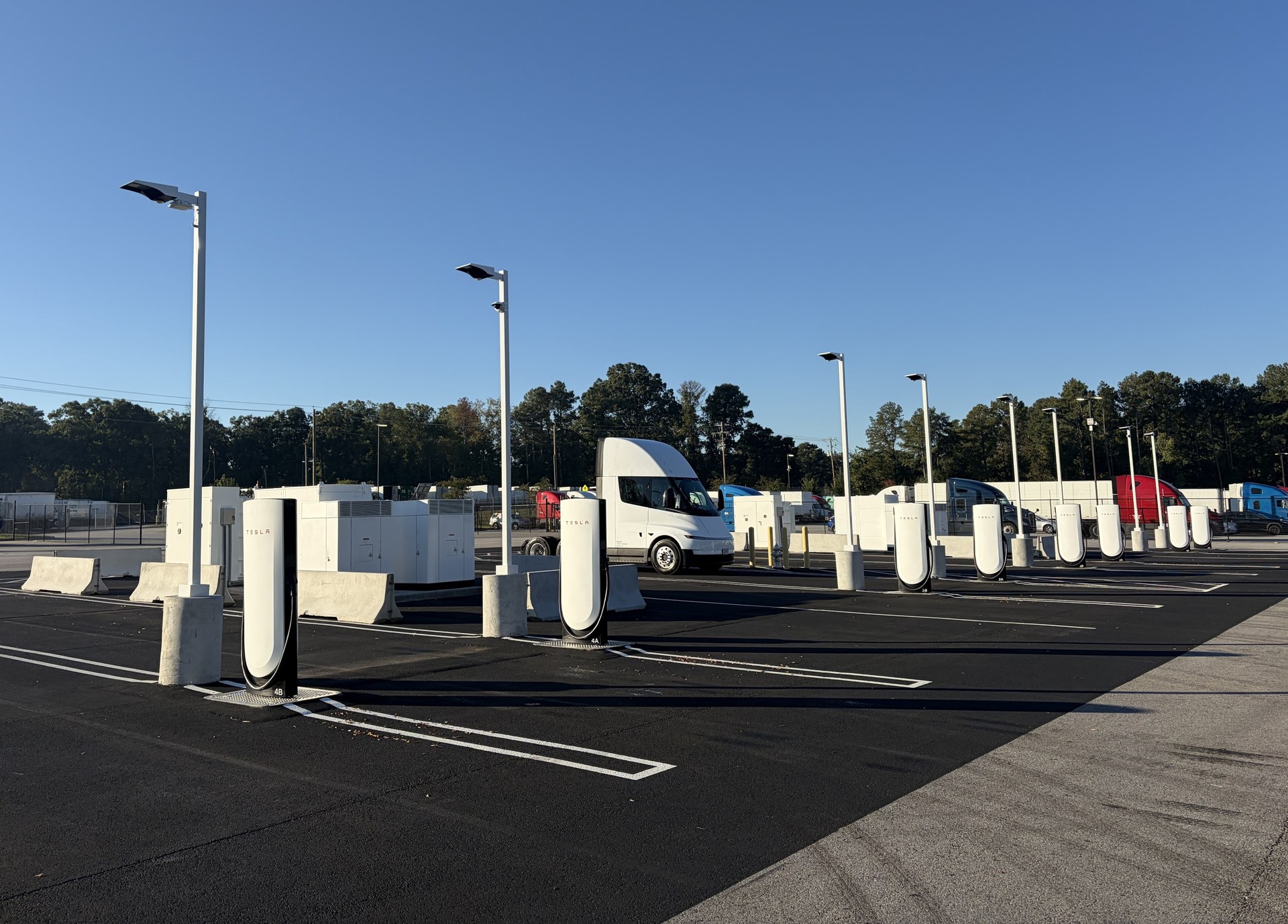
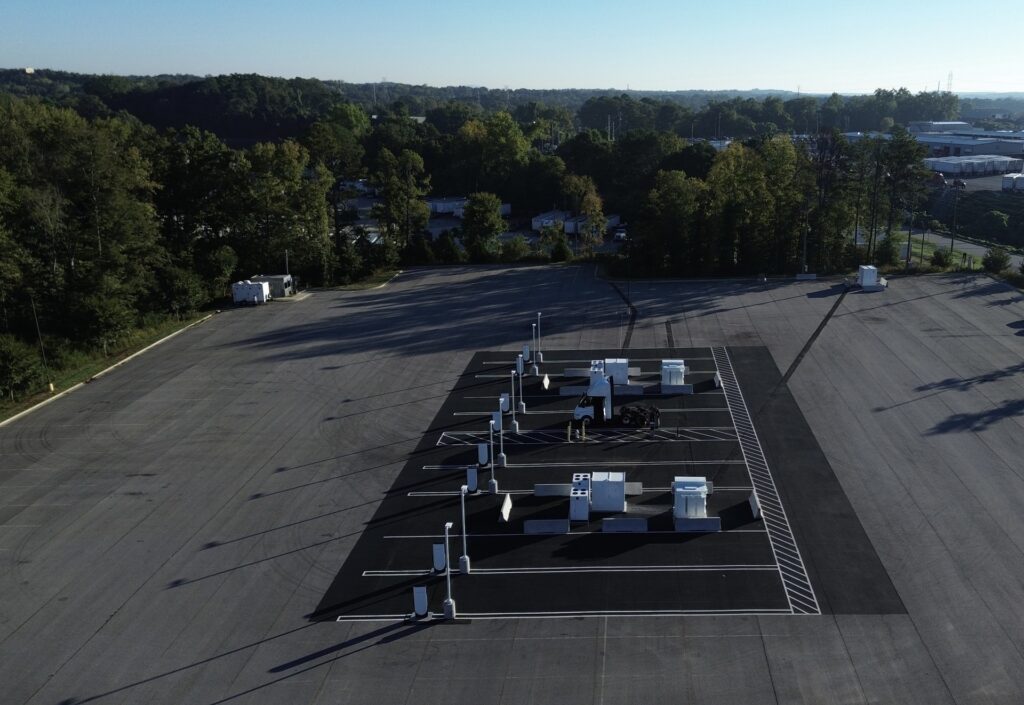
The first Tesla Megacharger on the East Coast is open, an eight-stall site for the Semi in Conley, Georgia, on the southeast edge of Atlanta. Tesla’s charging team posted the new location on Wednesday evening, and the Tesla Semi account followed with a simple line: “First Megacharger on the East Coast.”
What opened in Georgia
Megachargers are Tesla’s charging stations for the Semi, its electric Class 8 truck. Tesla rates them at up to 1.2 megawatts (1,200 kW) per post and says a Semi can recover about 60 percent of its range in 30 minutes. Tesla’s newest hardware comes as a pre-assembled V4 cabinet that feeds two posts, which Tesla says lowers the cost of deploying them.
Until now, the Megacharger openings Tesla has announced this year were in Southern California, including six-stall sites in Bloomington and Vernon. Conley is the first one Tesla has put on the other side of the country, and at eight stalls it’s bigger than those two.
Why the timing matters
The site opened two weeks after Tesla launched high-volume Semi production at its Nevada truck plant on September 24. A few days before that, Tesla said a new shippers’ alliance called ZET SCALE had picked it as the main supplier for 2,500 Semis, an order Tesla says will double the entire U.S. fleet of electric Class 8 trucks.
Trucks without chargers are a hard sell, and fleets don’t buy on promises. An electric semi only works for a carrier if it can be refueled where the freight actually moves, and for years the Semi’s charging story lived almost entirely in California. A working site in Georgia is the first real sign that the network is following the trucks.
The freight math, from Atlanta
Atlanta is one of the busiest freight crossroads in the Southeast, where several major interstates meet. Using Tesla’s numbers, a Semi rated at up to 500 miles could take back as much as 300 miles in a 30-minute session. That’s a best case for a truck that arrives low, and real range moves with load, terrain, and weather. Even so, it’s enough on paper for a run from Atlanta to the Port of Savannah, about 250 miles away, with room to spare.
The 30 minutes is the clever part. Federal hours-of-service rules already require truck drivers to take a 30-minute break after 8 cumulative hours behind the wheel. If the charge fits inside a break the driver has to take anyway, the Semi stops losing time to charging, and that’s where electric trucking starts to make sense for a fleet manager instead of just a sustainability report.
Tesla also says the Semi uses about 1.7 kWh per mile and claims a comparable diesel truck uses roughly three times as much energy. Fleets that want their own charging can buy the 1.2 MW Megacharger or a slower 125 kW Basecharger for depots, which matters because plenty of trucks start and end each day at the same yard.

What to watch
One site doesn’t make a network. The test now is how quickly Tesla fills the gap between California and Georgia, and whether more East Coast sites follow along the corridors fleets actually run. Tesla’s cars already sell at scale, as our Q3 2026 deliveries report shows, and the Semi is the next part of the company that has to prove it can do the same.
For drivers of Tesla’s cars, nothing changes at the Supercharger. Megachargers are built for the Semi, so your Supercharger stops stay the same. For the trucking industry, a Megacharger outside Atlanta is the moment the Semi stopped being a West Coast story.
FAQ
Where is Tesla’s first East Coast Megacharger?
In Conley, Georgia, just outside Atlanta. It has eight charging stalls for the Tesla Semi.
How fast does a Tesla Megacharger charge?
Tesla rates the Megacharger at up to 1.2 MW and says it can recover about 60 percent of a Semi’s range in 30 minutes.
Can Tesla cars use a Megacharger?
Megachargers are built for the Tesla Semi. Tesla’s cars keep using Superchargers.
How far can a Tesla Semi go on a charge?
Tesla says the Semi offers up to 500 miles of range.