
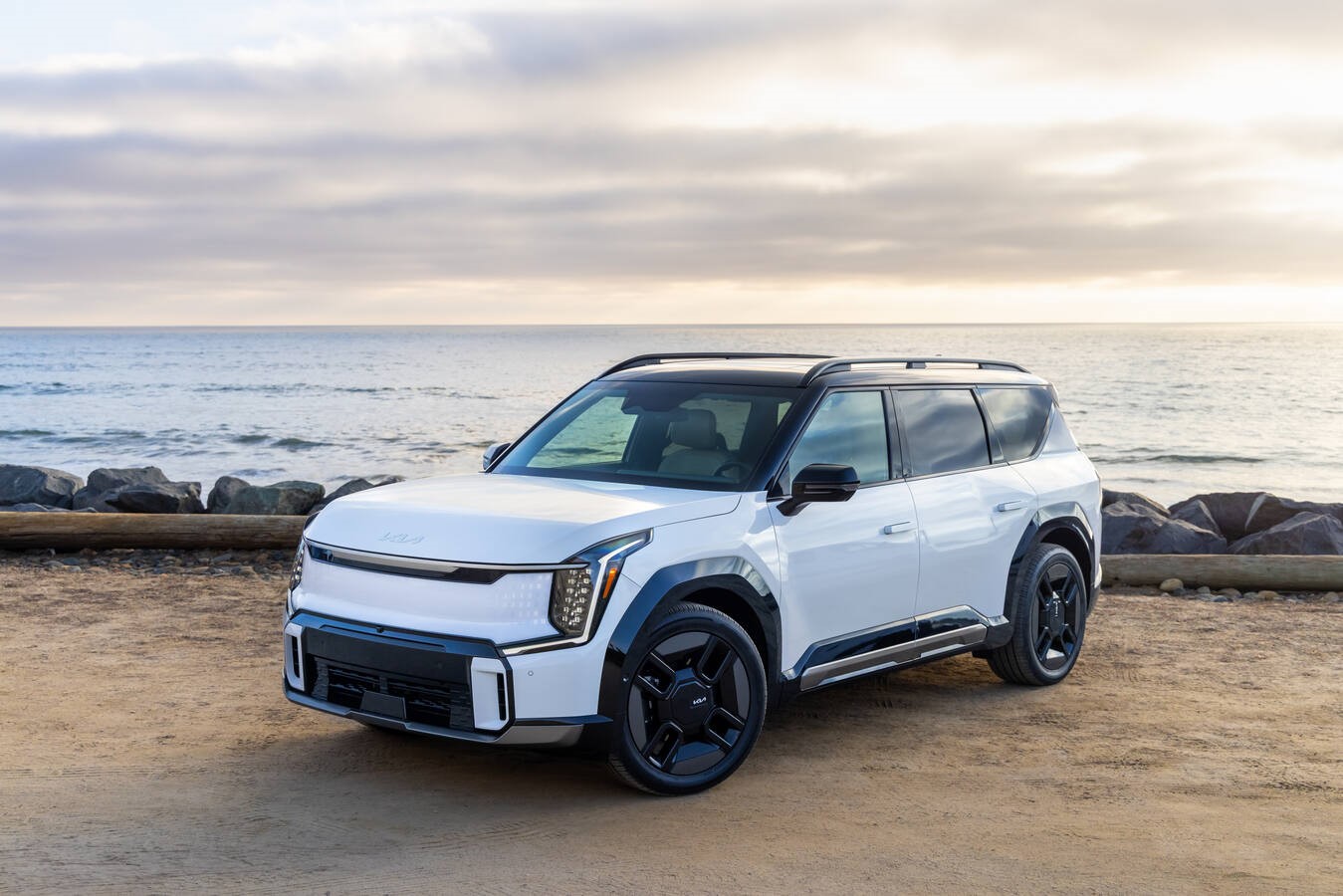
Hyundai and Kia both closed the third quarter with the best U.S. sales totals in their histories. The battery-electric models inside those totals went the other way. The split is in the model tables the companies released on October 1, not in the headlines.
Hyundai Motor America reported September sales of 77,439 vehicles, up 9% from 71,003 a year earlier, and a third-quarter total of 246,896, up 3% from 239,069. Through September, Hyundai had sold 697,464 vehicles, up 3%. Randy Parker, president and CEO of Hyundai Motor North America, pointed at SUVs, sedans, and hybrids. "Hybrid sales climbed 39% and represented 28% of September volume, while Tucson, Palisade, Sonata and Santa Fe all posted double-digit gains," he said.
The Ioniq rows on the same table are the electric-vehicle count.
The Ioniq 5, still Hyundai's volume EV, sold 2,928 vehicles in September, down 65% from 8,408. For the quarter it sold 10,382, down 53% from 21,999. Year to date it has sold 31,112, down 24% from 41,091. The quarter fell by about half. The nine-month figure fell by about a quarter, which means the earlier part of 2026 was not this weak. September was the soft month inside an already softer quarter.
The Ioniq 6 is close to gone from the sheet. Hyundai lists September as down 100% from 814 sales a year earlier, and the quarter at 107 vehicles, down 96% from 2,810. Year to date the sedan is at 1,348, down 85% from 9,132. A model that was a real second EV for Hyundai last summer is now a rounding error next to the Ioniq 5.
The Ioniq 9, the three-row, fell in the latest month and quarter and is still ahead for the year. September sales were 374, down 65% from 1,075. The quarter was 1,663, down 47% from 3,164. Year to date the Ioniq 9 is at 6,521, up 56% from 4,177. That year-to-date gain is against a 2025 period when the model was still ramping onto the market. It is not evidence that third-quarter demand improved.
Add the three Ioniq nameplates for the quarter and Hyundai sold about 12,150 dedicated Ioniq vehicles, against about 28,000 a year earlier. Hyundai does not print that subtotal. It is the sum of the three rows. The Kona line is not included, because the release does not separate the electric Kona from the gas Kona.
Hybrids are the record Hyundai is actually describing
Hyundai says its hybrid lineup set a September record, up 39%, and made up 28% of September volume. Third-quarter hybrid sales were also a record, up 35%. The Santa Fe hybrid and the Sonata hybrid set September records. Sonata Hybrid sales more than doubled in the quarter, and the Santa Fe Hybrid had its best quarter. Those are the powertrains Parker is talking about when he describes the quarter as a record. The Ioniq table is a different paragraph.
Kia's record has the same shape
Kia America, in a release the same morning, reported September sales of 77,009, up 18%, and a third quarter of 236,659, up 8%. Both are company records. Retail sales were 70,429 in September and 221,664 in the quarter. Year to date, Kia has sold 667,386 vehicles, compared with 636,148 a year earlier.
Kia's model table is September and year to date, not a full quarterly breakout, so the EV comparison has to stay inside those two columns.
The EV9 sold 1,955 vehicles in September, compared with 3,094 a year earlier. Year to date it is essentially flat, at 12,429 versus 12,448. The EV6 sold 835 in September, compared with 2,116, and 6,264 through September, compared with 11,077. The newer EV3 shows 514 sales in September and 520 for the year, with no 2025 column to compare. Almost the entire EV3 year-to-date total arrived in September. Eric Watson, vice president of sales operations, called the EV3 recently launched, in the same sentence as the Telluride, the 2027 Seltos, and the Carnival.
Kia says hybrid sales and electrified sales set September and quarterly records, up 152% and 60% year over year respectively. "Electrified" on Kia's releases includes hybrids and plug-in hybrids, not just battery-electric vehicles. The EV6 and EV9 rows show why that distinction matters. Kia can set an electrified record in the same month its two established EVs sell fewer vehicles than they did a year ago, because the hybrids are growing faster than the EVs are shrinking. The release cites the Telluride hybrid, Sorento hybrid (up 112%), Sportage hybrid (up 53%), and Carnival hybrid (up 47%) as the hybrid gain. It does not claim the EV6 or EV9 grew.
September EV9, EV6, and EV3 sales together were 3,304 vehicles. A year earlier the EV9 and EV6, with no EV3 yet, were 5,210. That is Kia's battery-electric direction for the month, calculated from the rows Kia published.
How to read the year-ago column
The IRS says federal new, used, and commercial clean-vehicle credits are not available for vehicles acquired after September 30, 2025. September 2025, and the quarter that contained it, were the last window in which many of these cars could still be bought in time for that credit. Hyundai and Kia do not mention the credit in these two releases. The same deadline is the backdrop in our note on Tesla's third-quarter deliveries. The tables do not need the credit to be legible. Total sales and hybrid sales went up. The named EVs, other than the Ioniq 9's year-to-date line and a brand-new EV3, went down.