
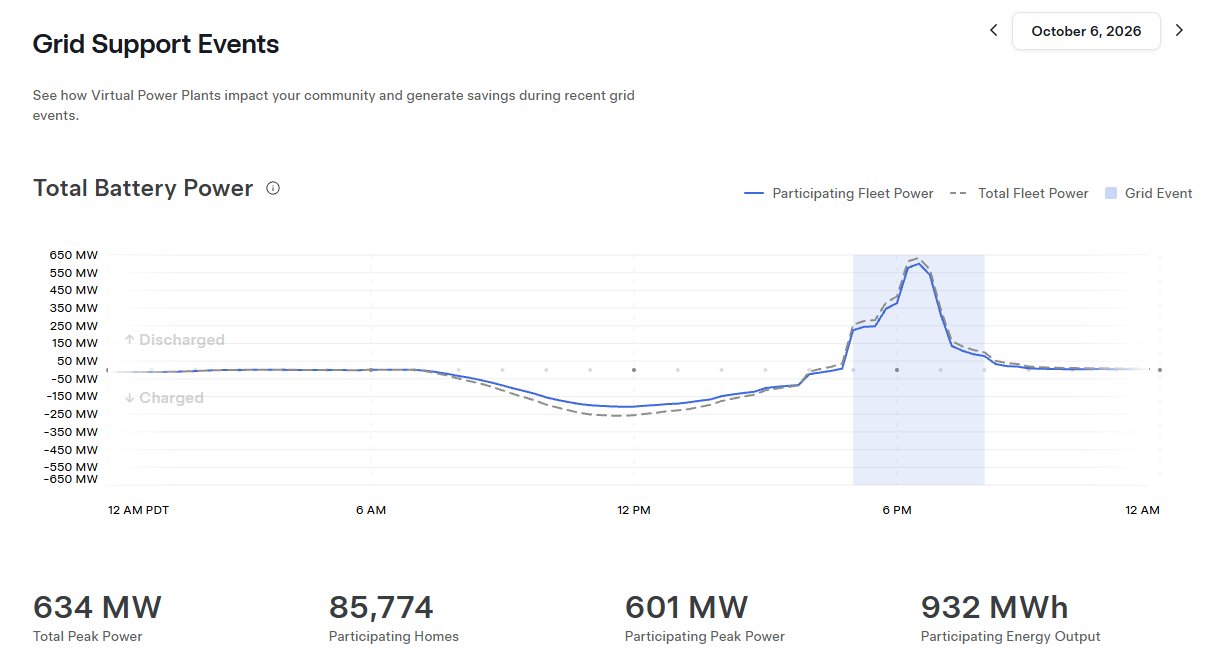
The Tesla Virtual Power Plant in California set a record on October 6, when 85,774 participating homes reached a peak of 601 MW. Tesla Energy called it a new record for the largest Powerwall VPP event, less than a month after the previous one. On the same dashboard, the wider Powerwall fleet, including homes that were not in the event, peaked at 634 MW, and the participating homes delivered 932 MWh.
Tesla’s short clip is the owner-side version of the same idea. Enrollment, opting out of an event, and the backup reserve all sit in the Tesla app. The October 6 numbers are what that network did on a peak evening.
What the October 6 dashboard shows
Tesla Energy posted the result on October 8. The post text rounds the result to 85,000+ Powerwall owners and more than 600 MW sent to the grid to help meet peak demand. The chart in that post is the California Virtual Power Plant page set to October 6, and it prints four exact totals: 85,774 participating homes, 601 MW of participating peak power, 634 MW of total peak power, and 932 MWh of participating energy output.
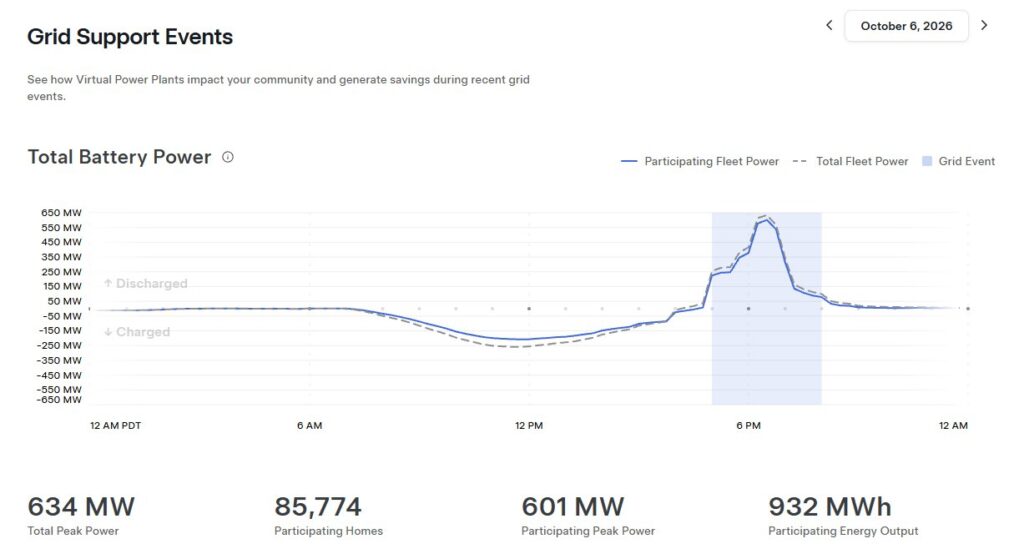
The shape of the day matters as much as the peak. Through the middle of the day the fleet sits below zero, which on this chart means the batteries were charging. In the evening the line flips up, a shaded grid event covers the spike, and output tops out after 6 PM PDT. Tesla reached for the same picture on September 9, calling a smaller dispatch “the output of a power plant, but from Powerwalls already in people’s homes.”
Spread across the participating homes, 601 MW works out to about 7.0 kW each at the peak, and 932 MWh works out to about 10.9 kWh each over the event. Those two averages are our math from Tesla’s totals. A Powerwall 3 is rated at 11.5 kW continuous and 13.5 kWh, so the average home did not empty a new Powerwall 3. Tesla tells owners the program keeps backup power available, and the app lets them hold a reserve.
Less than a month after September
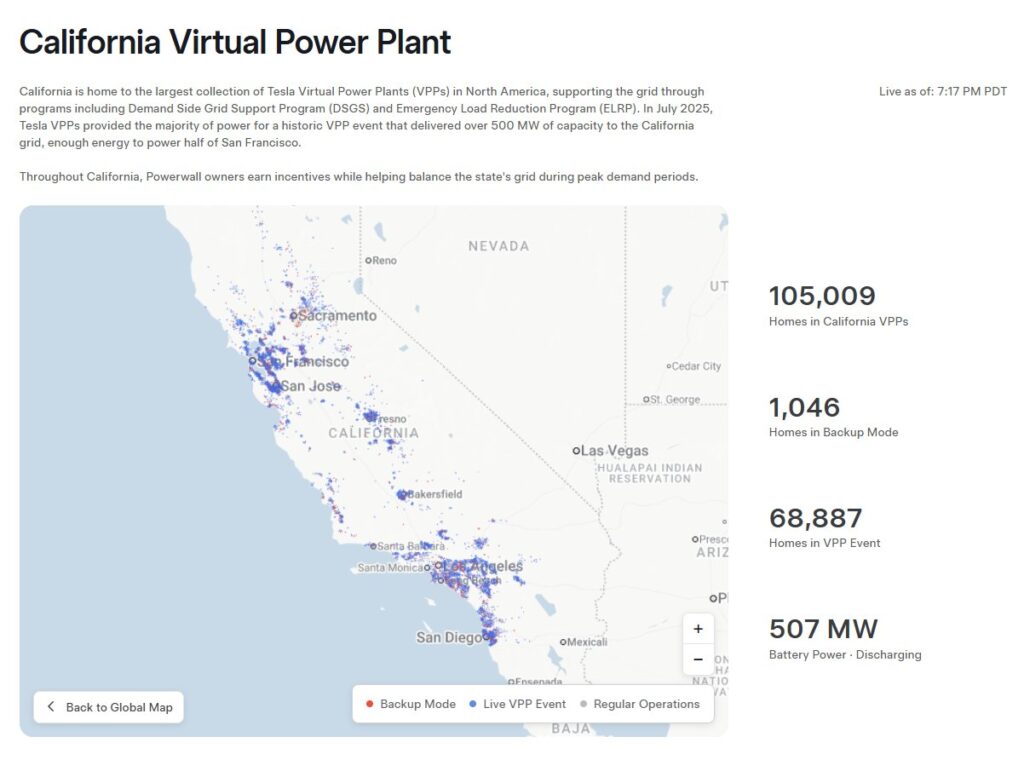
Tesla Energy’s “less than a month later” line points at September 9. That evening the company said about 69,000 Powerwall owners were dispatching more than 500 MW during a heatwave. The dashboard in the post, timestamped 7:17 PM PDT, showed 68,887 homes in the event, 507 MW discharging, 1,046 homes in backup mode, and 105,009 homes enrolled in California VPPs.
On September 21, Tesla Energy described that September 9 night with Sunrun as the largest residential virtual power plant event up to then. Tesla and Sunrun delivered 580 MW to the grid, and 517 MW of that came from 110,000 Powerwalls. September’s 110,000 is a joint Powerwall count. October’s 85,774 is participating homes on Tesla’s own dashboard. Tesla Energy is the one that has now called the October 6 event the Powerwall record.
The California page still cites July 2025, when Tesla VPPs supplied most of the power for an event of over 500 MW. Tesla says that was enough capacity to power half of San Francisco. October’s participating peak is 601 MW.
How a bunch of home batteries becomes one plant
Tesla’s description is plain. A virtual power plant is a group of customers who network home batteries, thermostats, chargers, and solar so they can support the grid the way a traditional power plant does. California holds the largest collection of Tesla’s plants in North America. The programs Tesla names there are Demand Side Grid Support (DSGS) and the Emergency Load Reduction Program (ELRP). Owners earn incentives. Tesla’s page says you get paid for the energy a Powerwall sends back.
On the DSGS support page, Tesla says an enrolled Powerwall is called when the wholesale price passes $200 per MWh. Those events run from May through October, between 4 PM and 9 PM, last no more than two hours, and stay under 35 in a summer, with at least one a month. Tesla lists earnings of up to $280 a year per Powerwall. The page covers PG&E, SCE, SDG&E, LADWP, and community choice customers in those areas. It does not say every home in the October 6 total was on DSGS. Signup is in the Tesla app.
Under the hood, each Powerwall sends encrypted data to Tesla every few seconds. Tesla says its Powerhub software rolls that up and sends one dispatch command when the grid operator asks. Adding the next battery is a software enrollment. The next megawatt shows up when another home joins.
The battery that also covers an outage
Exporting on a peak evening and keeping a house up in a blackout are two uses of the same Powerwall. Tesla says the VPP programs preserve backup. Earlier in October, Tesla also opened Powershare Home Backup to new Model 3 and Model Y orders that pair the car with a Powerwall 3. Tesla says that combination can add over two days of backup for a typical home. The car lengthens an outage. The October 6 record is the grid job: tens of thousands of those batteries discharging together while the houses keep a reserve.
601 MW from 85,774 homes is a power plant that was already installed. The batteries charged during the day, they covered the evening peak, and the owners were paid for the energy they sent.