
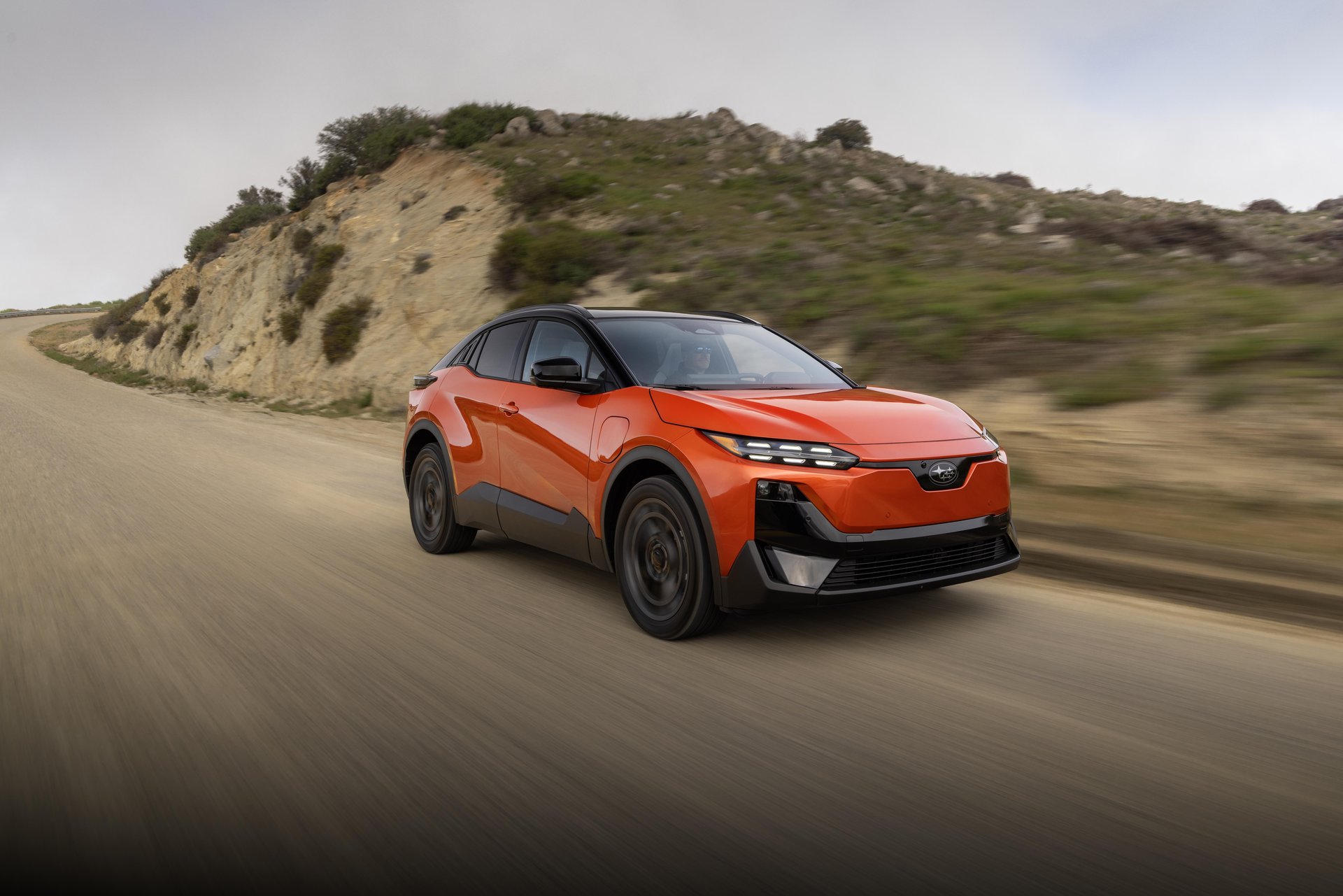
Subaru built its name on all-wheel drive, yet its cheapest electric car sends power to the front wheels only. The 2027 Subaru Uncharted Premium FWD starts at $34,995, while the first all-wheel-drive version, the Sport, is $39,795. Toyota, Kia, Honda and Chevrolet sell the same split: a single front motor at the bottom of the lineup and a second rear motor for more money.
In the FWD vs AWD EV choice, the front-drive version is the smarter buy for most drivers. It costs less, goes farther on a charge and charges just as fast. What you give up is acceleration and some traction when grip is low. Below is what the numbers say, using official maker specs and EPA ratings. Prices are MSRP as of November 2026 and exclude destination.
$2,100 to $3,700
AWD premium on the same trim
Up to 41 miles
Range lost with AWD (Kia EV3)
Same
DC fast-charging speed, FWD or AWD
FWD vs AWD EV price: the same trim costs $2,100 to $3,700 more with AWD
The cleanest way to price AWD is to compare the same trim with and without the rear motor:
- Honda Prologue: the 2026 EX is $39,900 with front drive and $42,000 with AWD, a $2,100 step. On the Touring, it is $2,800 (Honda).
- Kia EV3: the Wind FWD is $34,990 and the Wind AWD is $38,690, a $3,700 gap. The Land gap is $3,200 (Kia).
Subaru’s $4,800 jump to the Uncharted Sport also buys roof rails, a heated steering wheel and a 360-degree camera, so not all of it is the motor. For a full look at how Subaru and Toyota price their shared models, see our Toyota vs Subaru EV comparison.
Front-drive models go farther on the same battery
The front-drive car wins on range in every pair. EPA ratings from fueleconomy.gov:
| Model | FWD range | AWD range | Range lost |
|---|---|---|---|
| Subaru Uncharted (Premium vs Sport, 18-inch wheels) | 308 mi | 287 mi | 21 mi |
| Toyota bZ (XLE FWD Plus vs XLE AWD) | 314 mi | 288 mi | 26 mi |
| Kia EV3 (81.4 kWh Wind and Land) | 321 mi | 280 mi | 41 mi |
| Honda Prologue (EX) | 308 mi | 294 mi | 14 mi |
| Chevrolet Equinox EV | 319 mi | 307 mi | 12 mi |
The Uncharted GT on 20-inch wheels drops to 273 miles, and the bZ Limited falls from 299 miles with front drive to 278 with AWD. The Kia EV3 shows the biggest gap in the group at 41 miles, and the Chevrolet Equinox EV the smallest at 12.
The range loss comes from efficiency. A second motor adds weight (the Uncharted Sport is 285 pounds heavier than the Premium FWD on Subaru’s spec sheet), more drivetrain losses and usually more power that tempts heavier right feet. The Uncharted FWD is rated at 129 MPGe combined, or about 26 kWh per 100 miles. The AWD version uses 29 kWh per 100 miles. Our EV efficiency explainer covers why those small numbers add up.
In money terms, the EV3’s gap (29 vs 33 kWh per 100 miles) works out to about 480 kWh more a year at 12,000 miles. At an example rate of 18 cents per kWh, that is roughly $86 a year. Running cost is not the deciding factor. Range on a cold highway trip is.
AWD is quicker, but front drive is quick enough
The second motor adds a lot of power. The Uncharted and bZ go from 221 hp to 338 hp. The Prologue and Equinox EV go from 220 hp to 300 hp. The EV3 goes from 201 hp to 261 hp.
Kia publishes official 0 to 60 mph times for both versions. The EV3 spec sheet lists 7.5 seconds for the Land FWD and 6.3 seconds for the Land AWD. A 1.2-second difference is easy to feel on an on-ramp. But 7.5 seconds is still brisk for a small crossover, and instant electric torque makes city driving feel quicker than the number suggests. Our EV3 price and range guide covers every trim.
Front tires do two jobs, and that is the real traction limit
On a front-drive car, the front tires steer, carry most of the braking and put down all the power. When you accelerate, weight shifts toward the rear axle, which takes load off the front tires just when they need grip the most. On dry pavement that rarely matters. On a wet uphill launch or a snowy intersection, it is where front-drive cars spin a wheel first.
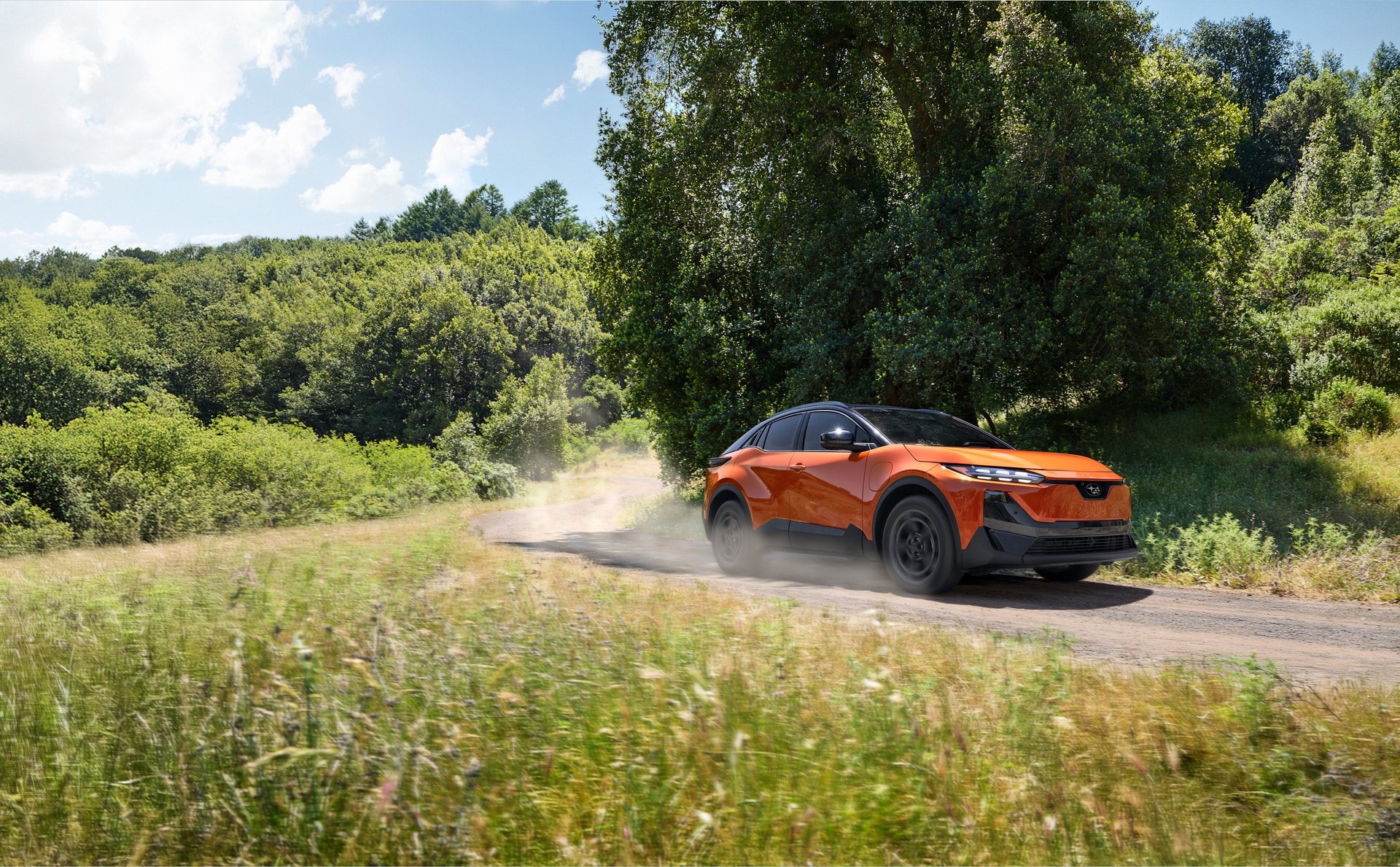
EVs soften this problem in two ways. First, the battery sits low and spreads weight across the car. Honda lists the Prologue EX FWD at 55.9% front weight, compared with 54.5% for the AWD (Honda specs). That is a modest front bias. Second, electric motors respond in milliseconds, so traction control can trim torque much faster than older systems could.
AWD still wins when you are accelerating on a slippery surface, because it spreads the work across four tires. Toyota and Subaru also reserve X-MODE and Grip Control for their AWD models.
Winter tires matter more than the second motor
AWD helps you get moving. It does not help you stop, and it does very little for steering grip in a slippery corner. Those depend almost entirely on the tires. A front-drive EV on proper winter tires will usually stop and turn better on snow than an AWD EV on all-season tires.
If you live where roads stay snowy for weeks, budget for a set of winter tires on separate wheels whichever version you buy. If you buy the front-drive car, part of the money you saved covers them.
Charging speed is the same on both versions
Picking front drive does not slow down road trips. The Uncharted charges from 10% to 80% in about 28 minutes on every trim. The EV3 does it in about 31 minutes on every 81.4 kWh trim. The Prologue’s 20% to 80% time is 35 minutes for both versions. The more efficient front-drive car even adds slightly more range per minute. Honda quotes 65 miles in 10 minutes for the EX FWD and 63 for the EX AWD.
Honda also gives every Prologue a 1,500-pound towing limit, front drive included. Check your trim’s rating in the owner’s manual before you hitch anything.
Volkswagen’s ID.4 shows the rear-drive alternative
Not every single-motor EV drives the front wheels. The Volkswagen ID.4 puts its single motor at the rear, which keeps steering and power on separate axles and helps traction under hard acceleration in the dry. The tradeoff pattern stays the same: the 2026 ID.4 is rated at 291 miles with rear drive vs 263 with AWD. Our ID.4 deal analysis covers pricing. Kia’s EV6 is another rear-drive option, and our EV6 trim guide lists its trims and prices.
Who should take the savings and who should pay for AWD
Take the front-drive savings if:
- You live where snow is rare or roads are cleared quickly.
- You do lots of highway miles and value range above all.
- You are willing to fit winter tires for a few cold months.
- You want the lowest price on a well-equipped trim, such as the Prologue EX FWD or the bZ XLE FWD Plus.
Pay for AWD if:
- You face steep, snowy driveways or unplowed roads regularly.
- You tow near the rated limit up wet grades or boat ramps.
- You want the quicker car and accept the range penalty.
FAQ
Is a front-wheel-drive EV safe in snow?
Yes, with the right tires. A front-drive EV on winter tires handles snow well for most drivers. AWD helps mainly when pulling away on slick or steep surfaces.
Does AWD slow down DC fast charging?
No. Subaru, Kia and Honda list the same official fast-charging times for their front-drive and AWD versions.
How much range do you lose with AWD?
Between 12 and 41 miles on the EPA cycle across these models, with the Chevrolet Equinox EV losing the least and the Kia EV3 losing the most.