
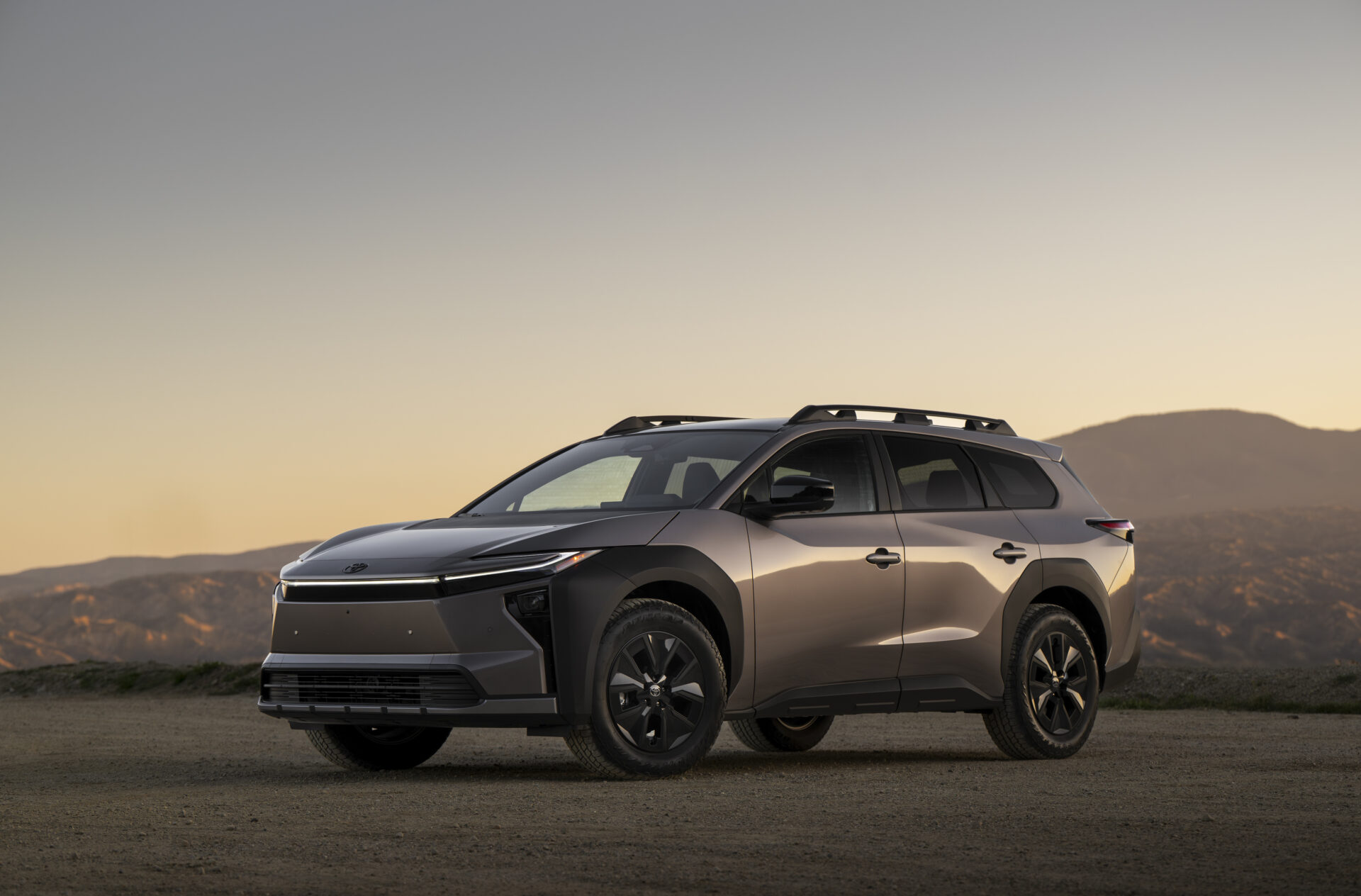
The Subaru Trailseeker and the Toyota bZ Woodland are built on the same platform, use the same 74.7 kWh battery, make the same 375 horsepower and carry the same 281-mile range rating. The Subaru starts at $39,995. The Toyota starts at $45,380. That $5,385 gap is the biggest price difference anywhere in the Toyota vs Subaru EV lineup, and it is the clearest example of why shoppers looking at either brand should price the other one too.
Toyota and Subaru now sell three pairs of electric SUVs that share the e-TNGA platform: the Toyota C-HR and Subaru Uncharted, the Toyota bZ and Subaru Solterra, and the bZ Woodland and Trailseeker. Buyers have noticed. Through the third quarter, Toyota sold nearly 35,000 EVs in the US, up 183.4% from a year earlier, and Subaru sold 14,630, up 46.7%, according to Kelley Blue Book figures reported by Electrek. Outside of Rivian, they were the only brands with higher US EV sales than last year, aside from Lexus, which Electrek listed separately at 12,676 sales, up 137.4%. We covered the broader Q3 US EV sales picture earlier this fall.
The twins are close, but they are not identical, and the cheaper brand changes from pair to pair.
All six 2027 models at a glance
Prices are each brand’s base MSRP for the 2027 model year, before destination or Toyota’s delivery, processing and handling fee (DPH). Subaru charges $1,525 destination on the Uncharted and Solterra and $1,545 on the Trailseeker. Toyota’s current DPH on the bZ, bZ Woodland and C-HR is $1,595. On the Trailseeker Premium versus the bZ Woodland, that makes the delivered gap $5,435 rather than the $5,385 MSRP gap. Ranges are manufacturer estimates from each brand’s 2027 announcements.
| Pair | Toyota | Price | Range | Subaru | Price | Range |
|---|---|---|---|---|---|---|
| Compact | C-HR SE (AWD) | $37,080 | 287 mi | Uncharted Premium (FWD) | $34,995 | 308 mi |
| Compact | Uncharted Sport (AWD) | $39,795 | 287 mi | |||
| Midsize | bZ XLE FWD Plus | $37,980 | 314 mi | No FWD Solterra | ||
| Midsize | bZ XLE AWD | $39,980 | 288 mi | Solterra Premium (AWD) | $38,495 | up to 288 mi |
| Rugged | bZ Woodland (AWD) | $45,380 | 281 mi | Trailseeker Premium (AWD) | $39,995 | 281 mi |
Every model in the table has a NACS port, so it plugs straight into a Tesla Supercharger, and all of them take roughly half an hour to charge from 10 to 80% on a fast charger. Subaru quotes 28 minutes at up to 150 kW for the Trailseeker, and Toyota quotes around 30 minutes for its models under ideal conditions.
Trailseeker vs bZ Woodland: the Subaru is the better deal
On paper the two are the same vehicle with different styling. Both have dual motors, 375 horsepower and a 3,500-pound towing rating. Subaru quotes 0 to 60 mph in 4.3 seconds and Toyota quotes 4.5 seconds. Ground clearance is 8.5 inches on the Subaru and 8.4 on the Toyota. The Trailseeker has 31.3 cubic feet of cargo room behind the rear seats, according to Subaru. InsideEVs lists 33.8 cubic feet for the Woodland (Toyota’s 2027 newsroom post only publishes 74.3 cubic feet with the seats folded), so the Toyota holds a little more.
The price gap is mostly an equipment gap. The base bZ Woodland comes with SofTex synthetic leather, heated outboard rear seats, a heated steering wheel, Digital Key capability and a 360-degree camera. The Trailseeker Premium has StarTex water-resistant upholstery and heated front seats only.
The fairer match is the Trailseeker Limited at $43,995. It adds heated rear seats, a heated leather-wrapped steering wheel, a digital key, a panoramic view monitor, Harman Kardon audio, a hands-free power liftgate and a 120-volt outlet in the cargo area. It is still $1,385 cheaper than the Woodland. The catch is its 20-inch wheels, which drop range to about 274 miles, 7 miles short of the Toyota.
If you want the Woodland’s all-terrain tire option, check range before you buy. Toyota rates the Woodland at 260 miles on those tires.
Our pick: Trailseeker Premium if you can live with StarTex seats and want the most range per dollar in this class. Trailseeker Limited if you want the heated rear seats and steering wheel. The bZ Woodland only makes sense if a local Toyota dealer is discounting it by more than the gap, or if you need the slightly larger cargo area.
Uncharted vs C-HR: Subaru wins on price, Toyota wins on all-wheel drive
This pair splits depending on what you need.
The Uncharted Premium is the only front-wheel-drive car in the compact pair. At $34,995 with an estimated 308 miles, it costs about $114 per mile of range by our math, the lowest of any model in either brand’s lineup. It even beats the Toyota bZ XLE FWD Plus, which we found was the best value in Toyota’s bZ range at $121 per mile in our Toyota bZ trim guide. Subaru says the Uncharted has more than 25 cubic feet of cargo space behind the rear seats and a turning circle close to the Crosstrek’s, so it suits city drivers who want a small car with long range.
If you need all-wheel drive, the math flips. The C-HR SE is all-wheel drive as standard and costs $37,080 for 287 miles. The Uncharted Sport, also all-wheel drive with the same 287-mile rating, costs $39,795. That’s $2,715 more for the Subaru with the same range. Toyota says the C-HR makes 338 horsepower and does 0 to 60 mph in 4.9 seconds.
The top trims follow the same pattern. The C-HR XSE and Uncharted GT both ride on 20-inch wheels and both drop to 273 miles. The C-HR XSE is $39,080. The Uncharted GT is $43,795, which is $4,715 more than the Toyota for the same range rating.
Our pick: Uncharted Premium FWD for anyone who doesn’t need all-wheel drive. C-HR SE for anyone who does.
Solterra vs bZ: Toyota has the trims that make the most sense
Subaru only sells the Solterra with all-wheel drive, so it has nothing to match the bZ XLE FWD Plus, the 314-mile Toyota that tops this whole comparison for range.
Among all-wheel-drive versions, the Solterra Premium is $1,485 cheaper than the bZ XLE AWD, and both are rated at up to 288 miles. The difference is power. The Solterra Premium and Limited make 233 horsepower. The bZ XLE AWD makes 338, the same output Subaru reserves for its Limited XT ($42,895) and Touring XT ($45,855). If you want the quicker all-wheel-drive version, the bZ XLE AWD is $2,915 cheaper than the cheapest Solterra XT.
Subaru does make the Solterra Premium better equipped than its price suggests, with heated front seats, a 10-way power driver’s seat, dual-zone climate control and a power liftgate as standard.
Our pick: bZ XLE FWD Plus for range, bZ XLE AWD for all-wheel drive with power. Solterra Premium if you want the lowest price for all-wheel drive and don’t care about acceleration.
How to shop the Toyota vs Subaru EV twins
Price the matching model at both brands before you visit a dealer. The vehicles share so much hardware that the deal, the equipment list and the dealer’s discount matter more than the badge. Both brands also have leftover 2026 inventory on lots. Toyota says the 2027 C-HR and bZ Woodland are unchanged from 2026 in features and specifications, so a discounted leftover 2026 can be the same vehicle for less. Add today’s $1,595 Toyota DPH, which the Nov 5 sheet applies regardless of model year.
Also compare like for like on fees. Subaru’s destination charge is $1,525 or $1,545, and Toyota’s DPH is $1,595, so add each before you work out the real gap.
Both brands are also adding three-row electric SUVs, and neither has a published price yet. Toyota expects to start selling the 2028 Highlander in early 2027, with the front-wheel-drive version following in mid-2027. Subaru now lists the Getaway as a 2028 model, and subaru.com still says the MSRP is not available. If you need a third row, wait for those prices.
FAQ
Are the Subaru Trailseeker and Toyota bZ Woodland the same car?
They share the e-TNGA platform, the 74.7 kWh battery, the 375-horsepower dual-motor powertrain and the 281-mile range rating. Styling, interior trim, standard equipment and price differ. The Trailseeker starts at $39,995 and the bZ Woodland at $45,380.
Which Toyota or Subaru EV has the most range?
The Toyota bZ XLE FWD Plus, at 314 miles. The Subaru Uncharted Premium FWD is next at an estimated 308 miles and costs $2,985 less.
Can these Toyota and Subaru EVs use Tesla Superchargers?
Yes. All 2027 models in both lineups have a built-in NACS port and can charge at Tesla Superchargers without an adapter.