
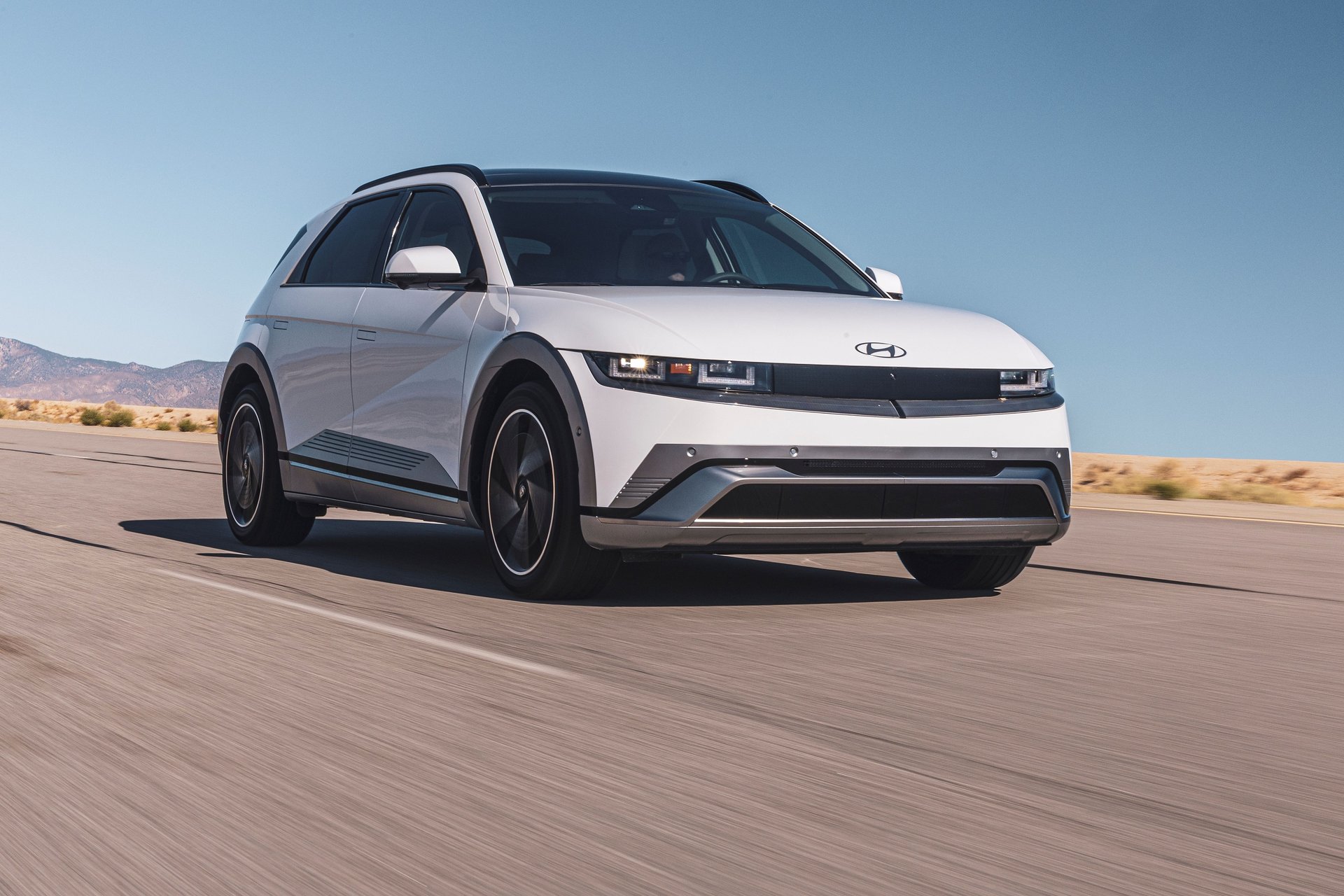
Among the 2027 Hyundai Ioniq 5 trims, the SE RWD is the one to buy for most people. At $37,750 it goes an EPA-estimated 318 miles, which ties for the longest range in the lineup and makes it the cheapest Ioniq 5 per mile of range by a wide margin. Every step up from there buys features, power or ground clearance, not distance.
The 2027 Ioniq 5 is now on sale. It carries over the 2026 car’s hardware and adds $250 to most trims, so the lineup starts at $35,250 for the SE Standard Range and tops out at $49,125 for the Limited AWD, before a $1,650 freight charge, according to Hyundai USA. Hyundai cut 2026 prices by $7,600 to $9,800 in October 2025, and those lower prices have stuck.
Price and range for each trim
Rear-drive Ioniq 5s use one 225 hp motor (168 hp on the Standard Range). All-wheel-drive versions add a front motor for 320 hp. Every trim except the Standard Range uses the 84 kWh battery; the Standard Range has 63 kWh. Prices are Hyundai’s 2027 MSRPs without freight. Price per mile of range is our math: MSRP divided by EPA range.
| Rear-wheel drive | MSRP | EPA range | Power | Battery | Price per mile of range (EM math) |
|---|---|---|---|---|---|
| SE Standard Range | $35,250 | 245 mi | 168 hp | 63 kWh | $144 |
| SE | $37,750 | 318 mi | 225 hp | 84 kWh | $119 |
| SEL | $40,200 | 318 mi | 225 hp | 84 kWh | $126 |
| Limited | $45,225 | 318 mi | 225 hp | 84 kWh | $142 |
| All-wheel drive | MSRP | EPA range | Power | Battery | Price per mile of range (EM math) |
|---|---|---|---|---|---|
| SE AWD | $41,250 | 290 mi | 320 hp | 84 kWh | $142 |
| SEL AWD | $43,700 | 290 mi | 320 hp | 84 kWh | $151 |
| XRT AWD | $46,525 | 259 mi | 320 hp | 84 kWh | $180 |
| XRT AWD with tow hitch | $46,975 | 259 mi | 320 hp | 84 kWh | $181 |
| Limited AWD | $49,125 | 269 mi | 320 hp | 84 kWh | $183 |
Hyundai’s model page shows only starting prices, so the AWD and tow hitch XRT prices come from the per-model MSRPs in Hyundai’s own offer listings.
What changed for 2027
Very little. Hyundai’s newsroom lists the 2027 Ioniq 5 as a carry-over model. Roof rails now come on the SEL and above instead of only the XRT and Limited. HomeLink moves the other way, from SEL and above to the Limited only, per Hyundai’s 2026 and 2027 spec sheets. Hyundai’s newsroom also lists the Limited’s cargo cover as an accessory for 2027 and drops two matte paints, Gravity Gold and Sage Silver.
Range, charging hardware, power and dimensions are unchanged. If a dealer still has a 2026 on the lot, it is the same car with slightly different equipment and, this month, better incentives (see below).
Rear drive or all-wheel drive
All-wheel drive costs $3,500 on the SE and SEL and $3,900 on the Limited. It raises output from 225 to 320 hp and torque from 258 to 446 lb-ft, and it helps in snow. It also costs range: the SE and SEL AWD are rated at 290 miles, 28 fewer than rear drive, and the Limited AWD drops to 269 miles on its 20-inch wheels.
If you live where winters are mild, rear drive is the better buy. The SE RWD is already quick enough for daily driving, and the extra 28 miles adds up on every road trip. If you need AWD, the SE AWD at $41,250 gives you the same 290 miles as the SEL AWD for $2,450 less.
The Standard Range is not the bargain it looks like
The SE Standard Range saves $2,500 over the regular SE but gives up 73 miles of range and 57 hp. Per mile of range it costs more than the SE, the SEL and the Limited RWD. It does charge a little faster on Tesla Superchargers (24 minutes from 10 to 80 percent versus 30 for the 84 kWh cars), but only because the smaller battery holds less. Unless your daily driving is short and the budget is fixed, spend the extra $2,500.
SEL and Limited: what the extra money buys
The SEL adds $2,450 over the SE in either drivetrain. Hyundai’s feature lists put Highway Driving Assist 2 (lane changes and better lane centering on the highway), wireless phone charging and, for 2027, roof rails on the SEL. For a car you plan to keep, that is a reasonable upgrade, and range is identical.
The Limited RWD costs $5,025 more than the SEL RWD and still goes 318 miles. It adds the fixed glass Vision roof, a head-up display, Surround View and Blind-Spot View monitors, Digital Key 2 and an interior power outlet (V2L) in the back seat. The Limited AWD is the most expensive Ioniq 5 at $49,125 and has the second-shortest range, so if you want the Limited, the rear-drive version is the one to get unless you need AWD.
The XRT
The XRT is the off-road-styled Ioniq 5. It is AWD only, with 18-inch wheels on 235/60R18 all-terrain tires, a 23 mm suspension lift and its own front and rear bumpers. Ground clearance rises from 6.1 to 7.0 inches. Hyundai’s 2025 launch release put its approach angle at 19.8 degrees (17.5 on other trims) and departure angle at 30.0 degrees (25.4).
That hardware costs range. The XRT is rated at 259 miles, the lowest of any 84 kWh Ioniq 5, and at $180 per mile of range it is near the top of the ladder. It shares many Limited features, including Surround View, Digital Key 2 and rear V2L, for $2,600 less than the Limited AWD.
Hyundai sells a version with a factory tow hitch for $450 more ($46,975). We could not find a towing rating on Hyundai’s current US pages, so check the owner’s manual or ask the dealer before planning around a trailer.
Buy the XRT if you drive gravel roads, trailheads or deep snow often. For pavement, the SEL AWD goes 31 miles farther for $2,825 less.
Charging: NACS port and Supercharger times
Every Ioniq 5 has a built-in NACS port on the rear driver’s side, so it plugs straight into Tesla Superchargers. Hyundai says that opens more than 30,000 Superchargers without an adapter. A CCS adapter comes in the box for Electrify America and other CCS stations.
The fastest stops are on CCS, not Superchargers. The Ioniq 5 runs an 800-volt system, and Hyundai quotes about 20 minutes from 10 to 80 percent on a 350 kW, 800-volt charger using the CCS adapter. On Supercharger V3 and V4 stalls, which Hyundai lists at 150 kW and 400 volts for this car, the same session takes about 30 minutes on the 84 kWh battery and 24 minutes on the 63 kWh Standard Range, per Hyundai’s spec comparison. Our 800-volt charging explainer covers why voltage makes that difference.
| Charging (Hyundai figures) | 63 kWh Standard Range | 84 kWh |
|---|---|---|
| 10-80%, 350 kW 800V CCS (adapter) | about 20 min | about 20 min |
| 10-80%, NACS Supercharger V3/V4 | about 24 min | about 30 min |
| 10-80%, 50 kW DC | 1 h 1 min | 1 h 21 min |
| 10-100%, 10.9 kW home Level 2 | 5 h 40 min | 7 h 20 min |
On a road trip, Superchargers give you the most locations and a 30-minute stop. When a 350 kW CCS station is on the route, it saves about ten minutes per stop. At home, the 10.9 kW onboard charger refills even the 84 kWh battery overnight. Hyundai included a dual-amperage Level 1 and Level 2 charging cord with every 2026 model; ask the dealer whether a 2027 comes with one.
Current Hyundai offers (through Nov 2)
Hyundai’s national offers, read from hyundaiusa.com on Oct 28 for ZIP codes in Illinois, Texas, New York and California, run from Oct 1 through Nov 2, 2026.
- 2027 Ioniq 5: 1.9 percent APR for 60 months, or up to $2,750 in Hyundai Motor Finance Dealer Choice Bonus Cash, both through Hyundai Motor Finance.
- 2026 Ioniq 5 (leftover stock): 0.9 percent APR for 60 months, or up to $3,500 in HMF Bonus Cash, which requires financing through HMF.
- Leases: 24 months with $4,999 due at signing and 12,000 miles a year.
| 2027 trim | Lease, per month | 2026 lease, per month |
|---|---|---|
| SE Standard Range | $359 | $339 |
| SE RWD | $369 | $349 |
| SE AWD | $419 | $399 |
| SEL RWD | $409 | $389 |
| SEL AWD | $459 | $439 |
| Limited RWD | $499 | $479 |
| XRT | $499 ($509 with hitch) | $479 |
| Limited AWD | $549 | $529 |
The leftover 2026 cars are the better deal this month. By our math, a 2026 SE RWD at $37,500 less $3,500 bonus cash comes to $34,000 before freight, against $35,000 for a 2027 SE RWD with its $2,750 bonus. The 2026 also gets the lower APR. Hyundai says offers may not be combined unless specified, so ask the dealer whether the bonus cash and the special APR can be stacked. Hyundai’s EV sales have been falling against its hybrids, which helps explain the incentives.
In California, first-time EV buyers may also qualify for the state’s $3,500 MyFirstEV discount, which Hyundai lists on its 2027 Ioniq 5 offers through Jan 15, 2027, while state funding lasts. It is limited to California residents who have never owned or leased an EV, and the car must be bought and registered in the state.
Battery warranty
Hyundai covers the battery against defects for 10 years or 100,000 miles from the original retail delivery, whichever comes first. Hyundai’s fine print says that coverage does not apply to leased or commercial vehicles, so if you lease, ask the dealer what battery coverage your contract carries.
Which Ioniq 5 to buy
Buy the SE RWD. It has the longest range, the lowest price per mile, NACS charging and 225 hp, and it costs $37,750. Step up to the SEL RWD if you want Highway Driving Assist 2 and wireless charging; the range stays at 318 miles. Pick the SE AWD if you need all-wheel drive, and the XRT only if you will use its clearance and tires off pavement. Skip the Standard Range unless your budget cannot stretch $2,500. Before you sign, price a leftover 2026: with $3,500 in bonus cash and 0.9 percent financing through Nov 2, it is the same car for less.