
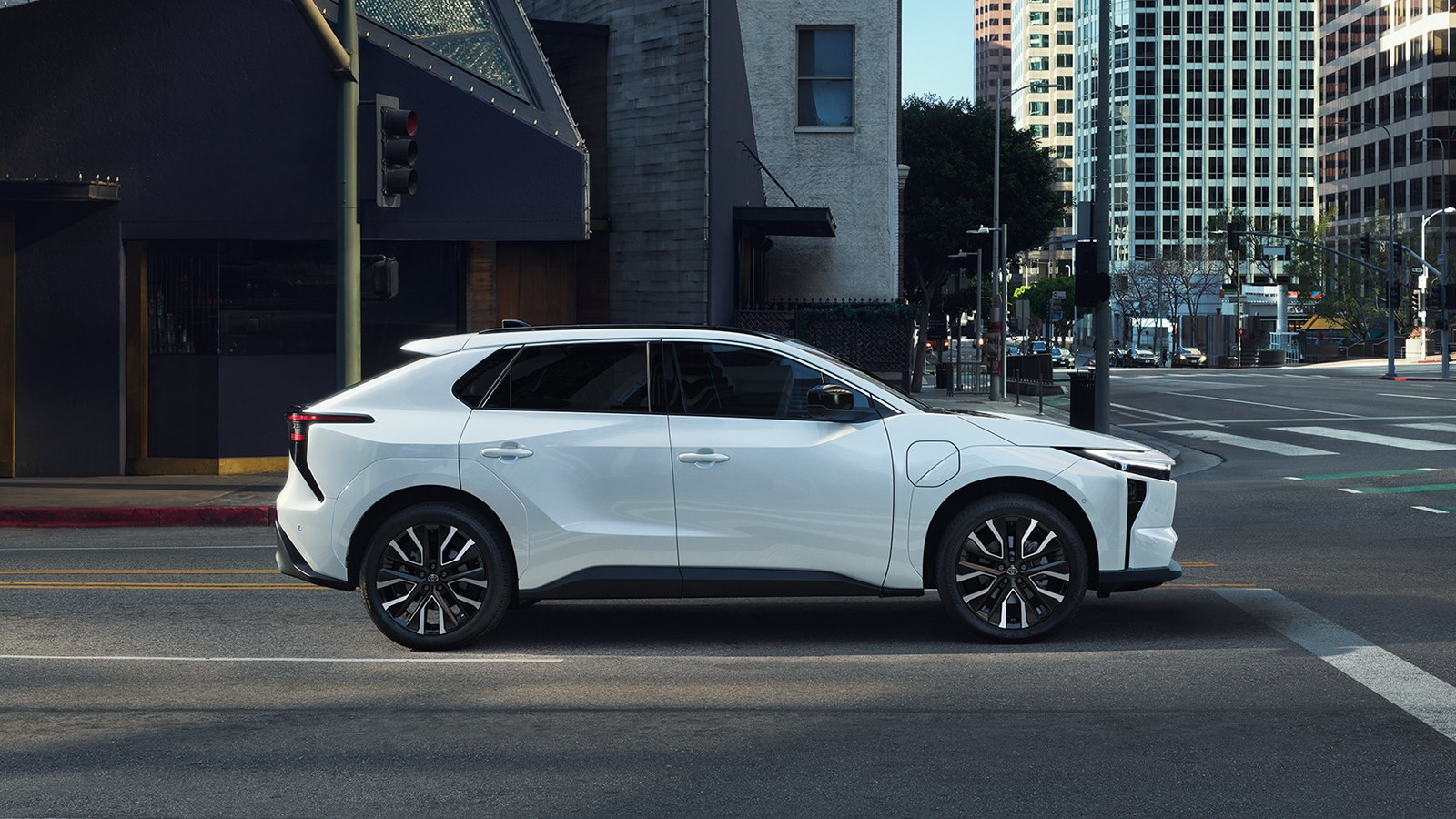
The Toyota bZ trim that goes the farthest isn’t the most expensive one. The XLE FWD Plus, at $37,980, has an EPA range of 314 miles, more than either Limited and 78 miles more than the base car that costs $3,000 less. For most people shopping on range, that’s the trim to buy. The other four still make sense for some drivers, and anyone looking at a 2026 model has a recall to check first.
The bZ (it was called the bZ4X until the 2026 model year) has turned into one of the better-selling EVs in the US. Cox Automotive estimates Toyota sold 7,391 of them in the third quarter, up 145% from a year earlier, and 24,944 through September, according to its Q3 2026 EV sales report. Our Q3 EV sales roundup has the rest of the market. Toyota says the 2027 bZ is unchanged from 2026, so everything below applies to both model years unless it says otherwise.
Every 2027 bZ trim at a glance
Prices are Toyota’s base MSRP before its dealer processing and handling fee. Range figures are EPA estimates from fueleconomy.gov, and the specs come from Toyota’s bZ spec page.
| Trim | Price | Battery | Drive | Horsepower | EPA range | Home charging, 10 to 100% |
|---|---|---|---|---|---|---|
| XLE FWD | $34,980 | 57.7 kWh | Front | 165 | 236 miles | About 5.5 hours |
| XLE FWD Plus | $37,980 | 74.7 kWh | Front | 221 | 314 miles | About 7 hours |
| XLE AWD | $39,980 | 74.7 kWh | All | 338 | 288 miles | About 7 hours |
| Limited FWD | $43,380 | 74.7 kWh | Front | 221 | 299 miles | About 7 hours |
| Limited AWD | $45,380 | 74.7 kWh | All | 338 | 278 miles | About 7 hours |
Every trim has five seats, 8.1 inches of ground clearance, an 11 kW onboard charger and a NACS charging port. Home charging times are Toyota’s figures at 240 volts and 48 amps.
Why the $37,980 trim goes the farthest
Three things decide a bZ’s range: battery size, how many motors it has, and how much weight and wheel it carries. The XLE FWD Plus gets the good side of all three. It has the bigger 74.7 kWh battery, a single front motor, the lightest curb weight of any 74.7 kWh trim (4,156 pounds), and the XLE’s 18-inch wheels.
EPA’s efficiency numbers show the effect. The FWD Plus uses 25.5 kWh per 100 miles, the best of the lineup. The Limited FWD has the same battery and motor but rides on 20-inch wheels and weighs more, and it uses 26.9 kWh per 100 miles, which costs it 15 miles of range. Adding the rear motor pushes the XLE AWD to 28.0 kWh per 100 miles and the Limited AWD to 28.9, which is why the most expensive bZ has the second-shortest range.
The base XLE FWD is actually efficient too, at 25.8 kWh per 100 miles. It just has a smaller 57.7 kWh battery, so the tank is smaller even if the mileage is good.
Price per mile of range
Dividing each trim’s price by its EPA range is a quick way to see what you’re paying for. These are our figures, rounded to the dollar.
| Trim | Price | EPA range | Price per mile of range |
|---|---|---|---|
| XLE FWD Plus | $37,980 | 314 miles | $121 |
| XLE AWD | $39,980 | 288 miles | $139 |
| Limited FWD | $43,380 | 299 miles | $145 |
| XLE FWD | $34,980 | 236 miles | $148 |
| Limited AWD | $45,380 | 278 miles | $163 |
The FWD Plus wins by a wide margin. The $3,000 step up from the base XLE buys 78 more miles, about $38 per extra mile, which is the best money you can spend on this car. The step from the FWD Plus to the Limited FWD costs $5,400 and loses range, so that money only makes sense if you want what the Limited adds: SofTex seats, ventilated front seats, heated rear seats, a panoramic fixed-glass roof with a power sunshade, and 20-inch wheels.
For a value comparison outside Toyota, our Kia EV3 trim guide works through the same question for Kia’s small SUV.
Who should buy which bZ
Most buyers: XLE FWD Plus. It has the longest range, the lowest price per mile and 221 horsepower, which is plenty for a family SUV. Unless you need all-wheel drive or want the Limited’s interior, this is the one.
Snow, dirt roads or steep driveways: XLE AWD. The second motor brings 338 horsepower, a 0 to 60 mph time of 4.9 seconds by Toyota’s own (prototype) testing, per its bZ brochure, and X-MODE with Snow/Dirt, Deep Snow/Mud and Grip Control modes. You give up 26 miles of range against the FWD Plus, and the XLE AWD is the cheaper way to get all-wheel drive.
Short daily drives on a budget: XLE FWD. At $34,980 it’s the cheapest bZ, and 236 miles covers most commutes with room to spare. The smaller battery also finishes charging at home faster, in about 5.5 hours. Skip it if you take regular highway trips, where the extra 78 miles of the Plus will matter.
Comfort first: Limited FWD. It keeps most of the range (299 miles) and adds the nicer cabin. The Limited AWD costs the most and goes the least far of the 74.7 kWh trims, so only pick it if you want both the Limited interior and all-wheel drive.
Charging on the road
Every bZ since the 2026 model year has a built-in NACS port on the front right of the car, so it plugs straight into a Tesla Supercharger without an adapter. The 2026 update also brought Plug & Charge. After a one-time setup in the Toyota app, a compatible station starts charging as soon as you plug in. Toyota said at launch that Tesla’s Supercharger network would be the first to support it, with IONNA, ChargePoint and EVgo to follow, and its brochure notes that Plug & Charge needs an active Remote Connect trial or subscription.
Toyota says a DC fast charge from 10 to 80% takes about 30 minutes in ideal conditions on a charger rated at 150 kW or more, according to its 2026 bZ announcement and spec page. MotorWeek’s road test puts the peak charging rate at 150 kW. On the 74.7 kWh battery, that 10 to 80% session adds roughly 52 kWh, enough for about 200 miles at the FWD Plus’s EPA efficiency. That’s slower than the quickest 800-volt EVs sold in the US, which manage 10 to 80% in roughly 18 to 21 minutes on the right charger (our 800-volt charging explainer covers why), but it’s a real step up from the old bZ4X, which had a 7 kW onboard charger and a CCS port.
Two habits help. First, use battery preconditioning before a fast charge in cold weather. It turns on automatically when you set a fast charger as your navigation destination, or you can start it manually, and Toyota says it can shorten charging in the cold. Second, stop fast charging around 80% when you can. Toyota’s bZ FAQ recommends stopping a DC fast charge around 80%, while charging to 100% at home on AC is fine.
The recall to check on a 2026 bZ
If you own a 2026 bZ or are looking at one used, check recall 26V393. Toyota is recalling certain 2026 bZ, Lexus RZ and Subaru Solterra models because the electronic control unit that manages the high-voltage battery can fault and cause a loss of drive power, according to the NHTSA recall listing. A sudden loss of power raises the risk of a crash.
Here’s what to do:
- Enter the car’s 17-character VIN at nhtsa.gov/recalls. The VIN is on the driver’s side of the dashboard, visible through the windshield, and on the registration.
- If the recall shows as open, book a dealer visit. Dealers update the battery ECU software for free. NHTSA’s listing doesn’t mark this as an over-the-air fix, so plan on a trip to the dealer.
- If you have questions, Toyota’s customer service line is 1-800-331-4331. Toyota’s numbers for this recall are 26LA07 and 26TA11.
Toyota mailed owner letters on August 17, 2026, so a car bought used since then may have missed it. If you’re buying a used 2026 bZ, ask the seller or dealer to show that the update was done. NHTSA lists no recalls for the 2027 bZ as of October 23.
The bZ’s siblings
The bZ is one of three battery EVs Toyota sells in the US, the company says in its 2027 bZ release. The bZ Woodland has an EPA range of 281 miles on its standard tires and 260 miles on the larger tire size, and the C-HR is an all-wheel-drive crossover rated for 287 miles on 18-inch wheels. Cox estimates Toyota sold 2,046 Woodlands and 3,467 C-HRs in the third quarter. Both are worth a look if the bZ’s shape isn’t quite right. Toyota also opened a battery development and testing center in Michigan this month to evaluate packs from its North Carolina plant.
For most people shopping a bZ, though, the choice is easy. The XLE FWD Plus is the one to beat, and anyone looking at a 2026 model should check that recall before signing.