
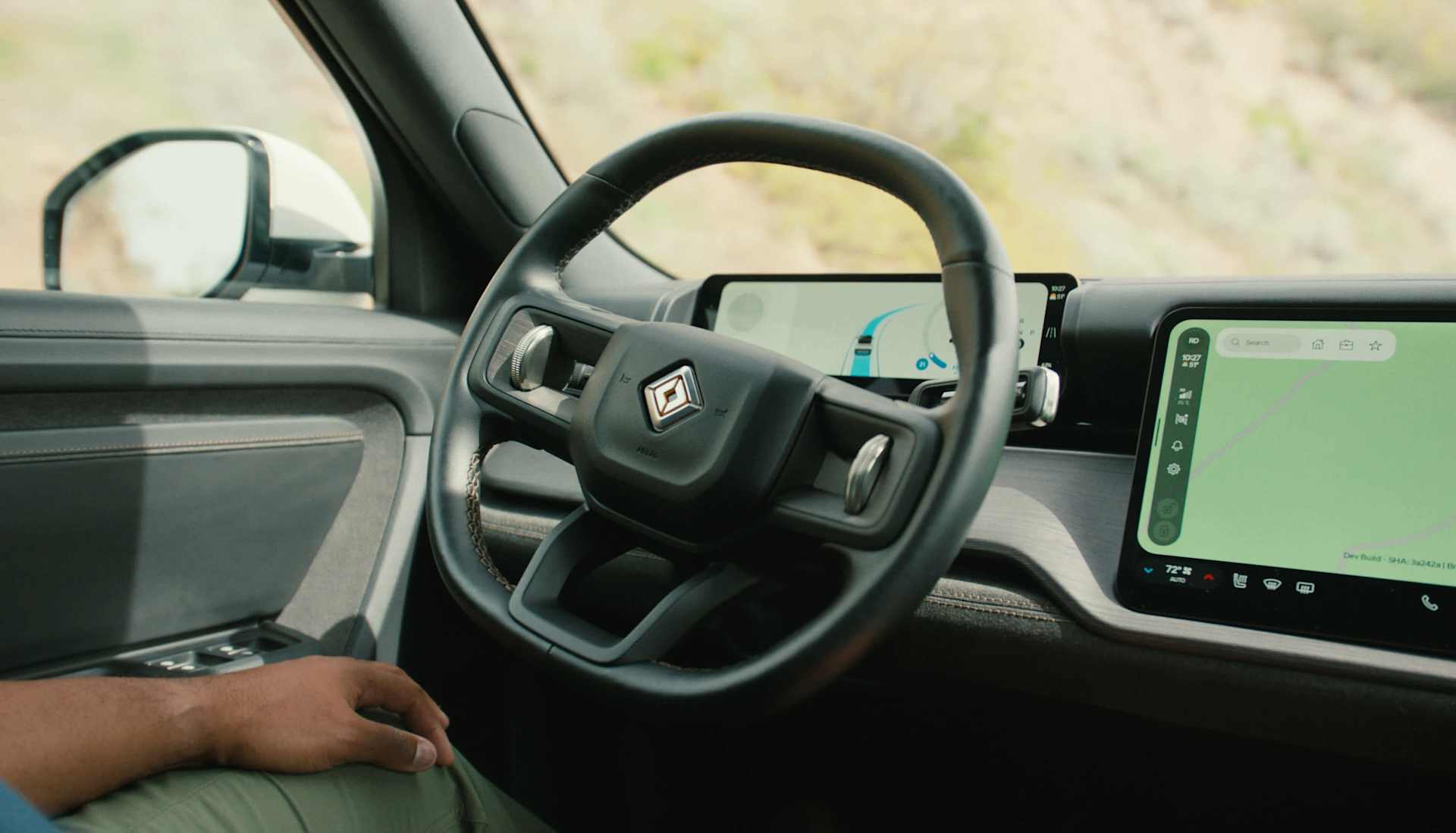
Rivian Point to Point vs Tesla FSD (Supervised) is about to become a real comparison. In the US, Tesla has long been the only automaker selling owners a system that could follow a navigation route from driveway to destination, turns and all, while the driver watched. Rivian’s version, Point to Point, goes to its first invited owners in December, and every eligible Rivian is due to get it in 2027.
The two systems will feel similar from the driver’s seat. Who gets them, what they cost and where they work are very different.
What each system does today
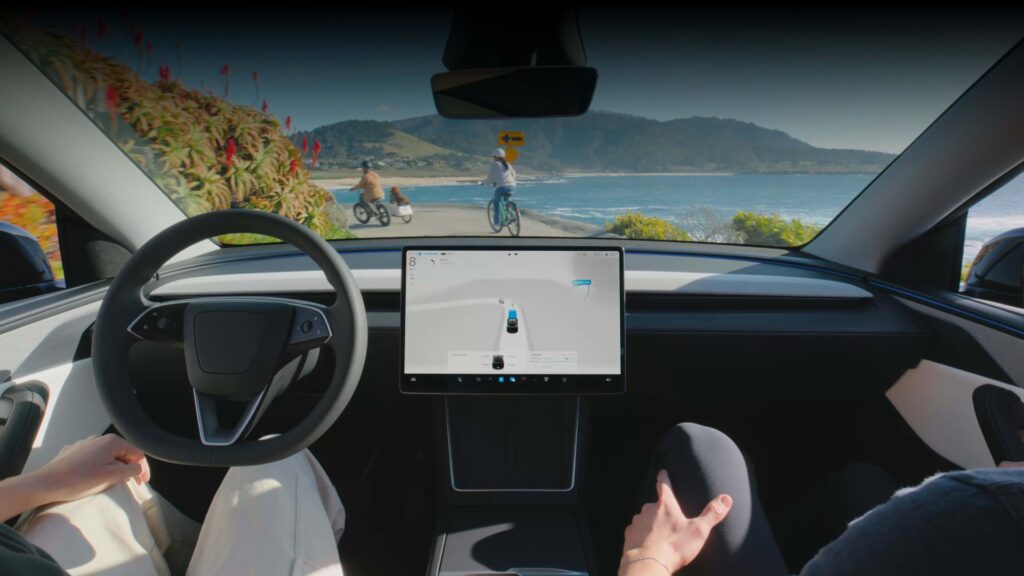
Tesla’s FSD (Supervised) already drives point to point. Tesla’s support page says it follows your navigation route, stops at and negotiates intersections, makes left and right turns, handles roundabouts and takes highway on- and off-ramps, on any type of road, including residential and city streets. You can engage it at any speed under 85 mph. It can also park itself and, with Actually Smart Summon, drive to you in a parking lot with no one inside.
Rivian’s shipping system is a step behind. Universal Hands-Free, part of the paid Autonomy+ package, lets Gen 2 R1 and R2 owners take their hands off the wheel on roads with clearly marked lanes, which Rivian says covers about 3.5 million miles of roads in the US and Canada. It changes lanes when you flick the turn signal. But it doesn’t follow your route, and Rivian’s Autonomy+ page notes that it won’t stop or slow down for traffic lights or stop signs.
Point to Point closes that gap. In Rivian’s words, the vehicle “follows your active turn-by-turn directions, handling supervised turns, highway transitions, and city streets to take you seamlessly from driveway to destination.” Rivian’s R2 Autonomy+ roadmap describes it as assisting with turns, lane changes and intersection maneuvers under your continuous supervision. It runs on the Large Driving Model, the in-house AI model Rivian introduced at its Autonomy & AI Day last December.
Neither system lets you look away. Rivian calls Point to Point “hands-free, eyes-on.” Tesla doesn’t use the hands-free label, but its cabin camera has handled attention checks since FSD v12.4, so the steering wheel nag goes away as long as the camera can clearly see your eyes. Look away too often and FSD strikes you out for the rest of the drive, and repeated strikeouts suspend it for a week.
Who qualifies
On the Rivian side, the line is the hardware generation. Point to Point is for Gen 2 vehicles, meaning the R1T and R1S from model year 2025 onward, plus every R2. Rivian’s support page puts the Gen 2 computer at about ten times the power of the Gen 1 system, and the camera, radar and driver-monitoring hardware changed too.
Gen 1 R1s, built for model years 2022 to 2024, are left out. Rivian’s early access page says so plainly (“Gen 1 and Canada excluded”), and Universal Hands-Free and Autonomy+ are Gen 2 features too. They keep Driver+, whose Highway Assist steers, brakes and accelerates on select highways. Rivian hasn’t announced any hardware upgrade path for Gen 1.
Tesla’s line is drawn differently. Cars with HW3 and HW4 (also called AI4) can both run FSD (Supervised) today, but they run different versions. Tesla’s newest software update, which started reaching cars on October 20, brings HW4 cars FSD v14.3.13 along with Automatic Collision Evasion, an HW4 feature that can step in if you look away while driving yourself. HW3 Model 3 and Model Y owners got FSD v14 Lite at the end of June, which Tesla says distills what HW4’s v14 learned into the older computer, and HW3 cars are now on v14.3 Lite. Some older Teslas need a paid hardware upgrade before they can subscribe at all, and Tesla’s subscription page tells you in the app if yours does. As a rule, a Model 3 built before the 2024 refresh has HW3, while the refreshed Model 3 and every Cybertruck have HW4. To be sure, check Controls, then Software, then Additional Vehicle Information on the touchscreen.
HW3 has a ceiling, though. On Tesla’s Q1 2026 earnings call, Elon Musk said HW3 “simply does not have the capability to achieve unsupervised FSD” because it has one-eighth of HW4’s memory bandwidth, as The Verge reported. Tesla plans a discounted trade-in toward an AI4 car, or a computer and camera retrofit, for owners who bought FSD. (Memory is turning into a bottleneck across the industry, as we covered in the RAMpocalypse.)
My own driveway shows the split. My 2023 R1T is a Gen 1 truck, so Point to Point, Universal Hands-Free and Autonomy+ are all off the table for it. The 2023 Model 3 parked next to it is an HW3 car, which means it can subscribe to FSD (Supervised) today and run the Lite version.
What it costs
Autonomy+ is $49.99 a month or $2,500 once, and the one-time purchase stays with the vehicle if you sell it. Point to Point comes inside Autonomy+ at no extra charge. New Rivians include a 60-day trial, and the R2 Performance with Launch Package includes Autonomy+ for the life of the vehicle.
FSD (Supervised) is $99 a month in the US, and there it’s subscription only now. Musk posted in January that Tesla would stop selling FSD after February 14, and Tesla’s support page confirms you can’t buy it outright. Owners who bought it earlier keep it on that car, but the program that let them move it to a new Tesla ended on March 31, 2026.
Over a year, Rivian’s subscription costs about $600 and Tesla’s about $1,188. Rivian’s one-time price pays for itself after about 50 months of subscribing. Tesla doesn’t offer that choice anymore.
Where it works
This is where Tesla is far ahead. Rivian sells cars only in the US and Canada, and Point to Point is US-only for now. Invitations start with owners in California and Florida, but once you’re enrolled, Rivian says the feature works on supported roads anywhere in the US. Canadian owners can use Universal Hands-Free but aren’t eligible for Point to Point early access yet.
Tesla’s subscription page lists 15 markets: the US, Canada, Mexico, Puerto Rico, Australia, New Zealand, the Netherlands, Lithuania, Estonia, Denmark, Belgium, Slovenia, the Czech Republic, Croatia and Slovakia. Tesla’s FSD page also lists China and South Korea. In much of Europe the system now goes by Tesla Assisted Driving, and Tesla’s Croatian page prices it at €99 a month. In most markets outside the US, HW3 cars are still waiting for v14 Lite. Tesla said in April that it plans to bring it to more markets but can’t give dates yet.
Side by side
| Rivian Point to Point | Tesla FSD (Supervised) | |
|---|---|---|
| Status | Invitations since October 15, software for early access in December 2026, broad release in 2027 | Available now |
| Roads | Route following on highways and city streets | Any type of road, including residential and city streets |
| Hands and eyes | Hands-free, eyes on the road | No wheel nag while the cabin camera sees your eyes, eyes on the road |
| Eligible cars | Gen 2 R1T and R1S (2025 on) and R2 | HW3 cars (v14.3 Lite) and HW4 cars (v14.3.13) |
| Left out | Gen 1 R1 (2022 to 2024) | Some older cars need a paid hardware upgrade first, and Musk says HW3 won’t go unsupervised |
| Price | Part of Autonomy+: $49.99/month or $2,500 once | $99/month in the US, subscription only |
| Regions | US (early access starts in California and Florida) | 15 subscription markets, plus China and South Korea |
The rollout timeline
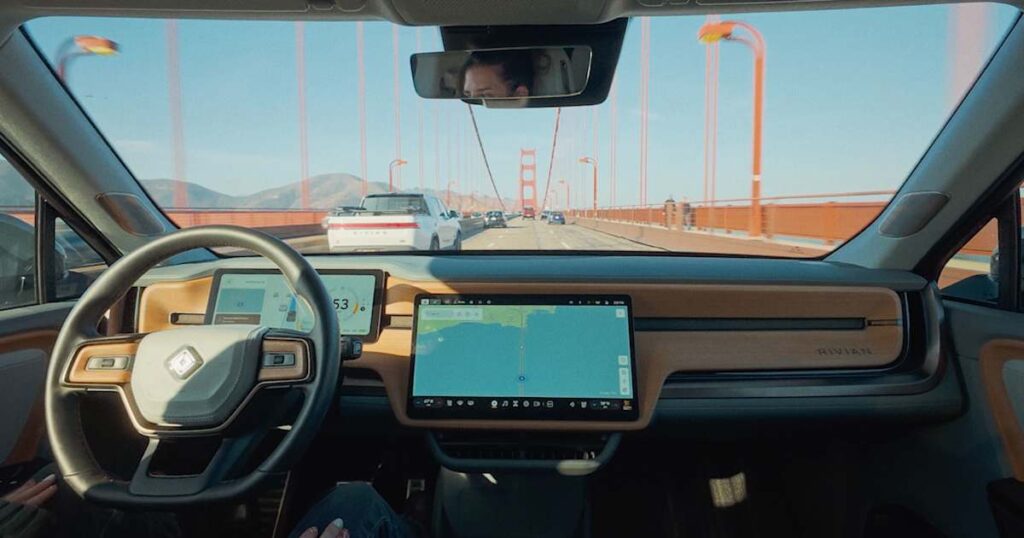
Rivian announced Universal Hands-Free at Autonomy & AI Day on December 11, 2025, and rolled it out to Gen 2 R1 owners later that month, according to its fourth-quarter shareholder letter. Paid Autonomy+ followed in 2026, and owners who took delivery before February 3 kept free access until April 4. In August, Rivian’s R2 roadmap set a limited Point to Point rollout for late 2026 and a widespread customer rollout for 2027.
Early access invitations started going out on October 15. Selection starts in California and Florida and favors owners who already use Autonomy features a lot and have a clean recent safety record. Free-trial owners can’t join, and testers work under a non-disclosure agreement, so don’t expect many videos at first. The software itself is targeted for December, so no owner is driving with Point to Point yet. Rivian has also sent a save-the-date for its second Autonomy & AI Day on December 9 in San Francisco, according to EV, though it hasn’t said whether Point to Point will be part of the show. We covered the program rules in detail in our Point to Point early access explainer.
Further out, Rivian’s second-quarter earnings presentation targets eyes-off driving for 2027 and an L4 robotaxi for 2028, dates it warns may change. Rivian hasn’t said which vehicles will get eyes-off. Its third-generation hardware, with the in-house RAP1 chip and LiDAR, debuts on the R2, and Rivian’s head of investor relations said in September that it reaches customers in 2027, as Electrek reported.
Tesla’s next steps depend more on regulators and hardware than on software reaching owners. The rest of the EU is waiting on a union-wide decision, and HW3 owners in most other markets are waiting on v14 Lite. Tesla has already said HW3 won’t reach unsupervised driving, and Rivian’s next big step lines up with new hardware on the R2, so neither company is promising today’s cars the whole road map.
Which one makes sense
If you own a Gen 2 R1 or an R2, Point to Point is coming at no extra cost on top of Autonomy+, and the $2,500 one-time price is something Tesla no longer offers. Signing up for early access only makes sense if you’re happy to drive it every week, report issues and keep quiet about it.
If you want door-to-door supervised driving today, or you live outside the US, FSD (Supervised) is the only one of the two you can use. If you own a Gen 1 R1, neither system is available to your Rivian, and Rivian hasn’t said anything to change that.