
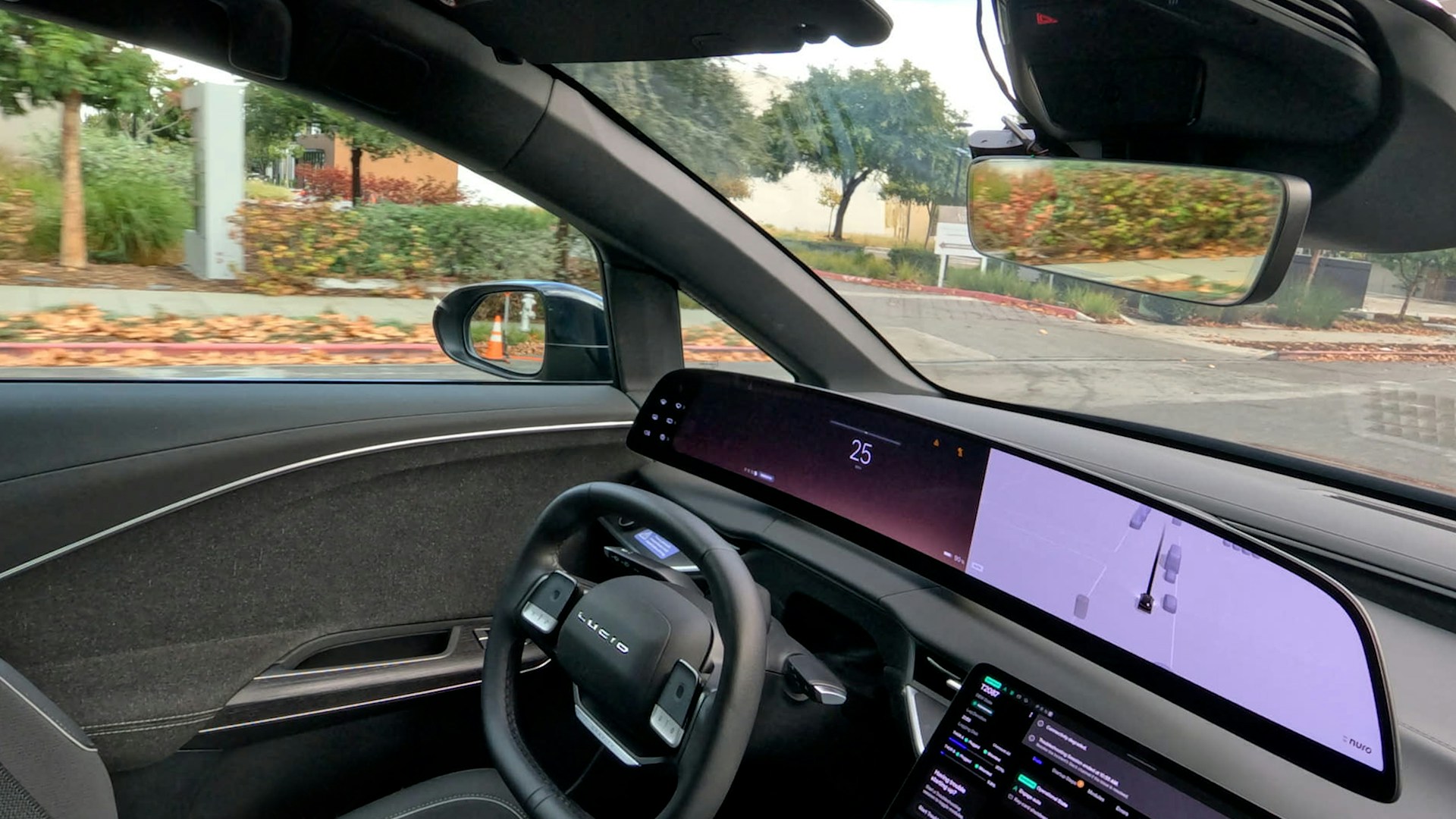
The Lucid Gravity robotaxi is now driving itself on public roads with nobody in the driver’s seat. Nuro, Lucid and Uber announced on November 24, 2026 that fully driverless testing has started in Palo Alto, Mountain View, Los Altos and Sunnyvale, with employee rides coming soon and a public launch on Uber expected in the first quarter of 2027.
Lucid has also delivered more than 100 updated Gravity robotaxis for this phase, with hardware, software and rider-experience changes that the companies say bring the vehicle closer to commercial service.
4 cities
Palo Alto, Mountain View, Los Altos and Sunnyvale
100+ vehicles
Updated Gravity robotaxis delivered by Lucid
Q1 2027
Expected public launch on Uber in the Bay Area
Inside the Lucid Gravity robotaxi
The robotaxi starts as a Lucid Gravity, the brand’s three-row electric SUV, and adds the Nuro Driver, an end-to-end Level 4 autonomous driving system. Level 4 means the car handles all of the driving inside a defined area and set of conditions, with no human expected to take over.
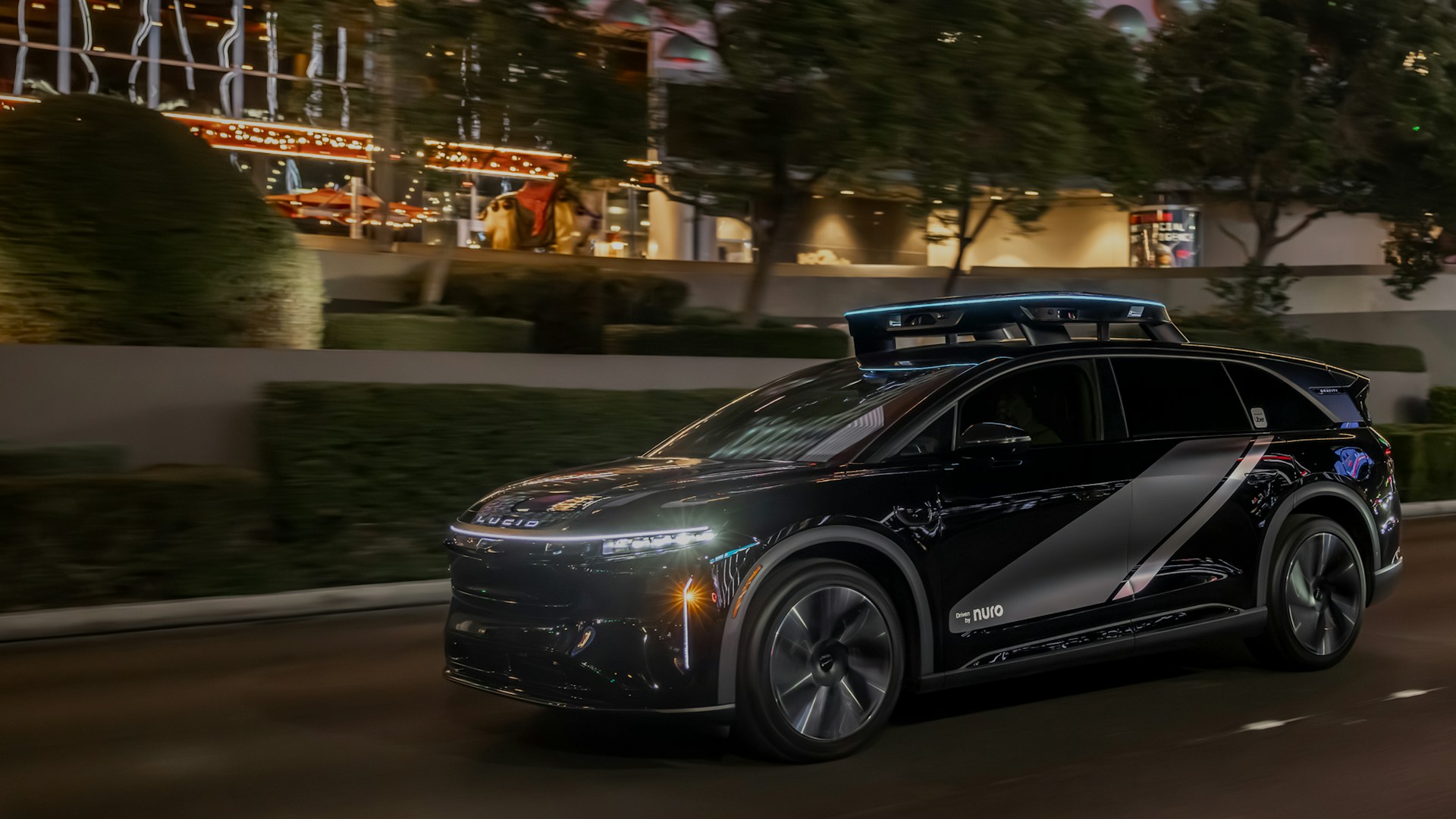
According to the joint release, the vehicle uses a redundant sensor suite of cameras, lidar and radar plus a roof-mounted halo. Nuro’s program page adds more detail. The sensors are built into the body and the low-profile halo for 360-degree awareness, and the computing runs on NVIDIA DRIVE AGX Thor. Lucid installs the autonomy hardware on the production line at its Casa Grande, Arizona, factory rather than bolting it on afterward.
The halo does double duty for riders. An LED display on it shows the passenger’s initials so you can pick out the right car at a busy curb, and it gives status updates from pickup through dropoff.
The cabin is set up for groups, with seating for up to six passengers and room for luggage. Interactive screens let riders adjust the heated seats, climate and music, contact support, or ask the vehicle to pull over. A real-time visualization shows what the car sees and what it plans to do next, including yielding to pedestrians, slowing for lights and changing lanes. Uber is designing the broader in-cabin experience, including personalization, support and rider controls, while Nuro provides the autonomy visualization. Nuro’s page lists the Gravity’s range at up to 450 miles, which helps keep a fleet vehicle on the road longer between charges.
Driverless testing means no safety operator on board
Since December 2025, Nuro has run round-the-clock autonomous testing of the Gravity robotaxi in the San Francisco Bay Area and Houston, always with a safety driver present. The new phase removes that person entirely.
The companies say the decision comes from Nuro’s Safety Case Framework, a structured process that gathers evidence from on-road testing, large-scale simulation, system performance data and operational procedures, then checks it against defined safety and reliability requirements. Part of that work happened on a closed course at Nuro’s Las Vegas facility, where the team ran no-vehicle-operator testing through rare and difficult situations such as pedestrian encounters, right-of-way violations, road hazards and unusual traffic.
Tilo Schwarz, Nuro’s Vice President of Engineering and Head of Nuro Driver, put it this way: “Driverless isn’t new to us, but this marks an exciting first: bringing that experience to a passenger vehicle as we take the next step toward launching our next-generation robotaxi program.” Nuro’s earlier driverless work was with small delivery vehicles, so this is its first time removing the driver from a car built to carry people.
Two California permits made the step possible. Earlier this year Nuro received a CPUC Drivered Pilot Permit, which allows passenger rides with a safety operator, and a California DMV Driverless Testing Permit. The release says that makes Nuro one of just six companies allowed to test on California public roads with no driver behind the wheel.
The robotaxi tests in four South Bay cities, day and night
Driverless testing covers Palo Alto, Mountain View, Los Altos and Sunnyvale for now, with more Bay Area cities planned next year. The California DMV’s permit list spells out the limits for Nuro’s “Lucid Gravity R3 Nuro Robot”: driverless testing in Santa Clara and San Mateo counties at all times of day and night, on dry or wet pavement including light rain and light to moderate fog, at speeds up to 45 mph.
If you live or work in those four cities, an empty-seat Gravity with a glowing roof halo is now a realistic sight in regular traffic.
Public Uber rides are expected in Q1 2027
The public cannot ride yet. The next step is driverless rides for employees, which the companies say will begin soon. After that, the service is expected to open to the public in the Bay Area in the first quarter of 2027, booked through the Uber app like any other ride.
The robotaxis will be available only on Uber. The vehicles will be owned and operated by Uber and its fleet partners, not by Lucid or Nuro.
Samarth Kejriwal, Uber’s Global Head of Autonomous Mobility, said the partners will spend the coming months refining “our operations, infrastructure, and the in-cabin experience” ahead of the first driverless passenger rides. The partners had first aimed for a late-2026 launch, and Nuro COO Andrew Chapin told Axios the partners pushed the target to early 2027 as they finish the product and work through final permitting, calling it “a little bit of a push to the right” that is “not something substantial.”
Houston is next
Houston is the program’s second planned market. Nuro, Lucid and Uber announced in June that robotaxi service is coming there in 2027, and the Gravity has already been part of the supervised testing in Houston since December 2025.
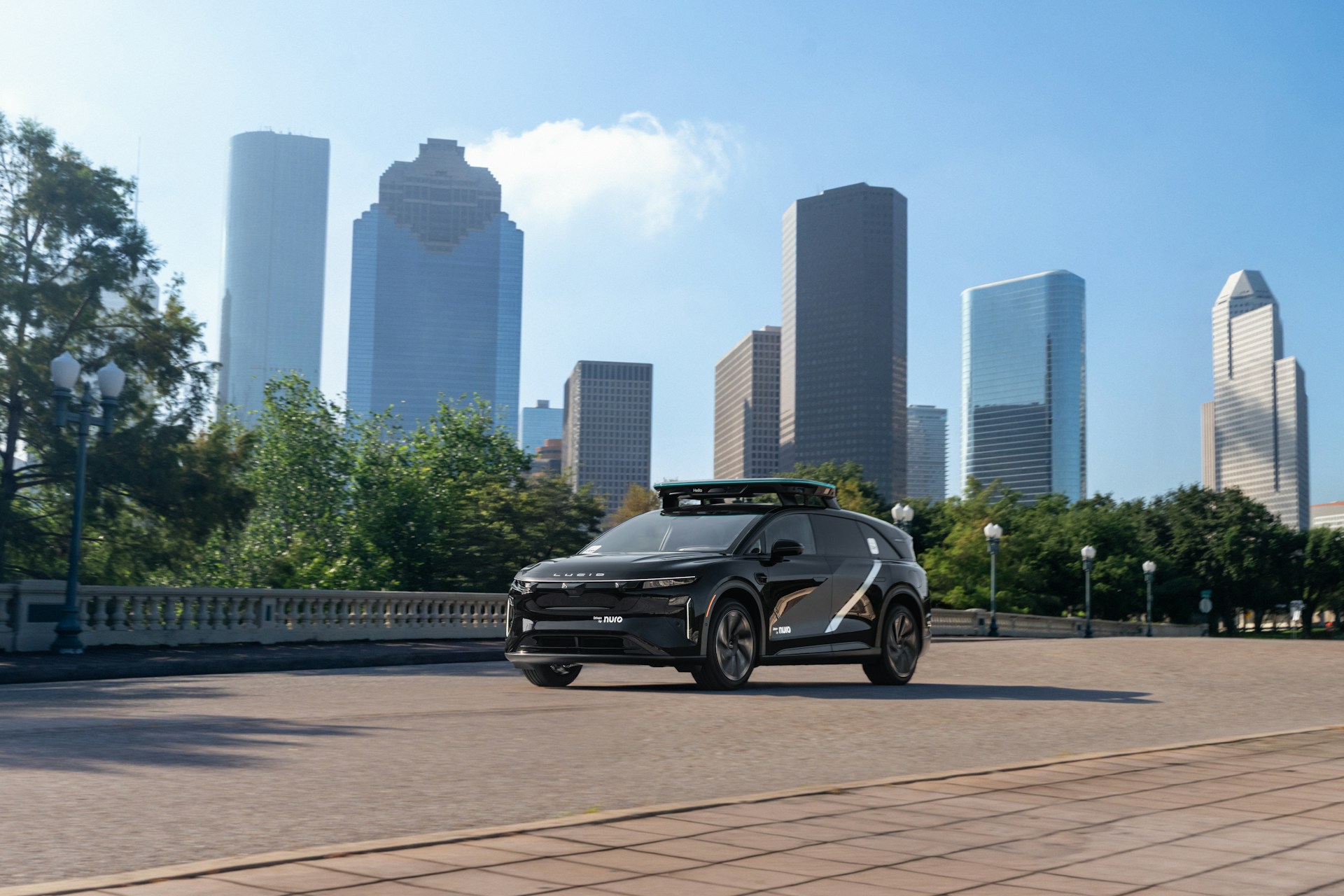
Beyond those two cities, Uber has committed to purchase at least 35,000 Lucid vehicles equipped with the Nuro Driver, with plans to expand across dozens of markets around the world in the coming years.
Lucid’s midsize platform joins the fleet later
The Gravity is only the first vehicle in this program. The release says the service will use the Gravity “as well as future Lucid Midsize vehicles equipped with the Nuro Driver.” That ties the robotaxi plan directly to Lucid’s next platform, which we covered in our look at the Lucid Cosmos release date. Lucid has said production of its midsize vehicles is planned for the second half of 2027.
Kay Stepper, President of Lucid Technologies and Chief Digital Officer at Lucid, credited “the strength of Lucid’s software-defined vehicles, our manufacturing velocity, and the close collaboration among all three partners” for the milestone.
Lucid isn’t alone in building the robotaxi hardware in at the factory. Waymo is taking a similar route with Toyota, as we explained in our story on Waymo’s bZ4X robotaxi with factory-installed sensors.
FAQ
Can I ride the Lucid Gravity robotaxi yet?
Not yet. Employee rides in the driverless vehicles come first and are set to begin soon. Public rides in the Bay Area are expected to begin in the first quarter of 2027 through the Uber app.
Where is the driverless Gravity testing?
Palo Alto, Mountain View, Los Altos and Sunnyvale, with more Bay Area cities planned next year. Houston is the second planned market, with service expected in 2027.
How will I know which car is mine?
The LED display on the roof halo shows your initials and gives status updates from pickup to dropoff, much like checking a license plate in the Uber app today.
Will Lucid sell the robotaxi version to the public?
No. The robotaxis are owned and operated by Uber and its fleet partners and are available only through the Uber network.