
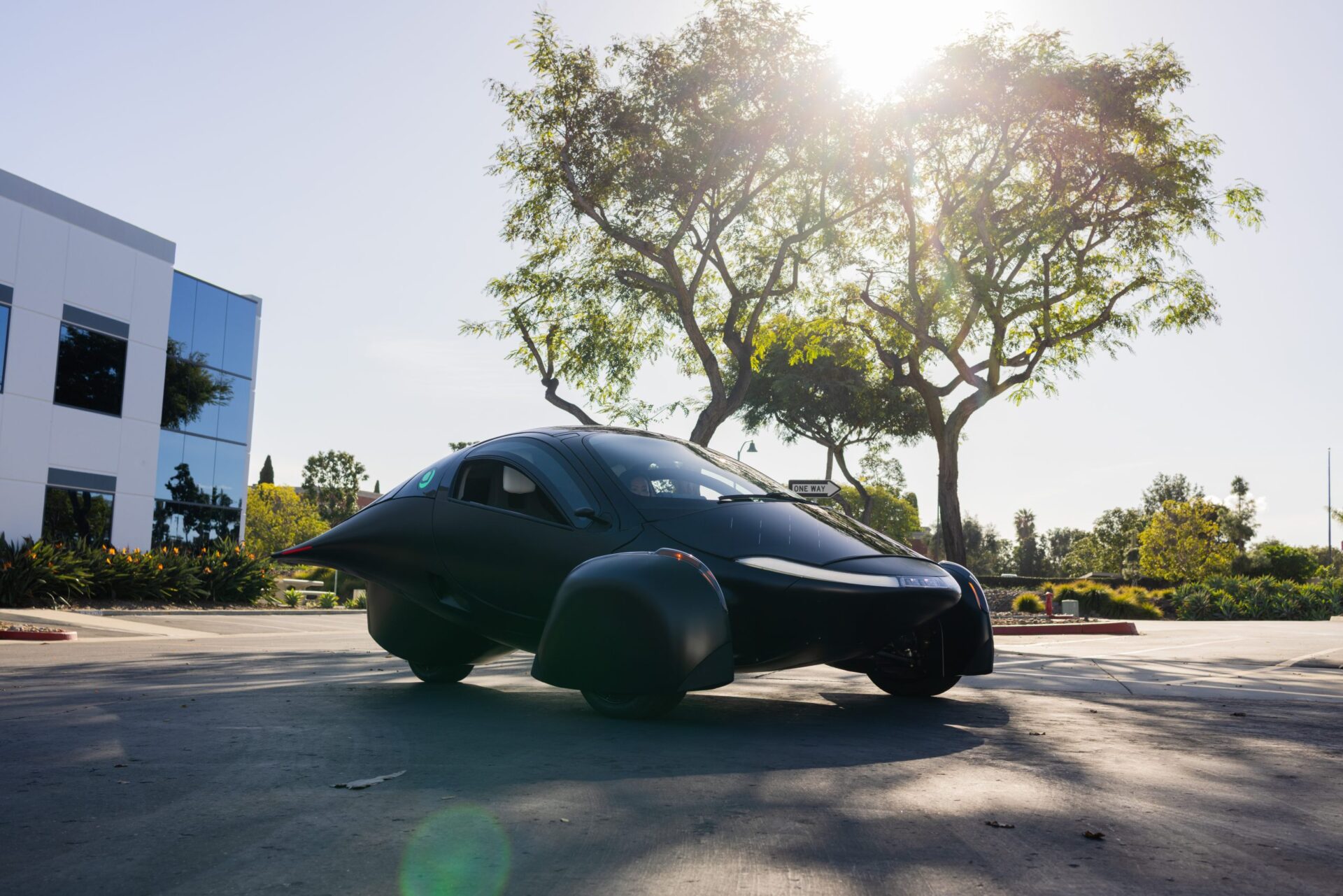
The first Aptera customer vehicle is complete. Aptera Motors, based in Carlsbad, California, announced on November 19 that it has finished its first vehicle built for sale to a customer, which it calls its first production solar electric vehicle. The car is finished in Noir, a matte black exterior, and Aptera says it intends to export it to the buyer outside the United States (Aptera).
The buyer is Martin Hartono, CEO of GDP Venture, who holds Accelerator #1. Accelerators are early Aptera investors whose delivery positions are ranked by how much they invested (Aptera). Aptera did not give a delivery date, a price or a trim for the car.
The first Aptera customer vehicle goes to Accelerator #1
Aptera ran its Accelerator Program from January 2023 to January 2024. It offered the first 2,000 delivery positions to investors who put in at least $10,000, and the average Accelerator invested about $18,700 (Aptera Form 10-Q, Nov. 13, 2026).
“To Accelerator #1, and to every reservation holder and shareholder who believed in this vehicle: thank you. We’re working to complete more vehicles for early customers as soon as possible,” Co-CEO Chris Anthony said in the release.
The release cautions that completing a single vehicle “is not indicative of future deliveries,” and that the sale, export, delivery and registration of this car are still to be completed (Aptera).
Aptera’s solar claim has independent test data behind it
The Aptera is a three-wheel EV with solar cells built into its body, and it also plugs in like any other EV. Aptera says the solar panels are designed to add up to about 40 miles of driving a day under favorable conditions (Aptera).
In July, TÜV Rheinland measured the solar energy that reached the battery over three days at Aptera’s Carlsbad facility. Left parked and untouched all day, the car delivered 4.23 kWh. Turned once at solar noon, it delivered 4.40 kWh, and with its rear hatch raised and angled toward the sun, 4.75 kWh. Aptera converts those to roughly 42, 44 and 47 miles using its targeted efficiency of 100 watt-hours per mile, and notes that results will vary with weather, location, parking and season (Aptera, Aug. 27, 2026).
49,000+
Aptera reservation holders, Sept. 30, 2026 (10-Q)
4.23 kWh
Solar energy into the battery on a parked day, TÜV Rheinland
400 mi
Aptera’s range target, 44 kWh Launch Edition (not EPA-rated)
Aptera says its first 5,000-plus vehicles will be the Launch Edition, with a 44 kWh battery designed for 400 miles of range, a target price of $40,000, 0 to 60 mph in under 6 seconds and an expected top speed of 101 mph (Aptera FAQ). For scale, the BMW iX5 we covered this week uses a 144 kWh pack for an EPA rating of up to 456 miles. Aptera’s 400-mile figure is a company design target, not an EPA range rating.
The first customer car comes about three years after Aptera’s production goal
Aptera began taking $100 reservations in December 2020 and had more than 49,000 reservation holders as of September 30, 2026 (Form 10-Q). In January 2023, the company set a goal to begin production by the end of that year, while saying its timeline depended on funding (Aptera, Jan. 20, 2023).
The milestones came in 2026. The first vehicle left Aptera’s 14-station validation line on March 3 (Aptera), and five validation cars were done by May 12 (Aptera). The EPA issued a Certificate of Conformity for the 2026 Aptera Launch Edition on June 18, which covers federal emissions requirements (Aptera). In August, Aptera ordered bodies and chassis for its first 40 production vehicles (Aptera).
Deliveries to US reservation holders hinge on safety compliance and funding
This first car is going to a buyer outside the United States. For reservation holders in the US, Aptera’s November 13 quarterly filing names compliance with the Federal Motor Vehicle Safety Standards as the last federal step before US deliveries, and Aptera is working to demonstrate it with validation vehicles. The same filing says Aptera’s cash at September 30 was not enough to fund operations for the next 12 months, and that substantial doubt remains about its ability to continue as a going concern (Form 10-Q).
In October, Aptera cut its estimate of the money needed to reach start of production to about $25 million, from $40 million to $45 million. It plans to start building the first 40 production vehicles by the end of 2026 and begin customer deliveries in early 2027, subject to timely financing. It puts the cost of reaching 500 vehicles a month, the rate where it believes the business could fund itself, at about $65 million in total (Aptera, Oct. 1, 2026).
FAQ
When will US reservation holders get their Aptera?
Aptera has not given a date. Its October plan targets customer deliveries in early 2027, subject to financing, and US sales also require compliance with federal safety standards. Aptera says delivery order depends on reservation date, configuration, location and, for Accelerators and other investor programs, investor status (Aptera FAQ).
Is Aptera’s 400-mile range an EPA rating?
No. The EPA certificate Aptera received in June covers emissions compliance. The 400-mile range and the 40 miles a day of solar driving are Aptera’s own design targets, based on its targeted efficiency of 100 watt-hours per mile.
How is the Aptera registered?
Aptera says the car is classified, registered and insured as an autocycle or a motorcycle, depending on the state. It also says a standard driver’s license is enough to drive it in every state except Alaska (Aptera FAQ).
Sources
- Aptera: Aptera Completes Its First Solar Electric Vehicle for Customer Delivery (Nov. 19, 2026)
- Aptera Motors Corp.: Form 10-Q for the quarter ended Sept. 30, 2026 (filed Nov. 13, 2026)
- Aptera: Reduced estimated capital requirements for production (Oct. 1, 2026)
- Aptera: TÜV Rheinland solar testing (Aug. 27, 2026)
- Aptera: Bodies and chassis for first 40 production vehicles (Aug. 4, 2026)
- Aptera: EPA Certificate of Conformity (July 7, 2026)
- Aptera: First five validation vehicles (May 12, 2026)
- Aptera: First vehicle off validation line (March 3, 2026)
- Aptera: Launch Edition announcement (Jan. 20, 2023)
- Aptera: FAQ
Disclosure: Electron Motion’s publisher is a proud Aptera investor and reservation holder.