
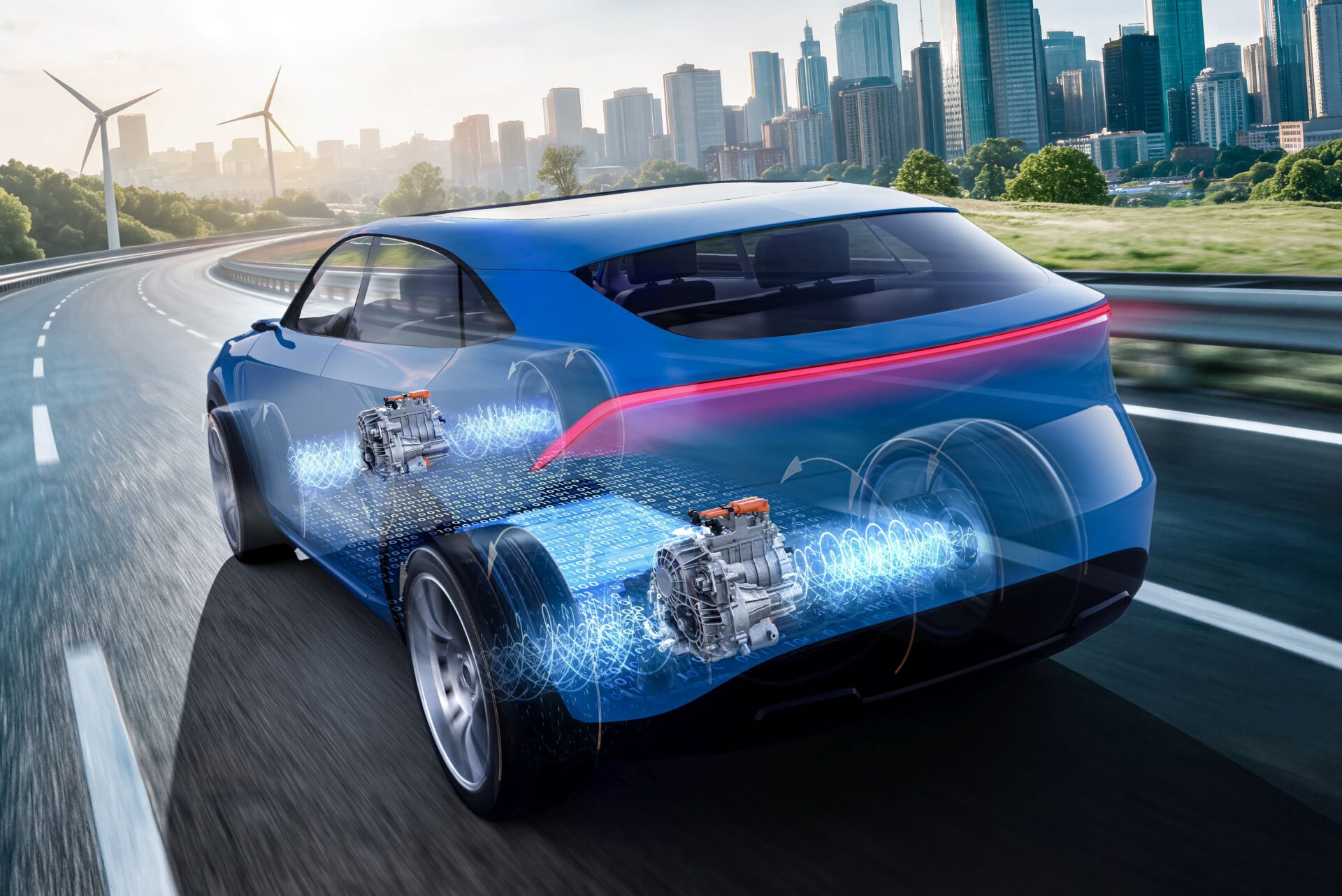
ZF, the German supplier that builds drive units and transmissions for many automakers, has shown an electric drive whose motor spins up to 30,000 rpm. That is a high number for a motor aimed at ordinary family cars rather than hypercars, and it is the whole point. ZF says its new High Revolution Drive is nearly 25 percent smaller and nearly 25 percent lighter than a comparable ZF drive that tops out at 18,000 rpm, while needing half the magnet material and running at nearly the same efficiency.
The idea behind it is old physics put to a new cost problem. Understanding it also explains why so many EV makers keep chasing motor speed.
Power is torque times speed
An electric motor’s power output is its torque multiplied by how fast it spins. If you want 200 kW, you can get there with a lot of torque at modest speed, or with less torque at high speed.
That choice matters because torque is closely tied to the size of the rotor, the spinning part inside the motor. ZF makes the same point in its announcement: at the same power, higher speed reduces the torque the motor has to produce, and a lower-torque motor can be built smaller and lighter. In a permanent-magnet motor, a smaller rotor also means fewer magnets.
Here is what that looks like at the 200 kW peak ZF quotes for the version it showed:
| Motor speed | Motor torque needed for 200 kW |
|---|---|
| 18,000 rpm | about 106 Nm |
| 30,000 rpm | about 64 Nm |
Those figures are our own calculation from the basic power formula, not ZF data. They show roughly 40 percent less torque required at the higher speed for the same power.
The 18:1 gearbox turns speed back into push
A car does not need its wheels spinning at 30,000 rpm, so the speed has to come down before it reaches the tires. ZF uses a two-stage gear reduction of about 18:1. Two-stage here means the reduction happens through two sets of gears in a row, not that the car has two selectable gears. It still drives like any single-speed EV.
Gearing down multiplies torque. ZF quotes 3,500 Nm of peak torque at the wheels, which is about 2,581 lb-ft. Dividing by the ratio, the motor itself needs to produce only about 194 Nm at its peak to deliver that.
The comparison with a slower motor is where the size savings come from. As an illustration, assume a tire about 2.2 meters around, which is in the range of a typical compact SUV tire. At 30,000 rpm through an 18:1 reduction, the wheels turn about 1,667 rpm, which works out to roughly 137 mph. A motor limited to 18,000 rpm would need a ratio closer to 10.8:1 to reach that same top speed. To deliver the same 3,500 Nm at the wheels with that shorter gearing, the motor would have to make about 324 Nm, around two thirds more than the faster motor.
That extra motor torque is the material ZF is trying to remove. The tire size and top speed in this example are our assumptions to show the relationship; ZF has not published a target top speed or vehicle.
Half the magnets matters more than the weight
ZF’s headline claims are nearly 25 percent less volume, nearly 25 percent less weight and 50 percent less magnet mass compared with its 18,000 rpm SELECT drive at the same 200 kW. ZF says efficiency stays near 93 percent, roughly matching that SELECT system.
The magnet number is the one that should get automakers’ attention. Most EV motors use permanent magnets made with rare earth elements such as neodymium, and that supply chain is concentrated in China. Cutting magnet mass in half reduces both cost and exposure to that supply risk. ZF says as much, citing lower costs and reduced dependence on critical supply chains.
The weight savings help range, as ZF notes, but ZF has not said how many kilograms the drive actually weighs, so there is no honest way to turn the 25 percent figure into miles. A drive unit is a modest share of a car’s total mass next to the battery and body, so the range effect is likely to be small on its own. The space savings may be more useful in practice: a shorter, smaller drive gives engineers more room for crumple zones, cargo space or a lower hood.
Faster motors bring their own problems
Higher speed is not free. Spinning parts at 30,000 rpm puts large forces on the rotor, and high-speed gears and bearings are harder to keep quiet. Noise and vibration are the challenges ZF highlights, and the company says it designed the motor, gearing, bearings and tooth shapes together as one system to keep them under control. ZF describes 30,000 rpm as the economic and technical sweet spot for this configuration, which suggests going faster would cost more than it saves.
A buyer will never see a spec sheet line for gear whine, but it is the kind of thing that shows up on a test drive. Quietness at highway speed is where this kind of design either works or does not.
Other automakers are chasing the same tradeoff
ZF is not the only company pushing smaller, cheaper drive units. Lucid, already building the Gravity GT-S, introduced a new drive unit called Atlas for its upcoming midsize platform in March, saying it extends Lucid’s efficiency lead while lowering cost. Different companies take different routes, from higher motor speeds to new magnet layouts to motors that avoid rare earths entirely, but the goal is the same: the same performance from less expensive material.
What makes ZF’s approach notable is the target market. ZF is aiming at high-volume passenger cars with drive outputs of about 150 to 200 kW, roughly 200 to 268 hp. That covers the power range of many mainstream compact and midsize EVs. The drive is built on ZF’s existing SELECT platform and is designed for both 400-volt and 800-volt cars, which should make it easier for an automaker to fit into a new model without starting from scratch.
When it could reach a car you can buy
Not soon. ZF says it is in talks with several automakers and is targeting production by 2030. It has not named a customer or a vehicle. The drive is still in pre-series development, so the size, weight and magnet numbers are ZF’s targets for now, not measurements from a car on sale.
For anyone shopping for an EV today, this changes nothing about what to buy this year. It does show where the cost of an EV drive unit is heading. If suppliers can deliver the same power with half the magnets and a smaller housing, that is one more piece of the cost gap between electric and gas cars getting smaller, even if no single part decides the sticker price.
That 18:1 ratio is the hinge of the design. It is how ZF turns a smaller, lower-torque motor into the wheel torque it quotes, and it helps explain why 30,000 rpm is being considered for ordinary cars.