
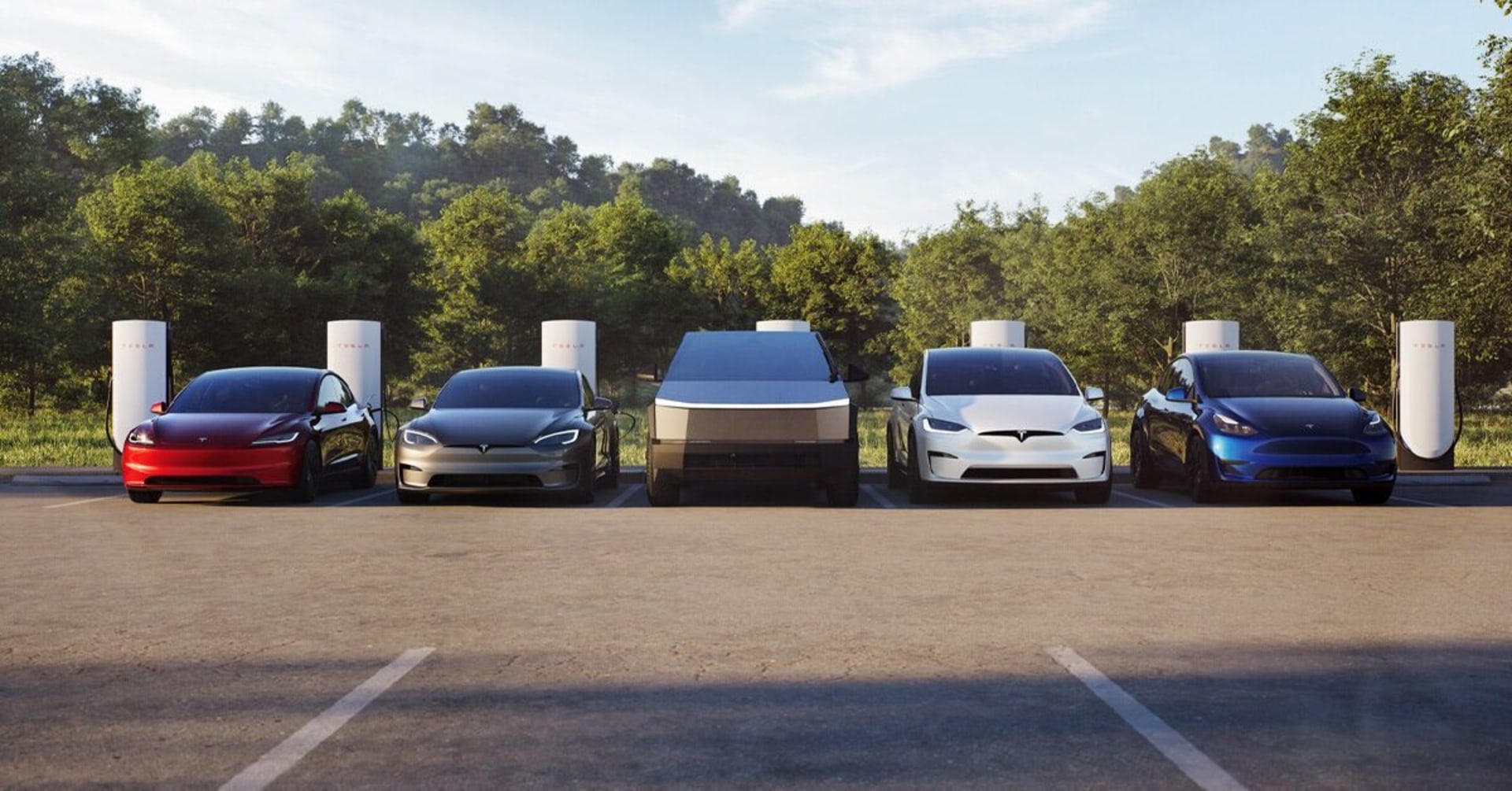
Elon Musk said Tesla will wind down Cybertruck production at Gigafactory Texas around mid-2027 so the plant can build more Cybercabs. Trucks already delivered keep rolling. New ones are still for sale while that Texas line runs. The announcement is a good moment to remember what this strange pickup actually delivered for drivers, and to ask Tesla what future remains for cars people still steer themselves.
Cybertruck never tried to look like every other truck in the lot. Stainless panels, a flat windshield, steer-by-wire, four-wheel steering, and a bed that can run tools turned a polarizing sketch into something you could order and drive. Love the shape or not, the engineering underneath was ambitious in ways that showed up in daily use.
Steering that shrinks a big truck
Cybertruck uses steer-by-wire: there is no mechanical column tying the steering wheel to the road wheels. Sensors and actuators do the work, with redundancy built in. All four wheels steer, so the rear helps the front. Tesla lists about 0.94 turns lock to lock and a curb-to-curb turning circle near 43.5 feet. In a full-size electric pickup, that is the difference between wrestling a long wheelbase around a city block and simply placing the truck where you want it.
48 volts for the little stuff
Most cars still run a 12-volt network for lights, pumps, and controllers. Cybertruck’s low-voltage system is 48 volts. For the same power, higher voltage means lower current, which allows lighter wiring and leaner power electronics for accessories. The drive battery is separate and high voltage (Tesla lists it around 700 volts nominal), which is the pack that feeds the motors and the fast-charging path people group in the 800-volt class. Our 800-volt charging explainer puts Cybertruck in that company. The split is elegant: a modern accessory bus down low, a serious traction pack up high.
Stainless skin and a working bed
The exoskeleton look is stainless steel, not a painted shell trying to fake toughness. The planes and angles are the design. You notice them in a parking garage the same way you notice them on a billboard.
The bed is where the truck earns its keep. Depending on build, Cybertruck can include a powered tonneau, under-bed storage, and bed tie-downs. When the powered cover is fitted, it opens from exterior buttons, the touchscreen, or the app while the truck is unlocked and in Park. Closed, it turns the bed into a lockable vault and helps the aerodynamics a little. Treat those pieces as configuration-dependent; Tesla says as much for tonneau, storage, and related hardware.
Power for tools, and power for home
Premium All-Wheel Drive and Cyberbeast Cybertrucks put real outlets on board: two 120-volt outlets in the cabin and, in the bed, two 120-volt outlets plus a 240-volt outlet. Tesla rates onboard outlet power at up to 9.6 kW, enough for jobsite tools or to add range to another EV. That is plug-in power from the truck itself. Dual Motor All-Wheel Drive builds without that package do not get those outlets.
Sending electricity to a house is different. Powershare Home Backup uses the charge port and installed home gear (a Wall Connector or Universal Wall Connector, and either a Powershare Gateway or a compatible Powerwall setup), not the bed outlets. Tesla says Powershare is available on every Cybertruck, with up to about 11.5 kW continuous for home backup when the hardware is in place. Outlets for a compressor are standard convenience on the trims that have them. Whole-home backup is an installation.
Towing and pace, by the chart
Tesla’s Cybertruck page lists Dual Motor All-Wheel Drive at 7,500 pounds of towing and Premium All-Wheel Drive and Cyberbeast at 11,000 pounds, with payload up to 2,500 pounds. Cyberbeast’s published 0 to 60 mph figure is 2.6 seconds; the dual-motor trucks are slower and still quick for their weight. Peak Supercharging is listed up to 325 kW on configurations that support it. Match the row on the chart to the truck you are looking at.
What we hope Tesla keeps building
Cybertruck is a human-driven machine: wheel, pedals, a person in charge. Giving Texas floor space to Cybercab makes the next question sharper. What future does Tesla still plan for vehicles people drive themselves?
We asked that in our open letter, Dear Tesla: Please Build a Driver’s Car the Rest of Us Can Afford. When Musk talked about the Roadster as, long-term, Tesla’s only manually driven car, we read “manually driven” the way he meant it: a car you steer, not a stick-shift trivia answer. We are glad Tesla builds robotaxis. We still want affordable driver’s cars with a real wheel, FSD for the miles you would rather hand off, and room in the lineup for people who love to drive.
Cybertruck proved Tesla can obsess over a vehicle you operate: steer-by-wire that tightens a giant footprint, a 48-volt backbone, stainless bodywork, a bed that powers tools, and a charge port that can, with the right install, help carry a home through an outage. The fleet will be around for a long time. Please keep a future for the Teslas we drive ourselves, not only for the ones that drive us.