
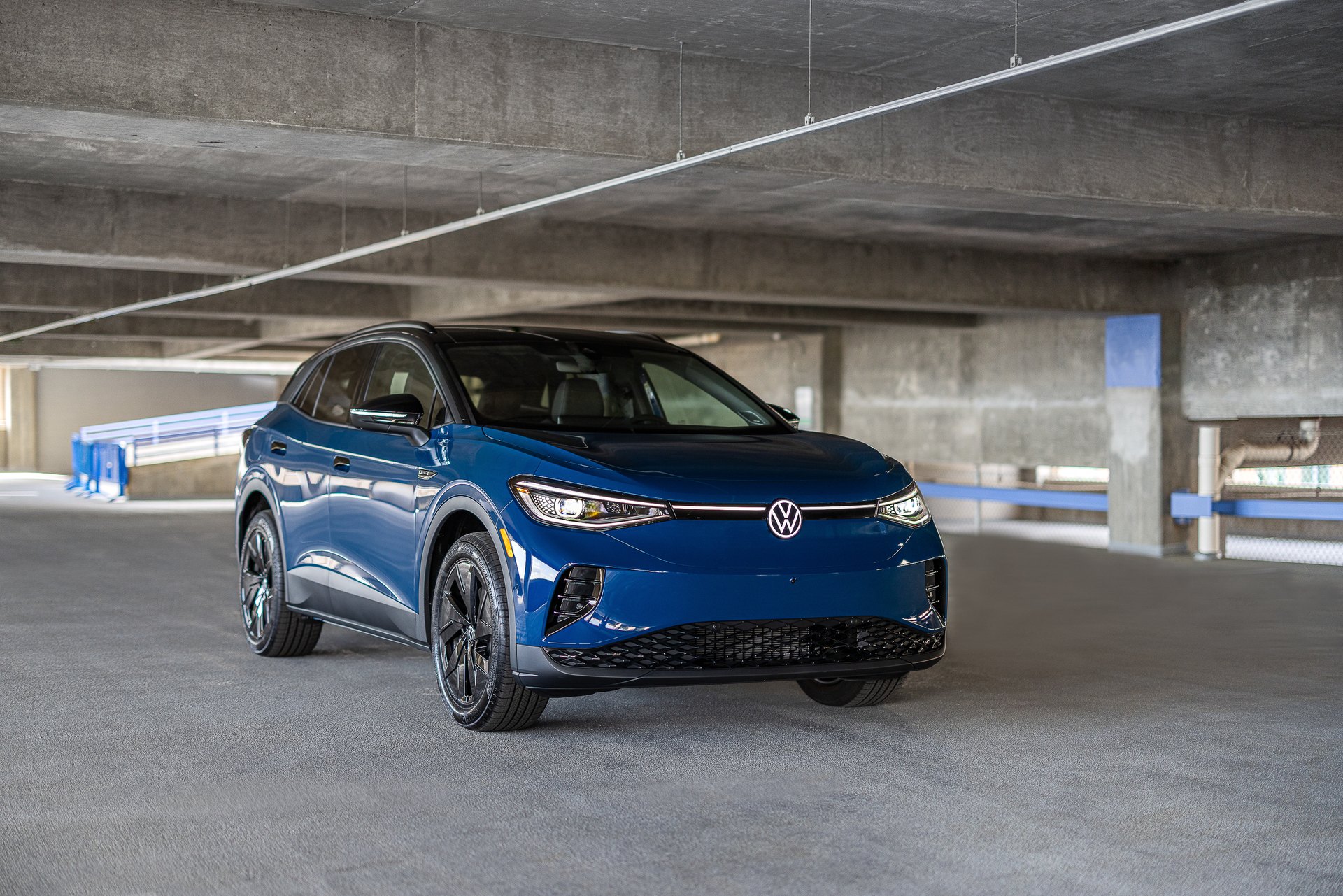
The VW ID.4 recall comes with a deadline this week: Volkswagen plans to put a temporary 80% charging cap on 22,524 recalled ID.4s in the U.S., and owners who don’t want it have until Wednesday, Oct 21 to decline. The setting is part of safety recall 93EX (NHTSA campaign 26V630), which covers a high-voltage battery fire risk that VW says is linked to charging above 80%. VW still does not know the root cause, so there is no permanent repair yet.
If you own a 2023 to 2026 ID.4, here is what is going on and what you can do this week.
What’s happening
According to VW’s recall report to the National Highway Traffic Safety Administration, certain charging patterns combined with a state of charge above 80% may set off thermal propagation inside the battery in some affected packs. In plain terms, a problem in one part of the pack can spread to the rest, and that can lead to a fire.
VW’s own timeline shows how it got here. In June, a review of battery thermal events in the field pointed to a possible link with certain isolation resistance readings and the share of DC fast charging. A field study followed. On Sept. 23, VW’s Product Safety Committee decided to recall the affected U.S. vehicles even though the root cause is still unknown. The filing lists 22 U.S. claims between January 2024 and August 2026, and VW estimates that about 0.1% of the recalled cars have the defect.
VW has not told owners to stop driving or to park outside. Its recall FAQ says the main precaution is simply to keep the charge at or below 80% until a fix is ready.
Who’s affected by the VW ID.4 recall
The recall covers 22,524 ID.4s from model years 2023 through 2026, according to NHTSA. The battery cells come from SK Battery America in Commerce, Georgia, and InsideEVs reports that all of the recalled cars were built at VW’s Chattanooga, Tennessee, plant, where the 2026 ID.4 press kit says U.S. ID.4s are assembled. VW chose the affected cars using assembly and battery tracing records, supplier production data and charging data. ID.4s outside that group either have cells built outside the suspect range or have charging histories that VW says stayed below its threshold.
The recall also reaches Canada. VW’s dealer notice lists 5,633 Canadian ID.4s from model years 2023 to 2025, and Transport Canada recall 2026469 tells those owners to set their maximum charge to 80% until repairs are done. Transport Canada notes that an overheating battery can be a fire risk even when the vehicle is parked and turned off, which is why the 80% setting matters even for cars that sit most of the day. The U.S. and Canadian filings don’t cover ID.4s sold in Europe or other markets.
This is not the first battery recall for the ID.4 this year. NHTSA’s records show two earlier ones filed in January, including campaign 26V030, which covered 43,881 model year 2023 to 2025 ID.4s for a battery that may overheat.
How to check your VIN
Enter your 17-character VIN at nhtsa.gov/recalls. VINs for this campaign have been searchable there since Oct. 6. The VIN is on the driver’s side of the dashboard, visible through the windshield, and on your registration. VW’s own recall lookup and the myVW app will also show the recall if your car is included.
The choice, and what it means
Owners of affected cars are getting a notice in the myVW app, and InsideEVs reported on Oct 18 that owners have been sharing photos of it. VW’s email version of the notice, filed with NHTSA, lays out two options:
- Accept, or do nothing. VW will apply a temporary setting that limits charging to 80% on or about Oct 27. You can tap Accept Setting in the app, or simply take no action.
- Decline by Oct 21. Open the myVW app, find the 93EX High-Voltage Battery Settings notice on the home screen and select Decline Setting. Your car will be left out of the change.
Declining does not mean VW thinks charging to 100% is fine. The notice says owners who opt out should keep limiting the charge to 80% themselves, using the car’s charge settings or the app. VW strongly recommends allowing the change, and it calls the cap an interim risk reduction step rather than a fix.
The recall report adds that whether VW can set the limit remotely depends on how a car is configured and whether it is online. Every affected owner will also get a warning sticker reminding drivers not to charge above 80%.
What the cap means for range
VW’s FAQ says the 80% limit may cut the range you have between charges. As a rough guide, here are the EPA range ratings for affected model years from fueleconomy.gov, with our estimate of 80% of each figure, rounded to the nearest mile. Real range will vary with weather, speed and terrain, and cold weather will cut it further.
| Model year and trim | Drive | EPA range | 80% of EPA range (estimate) |
|---|---|---|---|
| 2023 ID.4 / ID.4 S | RWD | 209 miles | 167 miles |
| 2023 ID.4 Pro / Pro S | RWD | 275 miles | 220 miles |
| 2023 ID.4 AWD Pro / AWD Pro S | AWD | 255 miles | 204 miles |
| 2024 to 2025 ID.4 / ID.4 S | RWD | 206 miles | 165 miles |
| 2024 to 2025 ID.4 Pro / Pro S | RWD | 291 miles | 233 miles |
| 2024 to 2025 ID.4 AWD Pro / AWD Pro S | AWD | 263 miles | 210 miles |
| 2026 ID.4 Pro and Pro S | RWD | 291 miles | 233 miles |
| 2026 ID.4 AWD Pro, Pro S and Pro S Plus | AWD | 263 miles | 210 miles |
For a long trip, you can plan an extra fast charging stop rather than raising the limit.
What to do before Wednesday
- Check your VIN at nhtsa.gov/recalls, or look for the 93EX notice in the myVW app.
- If your car is included, decide whether to let VW set the 80% cap. For most owners, accepting is the simplest and safest choice.
- If you decline, set your charge limit to 80% yourself in the car or the app, and leave it there.
- Check that your home charger or charging schedule isn’t overriding that limit.
- If you see a warning light, a charging problem or reduced performance, VW’s FAQ says to contact a Volkswagen dealer as soon as possible.
Questions can go to VW customer service at 1-800-893-5298, the number in NHTSA’s recall record, or to Volkswagen Customer CARE at 1-800-822-8987, which VW lists in its owner email. NHTSA’s Vehicle Safety Hotline is 1-888-327-4236.
What happens next
VW plans to mail interim owner letters on Nov. 27, 2026, and will send another letter once a permanent remedy is ready, according to NHTSA. VW says the eventual repair will be free. Until then, dealers have been told to diagnose and fix any problems under existing repair procedures, and the affected cars stay within VW’s new vehicle limited warranty, which is why the filing says no separate reimbursement plan is needed.
For now, the safest habit is the same one VW is asking of every affected owner: keep your ID.4 at 80% or less, and keep an eye out for VW’s letter. If you’re weighing a newer VW Group EV instead, our October 2026 VW Group EV incentives post has the current factory offers.