

The Rivian Redwood battery partnership now runs from the factory floor to the end of a pack’s working life. Rivian and Redwood Materials announced on October 14 that Redwood will take back retired Rivian battery packs, decide whether each one can keep working as stationary storage, recycle those that cannot, and now also recycle the battery scrap that comes off Rivian’s production lines.
It is a meaningful step for both companies. Rivian gets a single partner for everything that happens to its batteries outside the car, and Redwood gets a steady domestic stream of packs and materials to feed its storage and recycling businesses.
What happens to a Rivian battery after the car
Every R1T, R1S, EDV and, in time, R2 pack will eventually reach a point where it is no longer the right fit for daily driving. Under the expanded agreement, that is where Redwood steps in.
When a pack is retired, it comes back through Rivian’s service center network across the United States. Redwood collects it there and evaluates its condition. From that assessment, each pack goes down one of two roads:
- Second life in stationary storage. Packs with healthy remaining capacity get repurposed into energy storage, either at Rivian’s own manufacturing sites or at other locations.
- Recycling. Packs that are better suited for material recovery go straight into Redwood’s recycling process.
The second-life route matters because a battery that is tired by vehicle standards often still holds a lot of usable energy. A car needs high power and range from a pack that rides in a tight space. A storage system on a concrete pad is far less demanding, so the same cells can keep earning their keep for years before anyone needs to break them down.
Eventually, even those storage packs reach the end of the line, and they are recycled too. The result is a closed loop: a pack built for the road, reused for the grid, then returned to raw materials.
Factory scrap joins the loop
The new piece this time is manufacturing scrap. Building batteries creates offcuts and rejected material, and Redwood will now recycle the scrap generated in Rivian’s manufacturing operations as well.
That brings Rivian’s battery material flows under one roof. Scrap from today’s production and packs from vehicles built years ago both end up at the same partner, which simplifies logistics and keeps valuable metals in circulation from day one rather than only at end of life.
Redwood says its process recovers more than 95 percent of the lithium, nickel, cobalt and copper it handles. Those are the costly, hard-won materials at the heart of a battery, and recovering them in the United States supports a domestic supply chain for future cells.
Building on the Normal plant storage project
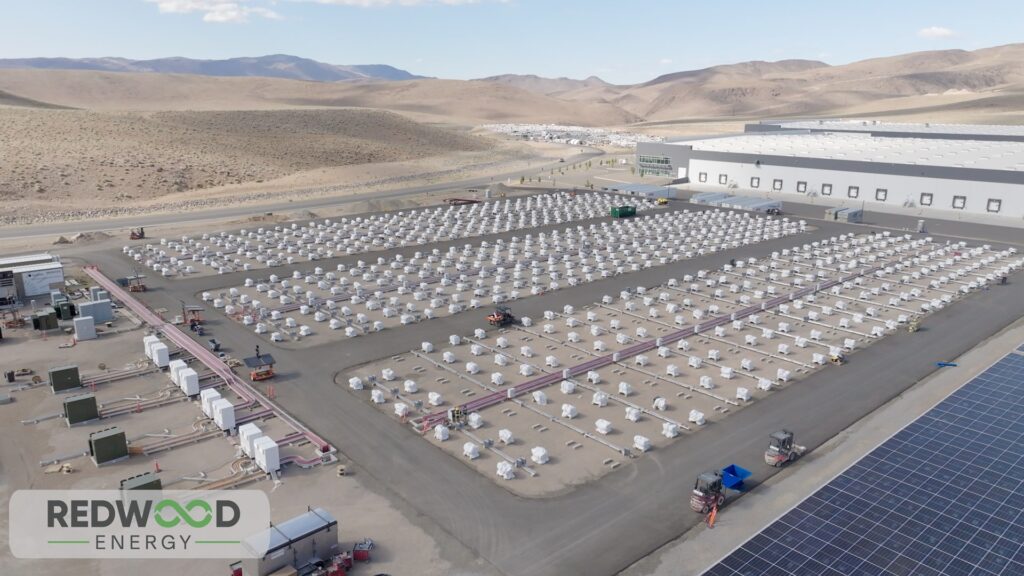
The new agreement grows out of the partnership Rivian and Redwood announced in April 2026. That project uses more than 100 second-life Rivian packs, integrated into a Redwood Energy system with Redwood’s Pack Manager technology, to give Rivian’s plant in Normal, Illinois an initial 10 megawatt-hours of dispatchable energy.
The idea is simple and practical. The plant can draw on stored energy during peak demand, such as a summer heat wave, which cuts what it pays for electricity at the most expensive times and eases strain on the local grid. When demand is low or renewable power is plentiful, the packs recharge and wait for the next peak.
With the expanded deal, the supply of retired packs flowing back through the service network gives that kind of system a clear path to grow, at Normal or at other sites.

What the founders said
Rivian founder and CEO RJ Scaringe called second-life storage “a massive unlock for the energy transition,” adding that working with Redwood turns “retired EV batteries into a powerful tool to make the grid more reliable and lower energy costs for everyone.”
Redwood founder and CEO JB Straubel framed every returning pack as two resources in one. “Every Rivian battery pack that comes back to us is a potential source of domestic grid energy storage in addition to critical materials,” he said, pointing to Redwood’s ability to integrate and redeploy Rivian batteries for fast, flexible and cost-efficient storage.
Why it matters for the grid and the supply chain
The announcement lands at a time when manufacturers are finding that new grid connections can take years and conventional infrastructure is in short supply. Storage that can be deployed quickly from packs that already exist is an attractive way to add flexibility without waiting on the utility.
For Rivian owners, the message is reassuring. The battery in an R1 or R2 is not destined for a landfill when the vehicle’s time is done. It has a planned route to a second job on the grid, and after that, back into the materials that build the next generation of batteries.
For the wider industry, Rivian and Redwood are showing what a full-lifecycle battery partnership looks like when one company handles collection, reuse, storage and recycling as a single system. It is a model other automakers are likely to watch closely.