
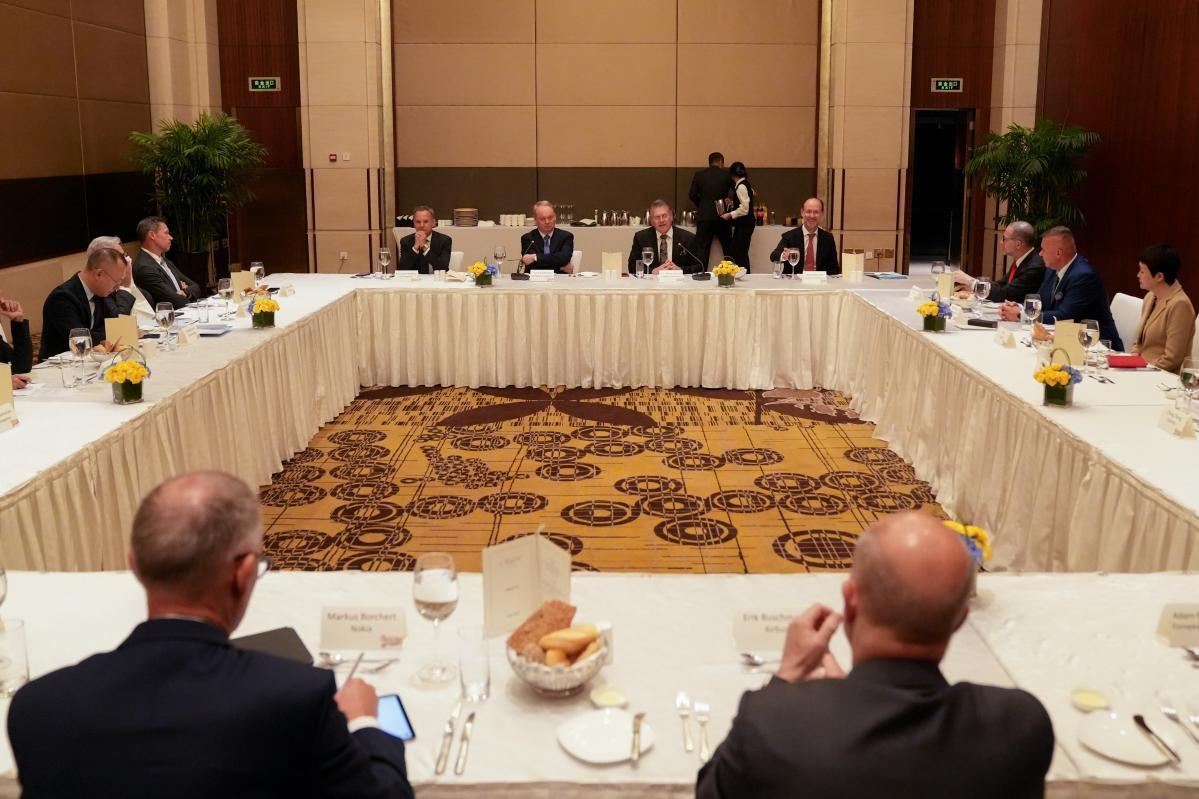
The deal to curb EU China hybrid exports still awaits EU leaders’ endorsement. The shared understanding that Trade Commissioner Maros Sefcovic reached with Chinese Commerce Minister Wang Wentao in Beijing on October 9 needs that endorsement before the Commission can turn it into a legal procedure, and no date for it has been set.
Sefcovic was clear about the order of events. After the October 8-9 talks, he said the understanding “opens the prospect of cutting China’s exports by more than a half.” At his press conference he said that over four years, hybrid and plug-in hybrid exports from China to the EU would fall by several million cars, measured against a no-change scenario. He would not describe the tool. EU leaders have to endorse the method first, and of the European Council he said, “That is where the final decision lies.”
The leaders meet at the European Council in Brussels on October 15 and 16, but the summit’s provisional agenda does not list the deal. It puts competitiveness first, followed by Ukraine, the next long-term EU budget, the Middle East, defence and security, migration, and enlargement. China and hybrid cars are not named.
What Beijing has said since
China’s Ministry of Commerce published the joint outcome on October 9, saying the two sides had reached an understanding on hybrid-vehicle trade “in a manner consistent with WTO rules.” On Monday, October 12, a ministry spokesperson went further, in remarks carried by Xinhua.
The spokesperson set out three principles both sides confirmed for hybrids: respect for facts, non-discrimination and compliance with WTO rules. Citing Eurostat, the ministry said the EU imported 107,000 hybrid vehicles from China in 2024 and 302,000 in 2025. It said the arrangement builds on the 2025 level and allows further increases, so Chinese companies can keep exporting and grow steadily. It also said no measure will single out Chinese products, and that China’s quota will be no lower than the one the EU grants any other source. China reserves all its WTO rights, including dispute settlement and trade compensation.
The two accounts measure different things. Brussels compares the new path with a projected no-change scenario, while Beijing describes room to grow from actual 2025 volumes. Neither side has published the mechanism, and leaders will be looking at the method, not a final rule.
Why hybrids, not battery-electric cars
The battery-electric lane is already tariffed. In late October 2024 the Commission imposed definitive countervailing duties for five years on new battery-electric passenger cars from China. The BYD group rate is 17.0%. The Geely group rate is 18.8%. SAIC is at 35.3%, other cooperating producers at 20.7%, and Tesla’s Shanghai plant at 7.8%. The Commission said those duties sit on top of the ordinary 10% import duty.
The regulation covers cars propelled only by electric motors, including cars with a combustion range extender. It does not cover hybrids. In an April 13, 2026 answer to the European Parliament, the Commission said the investigation did not cover hybrid imports, and that the duties cannot be extended to products that were not investigated.
Plug-in hybrids from China have kept moving through that opening. Reuters reported that EU imports of plug-in hybrids rose 86% in the year to September, that prices fell 20%, and that more than half of those imports now come from China. For 2025, Reuters said, China’s share was 30% by value.
The battery-electric case is still open, on a separate track. The joint list says both sides recalled the guidance on price undertakings in that anti-subsidy case and will continue the company procedures and reviews. Sefcovic said the guidance issued in January 2026 is still valid. Those undertakings are not, in the published list, the hybrid arrangement.
BYD’s plug-in hybrids in Europe
BYD sells a wide plug-in hybrid range in Europe beside its battery-electric cars. In a June 16, 2026 release on the DOLPHIN G DM-i, the company listed the Super Hybrid models already offered there: the ATTO 2 DM-i, SEAL 6 DM-i, SEALION 5 DM-i, SEAL U DM-i, and SEAL 5 DM-i. It called the DOLPHIN G DM-i the region’s first plug-in hybrid in the B-segment hatchback class. At the Paris Motor Show on October 12, BYD put the ATTO 2 DM-i, SEALION 5 DM-i, and SEAL U DM-i on its stand, and gave the Shark plug-in hybrid pickup its EU debut.
The Beijing texts cover exports from China to the EU. They do not sort the cut by brand, and they say nothing about cars built inside the Union. BYD is building a passenger-car plant in Szeged, Hungary. In September 2025 the company said it was on track to start by the end of that year, with the battery-electric DOLPHIN SURF as the first model. BYD’s Hungary careers site still describes the plant as in accelerated construction and trial production. The company has not said its European plug-in hybrids are built there.
Geely, through Lynk & Co
Geely is on the 2024 duty list at 18.8% for battery-electric cars from the Geely companies named in the regulation. Lynk & Co, whose parent for global product development is Geely Auto Group, sells the 01 and the 08 as plug-in hybrids and the 02 as a fully electric car. The company says the 08 offers up to 200 km of electric range. It is in 25 European markets, with more than 140 partner sales points, and Volvo Cars becomes its exclusive distributor in Europe in January 2027. Product development, and the business outside Europe, stay with Geely Auto Group.
The understanding names no brand, and it sets no terms for these companies outside the EU.
What else was agreed, and what was not
Hybrids were the first of three understandings Sefcovic listed. The second is lower MFN tariffs on EU products from car parts to olive oil and footwear, covering almost €4 billion in current export value and at least €225 million in duty savings. The third is easier Chinese export licensing for rare earths and permanent magnets. The joint list says China is willing, through a “green channel,” to keep facilitating those reviews for shipments to the EU. Sefcovic also met Vice Premier He Lifeng.
The ministers will talk again by video in January, then hold the third Trade and Investment Consultations in March 2027. Sefcovic said he expects that session in Europe. He called the Beijing outcome a crucial first step and only a first step. Where dialogue cannot deliver, he said, repeating President Ursula von der Leyen, the EU will use its tools.
For BYD, Geely, and the other Chinese brands selling plug-in hybrids in Europe, the 2024 duties never reached those cars. The October 9 understanding says Beijing and Brussels intend to moderate that flow, and Beijing’s own reading says it will still grow from 2025. Which version holds depends on the method EU leaders eventually endorse.