
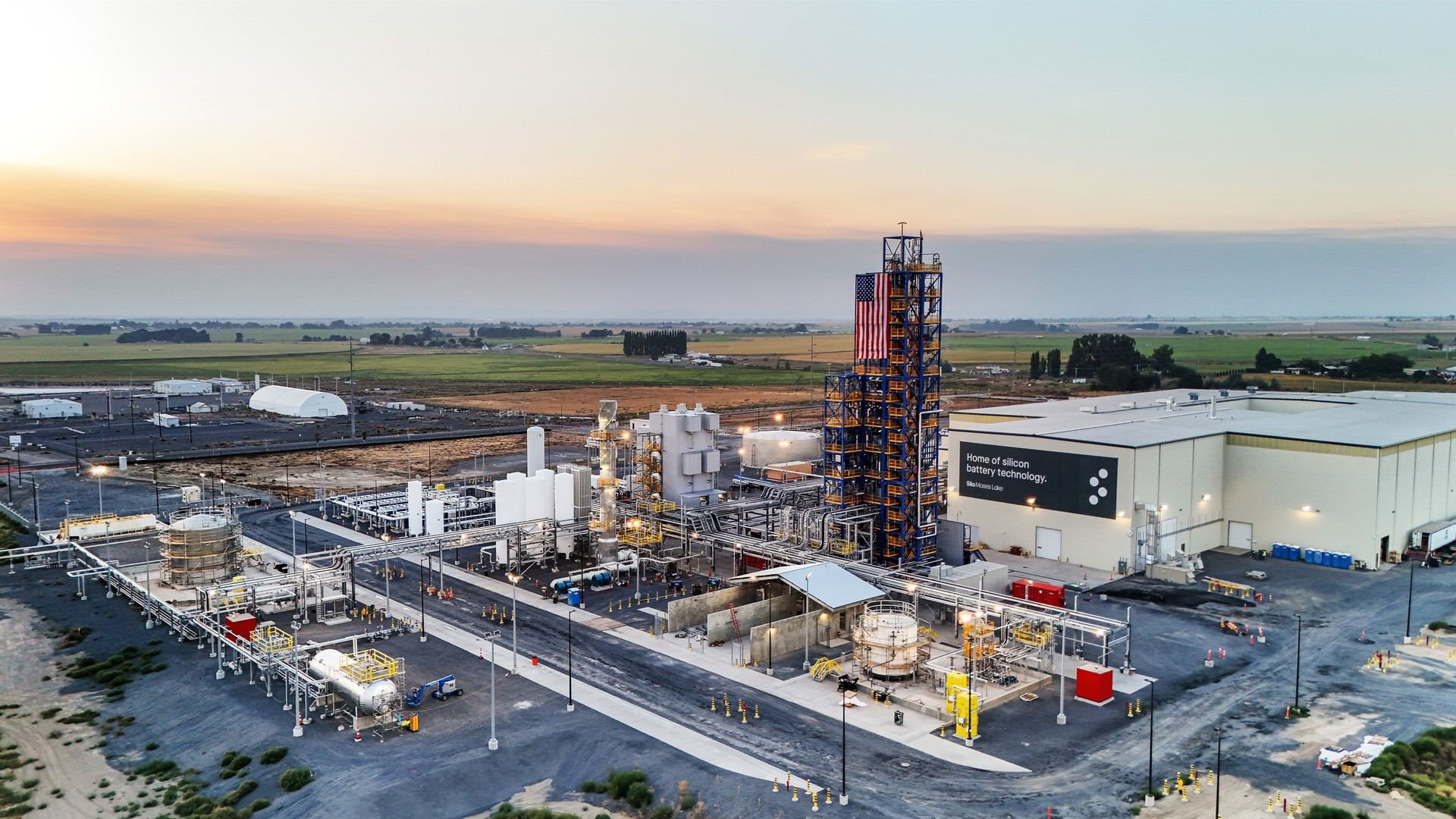
Sila will supply its Titan Silicon silicon-carbon anode material from Moses Lake, Washington, to Panasonic’s US battery plants under a new multi-year offtake agreement. Sila announced the deal on November 18 and described it as part of a long-term commercial relationship with the potential for over $1 billion of offtake over time.
That is a supply contract, not a new EV. It matters because the anode is one of the main levers left for adding range and cutting charge time in a lithium-ion cell, and because both companies are trying to make that material in the United States. It does not, on its own, change the range rating on any vehicle you can buy this week. Sila’s chief executive, Gene Berdichevsky, said the Moses Lake plant “will be ready to supply high-performance materials for our key strategic customers once qualified, and expand as needed.”
Over $1 billion
Potential offtake over time, per Sila
Moses Lake, Washington
Where Sila will produce the anode material
Once qualified
Sila’s wording on when supply to Panasonic starts
Silicon can store more lithium than graphite, if the cell can handle the swelling
Most EV cells still use graphite in the anode, the side of the battery that takes in lithium as the car charges. Most recent chemistry news has been on the other electrode, the cathode, from Ford’s first US-made LFP cells to GM’s LMR batteries. Silicon can hold much more lithium than graphite, which is why battery makers have chased it for years. In a December 12, 2023 release announcing a purchase agreement with Sila, Panasonic Energy put that difference in plain numbers: silicon has, in theory, 10 times the capacity of graphite. The same release described the usual catch. Silicon swells as it charges, and that swelling has a history of wearing cells out.
Sila’s answer is a silicon-carbon material it calls Titan Silicon. On its product page, Sila says replacing graphite with Titan Silicon “delivers a 20% energy density boost over the industry’s best performing cells, without compromising cycle life or safety,” can enable a fast charge of less than 10 minutes “with little energy penalty,” and has achieved more than 2,000 cycles. It also says cell-level swell is comparable to graphite. Those are Sila’s stated material results, not a tested range or charge-time figure on a production US EV.
Panasonic’s 2023 release pointed in the same direction, with a longer timeline. The company said it was aiming for a 25% increase in battery energy density, from 800 watt-hours per liter to 1,000 by 2031, and that next-generation silicon materials were essential to that goal. Using Sila’s material, Panasonic said, is expected to help deliver improved EV performance, increased vehicle range and reduced charging times. It did not publish a vehicle-level mile or minute figure then, and Sila’s November 18 announcement does not add one now.
The November deal builds on a 2023 purchase agreement
Panasonic Energy first said in December 2023 that it would buy Sila’s silicon anode material from the Washington plant to support its North American battery production. The November 18 announcement is a multi-year commercial offtake, and Sila says the two companies will also collaborate on intellectual property. Sila did not publish a tonnage, a gigawatt-hour total or a start date in that release, beyond Berdichevsky’s “once qualified” wording.
Yasuaki Takamoto, chief executive of Panasonic Energy Corporation of North America, is quoted in Sila’s release, praising the pace of work at Moses Lake and calling Sila “a trusted partner as we work together toward meeting our highest quality and performance standards.” The customer for the finished cells is also unnamed. Sila says Panasonic and its “OEM customers” get a clearer path to a more secure domestic supply chain. It does not say which automaker will get the first packs that use this material.
The plant itself is already a matter of public record. In September 2025, Sila said operations had begun at Moses Lake, with initial support for 2 to 5 gigawatt-hours of capacity and the ability to expand to as much as 250 gigawatt-hours within five years. The November 18 release says the new contract, together with other commercial commitments, results in an estimated additional 500 manufacturing and construction jobs at the plant as Sila scales production. The contract follows a recent $1.4 billion loan commitment to Sila from the US Department of Defense’s Office of Strategic Capital, and Sila calls offtake deals like this one a natural next step toward showing it can execute at scale.
Silicon-carbon anode gains are still material claims, not a window-sticker figure
If Panasonic qualifies the material and puts it into cells at the energy-density gain Sila advertises, a pack of the same size could go farther, or a shorter-range pack could be made lighter. A charge that Sila says can drop below 10 minutes, if a vehicle and a charger are actually designed around it, would also shrink highway stops. Panasonic’s 2023 language, increased range and reduced charging times, is the same idea in less specific terms.
None of that is in a window sticker yet. Qualification can take time, and the November release does not name a model year, a cell format or a charging curve. Until an automaker publishes a range rating or a 10% to 80% time for a pack that uses this anode, the 20% energy-density claim and the sub-10-minute charge time remain Sila’s claims for the material, not a buyer’s spec. The deal is still a meaningful one. It puts a US-made silicon-carbon anode on a path into Panasonic’s US cells, which is the step that has to happen before those numbers can show up on a car.
FAQ
When will EVs using this anode go on sale in the US?
Sila has not named a vehicle, a model year or a start date. Berdichevsky said Moses Lake will be ready to supply customers “once qualified.” Until an automaker publishes a pack that uses the material, there is no sale date to quote.
How much more range could a silicon-carbon anode add?
Sila says Titan Silicon can deliver a 20% energy-density gain over the industry’s best-performing cells. Panasonic, in 2023, said silicon has 10 times the theoretical capacity of graphite and set a 2031 cell-density target of 1,000 watt-hours per liter, up from 800. Neither company has published a mile figure for a production US EV that uses this offtake.
Is this the first time Panasonic and Sila have worked together?
No. Panasonic Energy announced a purchase agreement for Sila’s Titan Silicon anode material on December 12, 2023, and said it would procure the material from Sila’s Washington plant. The November 18 offtake is a later commercial agreement in that relationship, with Sila citing the potential for over $1 billion of offtake over time.