
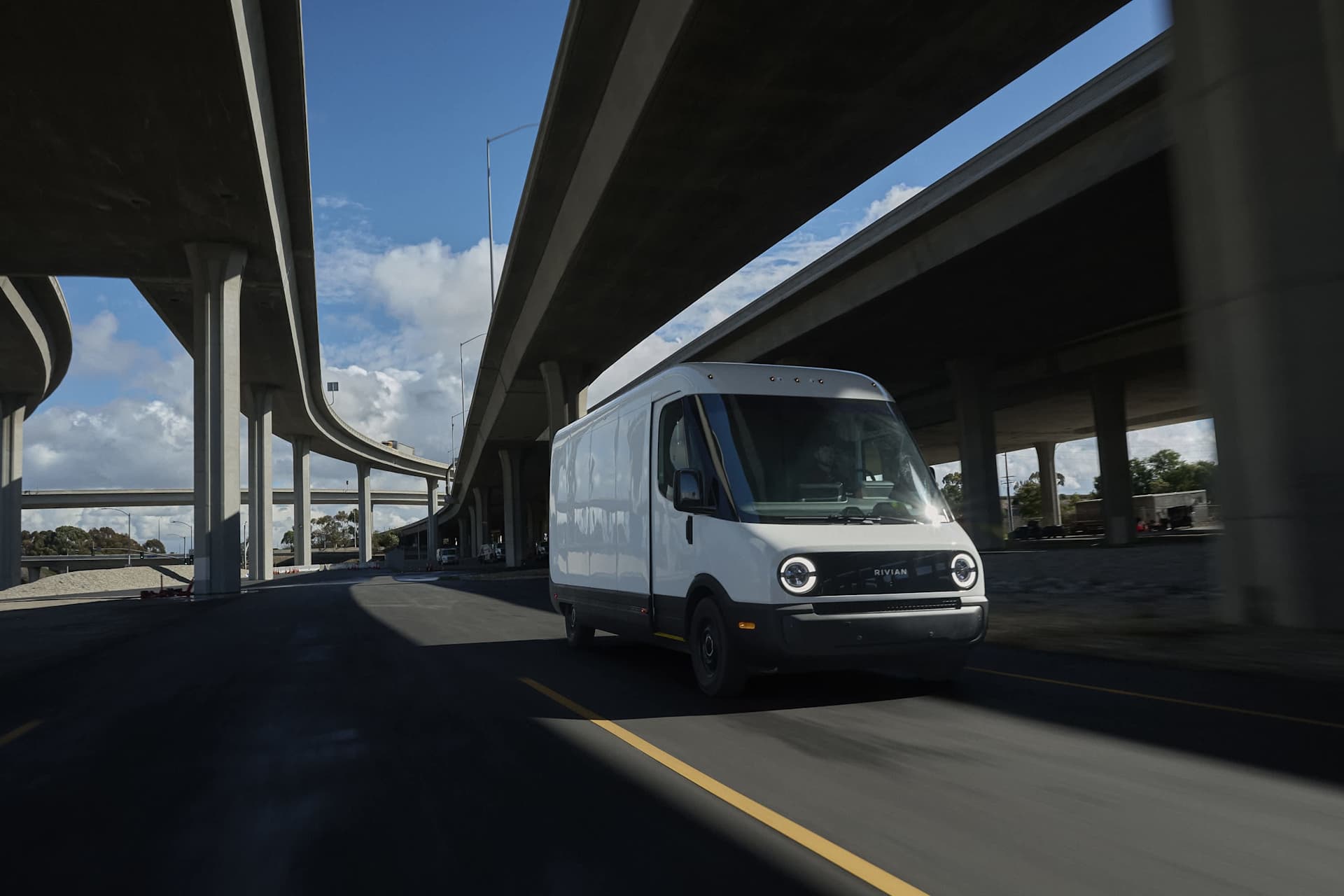
The Rivian EDV 700, the larger of Rivian’s two electric delivery vans, is getting its first major hardware upgrade since production began. In its Q3 2026 presentation, Rivian said that in early October it began delivering new van variants “specifically designed to expand route coverage into more rural networks,” including an all-wheel-drive configuration and a larger battery pack that offers a 30% increase in range.
According to EPA certification data for the 2027 EDV 700, issued September 17 and reported by Electrek, the new pack holds 129 kWh of usable energy. Like the current van, it uses LFP cells. The smaller EDV 500 keeps its existing battery and front-wheel drive.
What the 129 kWh pack does for range
Rivian currently rates the Delivery 700 at an estimated 160 miles on its fleet page. Applying Rivian’s 30% figure to that rating puts the long-range front-wheel-drive van at roughly 208 miles. That is our math, not a Rivian rating, and Rivian has not published official range figures for the new variants.
The EPA filing gives unadjusted lab results, which always run higher than real-world range because they skip the adjustment for actual driving. Those numbers show the size of the gain:
| EDV 700 version | Battery | Drive | EPA lab range (unadjusted) | Change vs current van |
|---|---|---|---|---|
| Current | Standard pack, LFP | FWD | 261.7 mi | Baseline |
| 2027 long range | 129 kWh usable, LFP | FWD | 355.5 mi | +36% |
| 2027 long range | 129 kWh usable, LFP | AWD | 322.25 mi | +23% |
Unadjusted EPA certification figures as reported by Electrek. Real-world range will be much lower; Rivian rates the current Delivery 700 at an estimated 160 miles.
Adding the second motor costs about a third of the range gain in the lab. Electrek estimates the AWD van at roughly 195 to 200 miles of real-world range, which is an estimate rather than a Rivian or EPA rating.
What AWD adds, and what it weighs
The AWD van adds a second motor, and Learn My EV reports from the EPA data that each motor is rated at 265 kW. The bigger pack and extra hardware add weight. The same report lists 8,223 lb for the long-range FWD van and 8,677 lb for the AWD van, compared with 7,295 lb for today’s EDV 700, and a gross vehicle weight rating of 10,000 lb, up from the 9,500 lb Rivian lists for the current van.
Charging stays built for depot use. The reported figures are 100 kW peak DC fast charging and 11.5 kW on AC, which works for overnight charging at a fleet yard but is slow for topping up mid-route.
Rivian’s stated target is rural routes. Those mean longer distances between stops and more gravel, mud and snow, which is hard on a front-wheel-drive van carrying a full load in the back.
What stays the same
The EDV 700 keeps its 652 cubic feet of cargo space, and the EDV 500 continues with 487 cubic feet, its current battery and front-wheel drive. As of October 29, Rivian’s fleet page still lists only the front-wheel-drive versions, at $83,900 for the Delivery 700 and $79,900 for the Delivery 500, with no pricing shown for the long-range or AWD variants.
Amazon remains the van’s main customer, and Rivian’s Q3 presentation describes Amazon continuing to expand its fleet of Rivian vans across North America. Rivian does not break out van volume from its 19,248 deliveries in the third quarter. Rivian also sells the van to other businesses through its fleet program. With GM’s BrightDrop van out of production, Electrek points to Ford’s E-Transit as the main full-size electric van alternative in the US.
For a fleet that ruled out the Rivian van because 160 miles left no margin on long routes, the 129 kWh EDV 700 is the version to price out, once Rivian publishes official range and pricing for it.
Sources: Rivian Q3 2026 earnings presentation (SEC filing), Rivian fleet vans, Electrek, Learn My EV.