
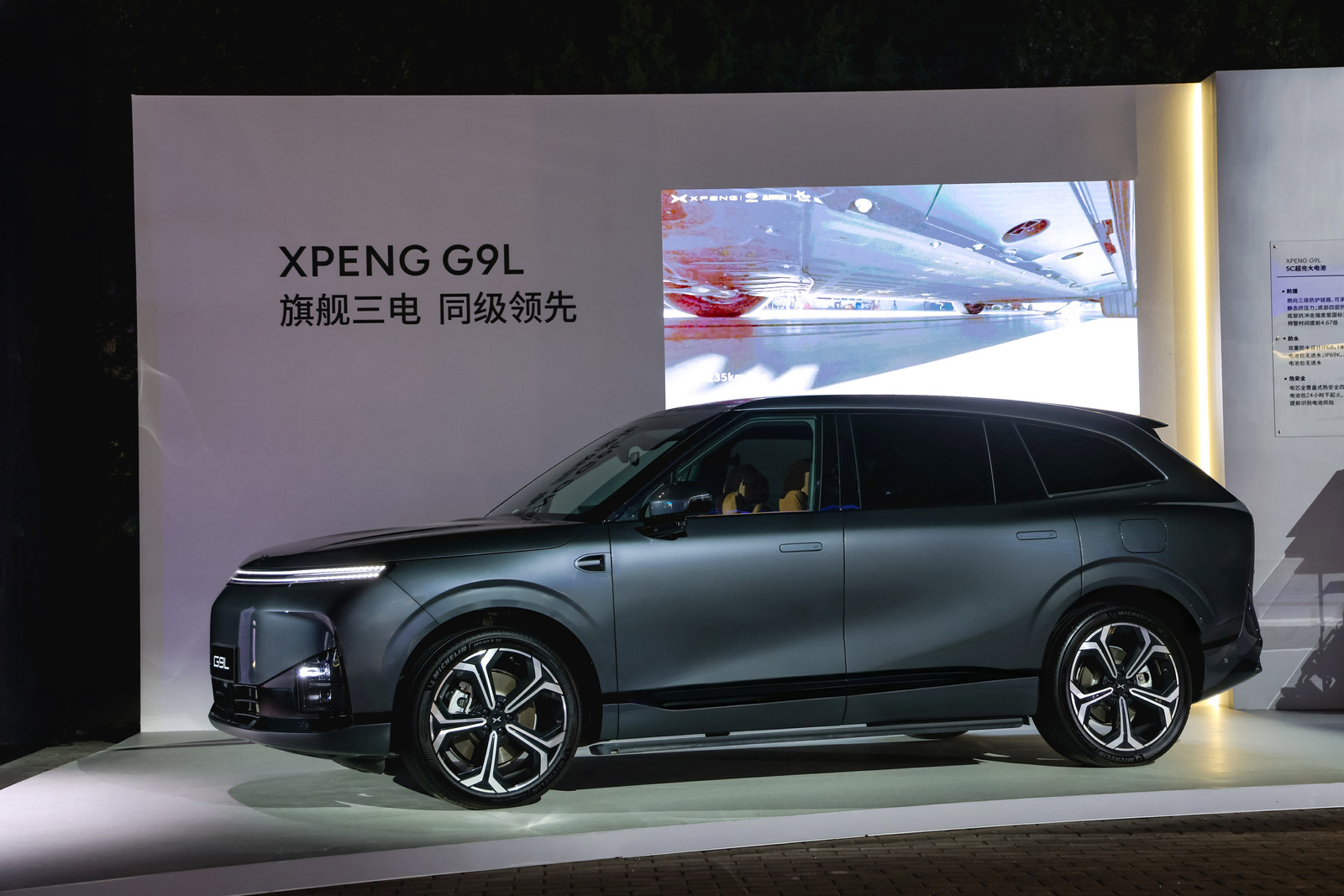
XPeng delivered 41,256 vehicles in September 2026, up 5% from the month before, and 118,390 in the third quarter, up 15% from the previous quarter. The October 1 release that carries those counts also puts a date on the next product step. The G9L, which XPeng launched in China on September 17, has its global launch in Paris in October.
The delivery release does not give a year-over-year rate for September or for the quarter. It gives the month-over-month and quarter-over-quarter changes above, and one model line inside the month: deliveries of the L03 exceeded 10,000 units in September. It does not say by how many.
What XPeng has actually published on the G9L
The product sheet is the China launch post on XPeng’s pressroom, dated from the September 17 event in Beijing. XPeng says the G9L will be sold in 64 markets. The global launch event is October 12 at the Paris Motor Show, Hall 6. Paris is the first stop, not the whole rollout.
XPeng offers the G9L as a battery-electric version and as a REEV version. The company uses that abbreviation in the launch post and does not print a battery capacity, a range, or a price in either document from this week. What it does print is the size. Overall length is 5,120 mm. Wheelbase is 3,100 mm. XPeng calls the wheelbase-to-length ratio 0.605, and says that ratio brings more space and sharper handling than segment peers. That comparison is XPeng’s claim, not a test published alongside the release.
The launch post says the G9L is built to the design standards behind four major five-star safety programs. XPeng says it has run 192 crash tests across Euro NCAP, ANCAP, C-NCAP, and CIASI, covering more than 110 individual items. It also says the development program put cars on roads in 26 countries and regions, with more than 6.74 million kilometres of testing over three years. The electric powertrain, XPeng says, is engineered to those global vehicle standards.
On software, the delivery release says XPeng began rolling out XOS 6.3.0 in China on September 22, powered by the latest version of its VLA 2.0 model. The G9L launch post says the SUV itself runs on VLA 2.0, and that it uses the same Turing AI chip as XPeng’s humanoid robot, IRON. He Xiaopeng, chairman and CEO, used the launch to connect those programs. “We believe in ‘car as robot’,” he said. “Over the past few years, we have built an in-house AI foundation based on our work in AI cars and humanoid robots, and it powers both.”
Built in Guangzhou and in Graz
Production is planned in two places. XPeng says the G9L will be built in Guangzhou and in Graz, Austria, at Magna’s plant. XPeng calls it the fourth model to come off that European line, after the G6, the G9, and the P7+. The company says a cooperation agreement with Magna was announced in September 2025, and that four models will have launched on those lines within a year. The cars in Graz, XPeng says, share the lines with European luxury vehicles already built there.
The October 1 note also updates the charging network that sits behind the fleet, as of September 30. XPeng says its self-operated network in China covered more than 430 cities and more than 4,000 stations, including more than 3,510 ultra-fast stations, with more than 22,200 charging piles. On September 15 it opened its first X-Energy megawatt ultra-fast station, in Hong Kong.
XPeng adds one emissions comparison of its own. It says vehicles delivered from January through September 2026 are expected to cut life-cycle greenhouse gas emissions by more than 4.14 million tons versus internal-combustion cars, which it equates to the carbon absorbed by 68.53 million young trees over 10 years. That is the company’s estimate, printed in the delivery release, not a separate audit.
Rivian published its third-quarter production and delivery figures the next day. Those counts, and the guidance Rivian left in place, are in our Q3 delivery report.
